
"Pericarp"
1366 article(s) found

Temperature between 15 and 25 ℃. Climate. Recent coffee planting temperature.
The optimal planting conditions of conditional coffee trees are as follows: the temperature is between 15 and 25 ℃, and the annual rainfall of coffee trees must reach 1500 to 2000 mm, and the rainfall time should be in line with the flowering cycle of coffee trees. Of course, in addition to the seasonal rainfall, there should also be fertile soil and good drainage. Fertile soil containing volcanic ash

Tanzanian coffee processed by washing Introduction Fine coffee beans
Tanzanian coffee is often washed, and coffee farmers will send the coffee fruit to the nearest processing plant for processing after picking. The washing method comprises the following steps: firstly, screening and removing impurities doped in coffee fruits; then removing coffee pulp and pericarp; sending the coffee fruits into a fermentation tank; removing pectin layer adhered to the pericarp through fermentation; and cleaning.

The differences and processes of primary ways of sun exposure, water washing and honey
Differences in the primary ways of tanning, washing, and honey and the process skin / pulp: two coffee seeds are surrounded by the outermost peel. Except for sun-or all-natural sun-treated coffee, the outermost peel is disposed of within hours of harvest. As edible fruit, we can also call this layer of peel pulp. In the case of coffee, most of this peel is

La Lajas Manor has passed the Japanese JAS, American USDA and NOP organic certification.
Professional coffee knowledge exchange more coffee bean information please pay attention to the coffee workshop (Wechat official account cafe_style) Lajas is also the first manor in Central America to start honey treatment and natural sun treatment. Tanning is a very traditional practice, which uses the least resources, but because there are too many uncontrollable factors, it is very difficult to do well. Francesca has added a lot of innovation.

Introduction to cultivation techniques of Coffee Fruit
Cultivation techniques require that the origin of coffee trees [4] is in Ethiopia in Africa. In botany, coffee trees belong to the evergreen trees of the subgenus Rubiaceae, and coffee beans, commonly known as coffee beans, are actually the seeds of the fruit of coffee trees. They are called coffee beans only because they are shaped like beans. Climate is the decisive factor for coffee cultivation, and coffee trees are only suitable for growing in the tropics or subheat.

Geographical Distribution cultivation techniques of Coffee trees
Coffee grows mostly in countries with alpine terrain between the Tropic of Cancer and the Tropic of Cancer. It is native to tropical Africa and is introduced and cultivated in South and Southwest China. [2] the cultivation technology editor requires that the origin of the coffee tree [4] is in Ethiopia in Africa. In botany, the coffee tree belongs to the evergreen tree of the coffee subgenus of Rubiaceae, and the so-called coffee bean is actually the fruit of the coffee tree.

Geographical Distribution cultivation techniques of Coffee trees
Coffee grows mostly in countries with alpine terrain between the Tropic of Cancer and the Tropic of Cancer. It is native to tropical Africa and is introduced and cultivated in South and Southwest China. [2] the cultivation technology editor requires that the origin of the coffee tree [4] is in Ethiopia in Africa. In botany, the coffee tree belongs to the evergreen tree of the coffee subgenus of Rubiaceae, and the so-called coffee bean is actually the fruit of the coffee tree.

The requirements of geographical environment for the cultivation techniques of coffee trees
The cultivation technology editor requires that the origin of coffee tree [4] is in Ethiopia in Africa. In botany, coffee trees belong to the evergreen trees of the subgenus Rubiaceae, and coffee beans, commonly known as coffee beans, are actually the seeds of the fruit of coffee trees. They are called coffee beans only because they are shaped like beans. Climate is the decisive factor for coffee cultivation. Coffee trees are only suitable for growing in the tropics or

Cultivation techniques of coffee trees how would you like your latte coffee milk foam to be beaten?
The cultivation technology editor requires that the origin of coffee tree [4] is in Ethiopia in Africa. In botany, coffee trees belong to the evergreen trees of the subgenus Rubiaceae, and coffee beans, commonly known as coffee beans, are actually the seeds of the fruit of coffee trees. They are called coffee beans only because they are shaped like beans. Climate is the decisive factor for coffee cultivation. Coffee trees are only suitable for growing in the tropics or

Introduction of cultivation and species of Coffee Tree
Cultivation techniques require that the origin of coffee trees [4] is in Ethiopia in Africa. In botany, coffee trees belong to the evergreen trees of the subgenus Rubiaceae, and coffee beans, commonly known as coffee beans, are actually the seeds of the fruit of coffee trees. They are called coffee beans only because they are shaped like beans. Climate is the decisive factor for coffee cultivation, and coffee trees are only suitable for growing in the tropics or subheat.

Grinding scale of coffee beans treated with water washing and sun honey introduction to the taste of the manor
Grinding scale of coffee beans treated with water and sun honey pectin: the pectin of the coffee fruit flows inside the pericarp, and the gelatinous substance surrounds two seeds. Because it is rich in gum and sugar, it is sometimes called honey. Pectin can be found in most fruits and is not unique to coffee fruits. ) endocarp: after pectin, there is a layer of cell membrane protection

Introduction to Arabica coffee beans | is the flavor and taste of Arabica coffee beans good
Professional coffee knowledge exchange more coffee bean information please follow the coffee workshop (Wechat official account cafe_style) Arabica coffee is the most used coffee beans in the coffee market, accounting for 70% of the coffee market, the so-called mobile phone of the coffee industry. Because Arabica is grown at high altitude, it has high nutrient absorption, abundant precipitation and slow ripening, so both aroma and taste

How about Arabica coffee beans? what kind of coffee beans does Starbucks use?
Professional coffee knowledge exchange more coffee bean information Please pay attention to the coffee workshop (Wechat official account cafe_style) actually Arabica is only a large category, is one of the three primary species of coffee in the world, the other two are the Robusta species (Robusta) and the Liberian species (Liberica). Robusta is commonly used for instant, instant drinks and specific Italian blends. Compared to the others

What is the way coffee beans are fermented? What are the ways to deal with coffee beans?
Professional coffee knowledge exchange more coffee bean information Please pay attention to the coffee workshop (Wechat official account cafe_style) during the natural fermentation of coffee, different biological decomposition procedures take place, and enzymes produced by yeasts and bacteria begin to break down the sugar in the pectin layer. Sugar breaks down lipids, proteins and acids and converts them into alkyd, which changes the smell, color and pH of coffee beans.

Introduction to the treatment of Costa Rican Fine Coffee with Black Honey in La Lajas Manor, Costa Rica
Professional coffee knowledge exchange more coffee bean information please follow the coffee workshop (Wechat official account cafe_style) country: Costa Rica name: Ras Lajas Manor Black Honey processing area: central Valley Grade: SHB treatment method: black Honey treatment Variety: Kaddura Kaduai Flavor description: dried pineapple, fruit wine, brown sugar, long-lasting and full-bodied, Body thick
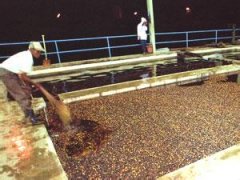
Introduction to the treatment of raw coffee beans-washing method
Coffee washing began in the mid-18th century. In the washing process, the pulp of the coffee fruit (red cherry) is first removed, then the residual mucous membrane on the inner pericarp is removed by a fermentation tank, and the beans are washed and dried. The difference between the non-washing method and the water washing method is that the non-washing method is to remove the pulp after drying, while the washing method is to remove the pulp before drying. Washing can pass every step.
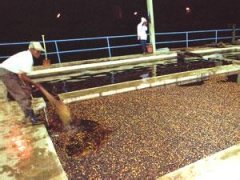
Introduction of water washing method for the treatment of raw coffee beans
Coffee washing began in the mid-18th century. In the washing process, the pulp of the coffee fruit (red cherry) is first removed, then the residual mucous membrane on the inner pericarp is removed by a fermentation tank, and the beans are washed and dried. The difference between the non-washing method and the water washing method is that the non-washing method is to remove the pulp after drying, while the washing method is to remove the pulp before drying. Washing can pass every step.

How many kinds of coffee fruit treatments are there? Sun, half-water washing, half-sun washing, whole water washing, honey treatment
Professional coffee knowledge exchange more coffee bean information please follow the coffee workshop (Wechat official account cafe_style) how many kinds of coffee fruit treatment? What is the difference between sunbathing, half-washing, half-sunbathing, full-washing and honey treatment? What's the difference between different treatments? It refers to the process of turning ripe red fruits into dried raw beans. Each treatment has its own advantages and disadvantages, and is affected by the natural origin.