
"305x250x160mm"
9004 article(s) found

Powder filler and Italian espresso extraction filler Italian coffee machine Italian coffee beans
Filler base diameter: the filler base diameter is very important, but the mainstream problem in the market is not the filler diameter, but its effective filling area. Most filler manufacturers, when making fillers, almost always wrap the edge of the base in an arc. However, this small design reduces the effective filling area. The following figure illustrates this phenomenon (VS

Large-grained coffee Coffea liberica Bull ex Hiern Liberica coffee
English name: big fruit coffee Name:Coffea liberica: coffee introduce: initiated in Liberia and West Africa. Large shrubs or small trees, 6-15 m tall; bark dark brown; branches spreading, hard and straight. Leaves opposite, leathery, elliptic or Obovate-elliptic, 15-30 cm long, apex mucronate, base broadly cuneate, margin entire, rarely microwave, often in axils of lower veins

Characteristics of Flavor and Taste in Colombian Coffee producing area introduction of Fine Coffee beans in Manor
The main varieties of Colombian coffee are small grains of coffee. Plants are small trees or large shrubs, 5-8 m tall, usually much branched at base; old branches gray-white, nodes dilated, young branches glabrous, compressed. Leaves thinly leathery, ovate-lanceolate or lanceolate, 6-14 cm long and 3.5-5 cm wide, tip long acuminate, acuminate part 10-15 mm long, base cuneate or slightly obtuse, rarely rounded, entire or

Introduction to the Grinding degree of the characteristic varieties of Rosa Coffee from Hope Manor in Colombia
Columbia Hope Manor has pedicels 0.5-1 mm long; bracts basally somewhat connate, dimorphic, of which 2 are broadly triangular, nearly equal in length and width, and the other 2 lanceolate, 2 times as long as wide, leaf-shaped; calyx tube tube, 2.5-3 mm long, calyx eaves truncated or 5-denticulate; Corolla white, length varies from variety to breed, generally 10-18 mm long, apically often 5-lobed, rarely 4-or 6-lobed, lobes often 5-lobed.

Introduction to the Variety characteristics of Colombian Coffee Flavor description treatment
Colombian Coffee Flavor description treatment method Variety characteristics Colombian Pavilion official Meriscio Prada told Xinhua that the venue held a two-week coffee exhibition for visitors to taste Colombian coffee and introduce and promote Colombian coffee and coffee culture to tourists from China and all over the world. Participated in the preparatory work of the Columbia Pavilion

Basic data of domestic common domestic Italian coffee machine Aibao E61 double boiler Huijia 210
There are many kinds of coffee machines in the international coffee industry, but not many are common in China, even less suitable for household use, so it is easy to sort out and sort out some related content for reference when you buy it. I am not in the industry, nor can I claim to be an expert. Some of these machines have been used and some have not been used, so in order to ensure credibility, these numbers

Introduction to the planting Environment of Colombian Coffee grown in the Highland introduction to the production area of Fine Coffee Bean Coffee Manor
The main varieties of Colombian coffee are small grains of coffee. Plants are small trees or large shrubs, 5-8 m tall, usually much branched at base; old branches gray-white, nodes dilated, young branches glabrous, compressed. Leaves thinly leathery, ovate-lanceolate or lanceolate, 6-14 cm long and 3.5-5 cm wide, tip long acuminate, acuminate part 10-15 mm long, base cuneate or slightly obtuse, rarely rounded, entire or

Introduction to the production areas of sweet Santa Rita Manor Coffee Grinding scale treatment
The suitable climate in Colombia provides a real natural pasture for coffee. Coffee trees in Colombia are mainly cultivated in the Andes, on steep slopes about 1300 meters above sea level, where the annual temperature is about 18 degrees Celsius, annual rainfall is 2000 to 3000 millimeters, latitude 1-11 15 north, longitude 72-78 west, and the specific range of elevation can exceed 2.000 meters. By

Colombian Santa Rita Manor Coffee with Gump in Acid: grindability, Price, Taste, introduction to the producing areas
The main varieties of Colombian coffee are small grains of coffee. Plants are small trees or large shrubs, 5-8 m tall, usually much branched at base; old branches gray-white, nodes dilated, young branches glabrous, compressed. Leaves thinly leathery, ovate-lanceolate or lanceolate, 6-14 cm long and 3.5-5 cm wide, tip long acuminate, acuminate part 10-15 mm long, base cuneate or slightly obtuse, rarely rounded, entire or

Coffee shop appreciation: American rural ╳ industrial style 82mm cafe
Taichung No.1 Business District, a popular paradise for car fans, is a hot spot in central Taiwan. Almost all the latest and trendy things originated here. Media man Kyle and his friends chose to open a dream coffee shop here, taking out their savings and years of treasures to transform the old house, so that the old photo studio successfully turned into a small paradise for car fans, creating a warm and relaxing place in busy neighborhoods.

Introduction to the description of Manor Flavor by Columbia Coffee Bean Grinding scale
After maturity, Colombian coffee beans have a reputation for flawlessness and elegance like jade in the jade world, with heavy particles, rich nutrition, rich flavor, soft taste, smooth taste and excellent balance; the color is as clear and transparent as emerald emerald; when it comes to the mouth, it makes people uncontrollably play with the emerald.

Colombia coffee history trace species morphology
The history of coffee cultivation in Colombia can be traced back to the Spanish colonial era in the 16th century. There are also many sayings about the history of coffee in Colombia: First, it is said that it came from the Caribbean island of Haiti via Salvador in Central America. Second, coffee beans were first introduced into Colombia in 1808 by a priest from the French Antilles via Venezuela. one of
Description of taste and flavor of coffee beans produced in Colombian Hope Manor by variety treatment
Colombia hopes to describe the taste and flavor of the vineyard coffee beans produced by the variety treatment method. Colombia's suitable climate provides a real natural pasture for coffee. Coffee trees in Colombia are mainly cultivated in the Andes, on steep slopes about 1300 meters above sea level, where the annual temperature is about 18 degrees Celsius, annual rainfall is 2000 to 3000 millimeters, and latitude 1-1.

Colombia Coffee Region Flavor Taste Introduction Lazmus Manor
Colombia coffee varieties are mainly small coffee. Plants are small trees or large shrubs, 5-8 meters high, usually multi-branched at the base; old branches are gray, nodes expand, young branches glabrous, compressed. Leaves thinly leathery, ovate-lanceolate or lanceolate, 6-14 cm long, 3. 5 -5 cm wide, apex long acuminate, acuminate part 10-15 mm long, base cuneate or slightly obtuse, rarely rounded, entire or rounded

Introduction to Hope Manor, the main variety of Colombian coffee
One: it is said to come from the sea island of the Caribbean and from El Salvador in Central America. Second: in 1808, a priest introduced coffee beans to Colombia for the first time from the French Antilles via Venezuela. One of them is that Colombia's first coffee seeds were imported from Venezuela through the province of Santander. [1] third: the earliest coffee cultivation in Colombia
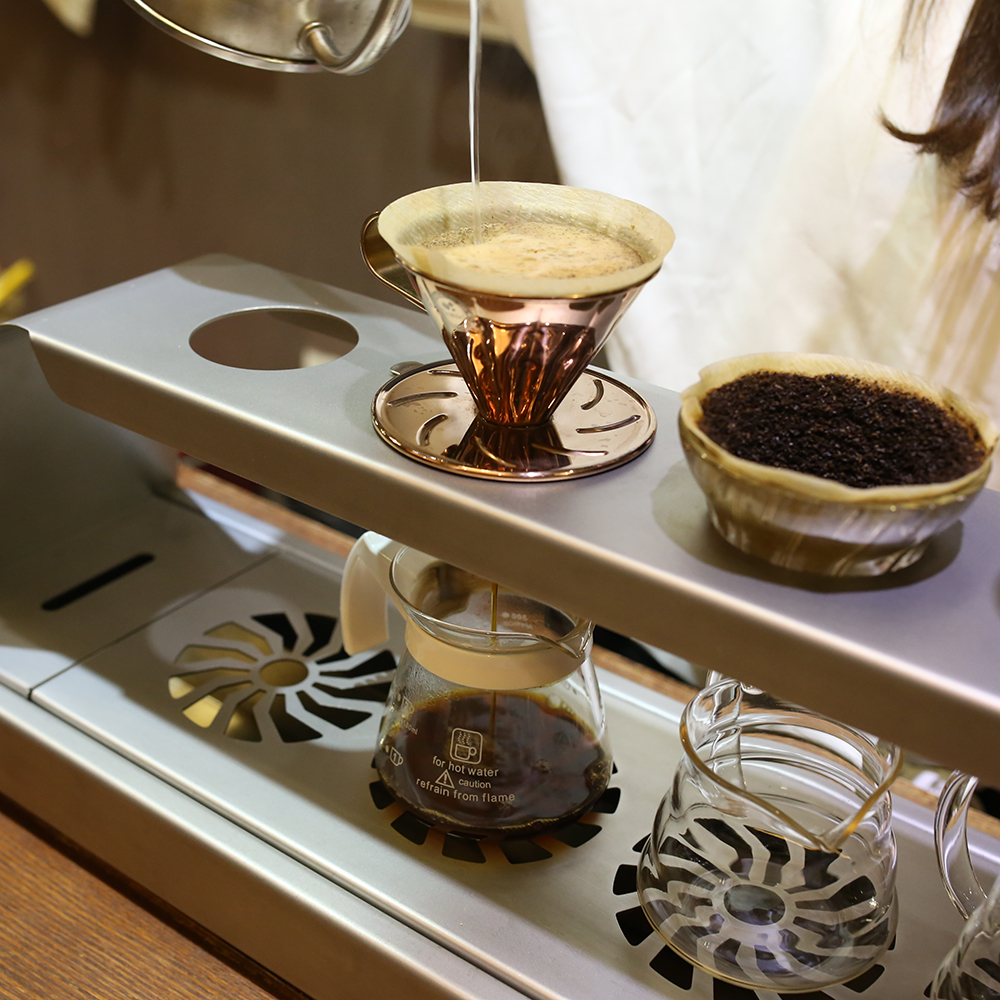
4-hole coffee hand frame Philharmonic pressure rack coffee bar special 2mm stainless steel sandblasting novice must have
Single hole aperture: 79 mm, can perfectly control the Philharmonic pressure, Harrio V60, TIAMO and other brands of filter cups, strong compatibility. The position of the four-hole distribution has also been precisely calculated, so that there will be no hindrance to the operation. Specification L*H*W (cm): 72.3X 22.9X 20.2 2mm stainless steel, integral sandblasting treatment. Because on the premise of self-use, there is no design and production at all.

Colombian Coffee Flavor Manor introduction to Lazmus Manor
The main varieties of Colombian coffee are small grains of coffee. Plants are small trees or large shrubs, 5-8 m tall, usually much branched at base; old branches gray-white, nodes dilated, young branches glabrous, compressed. Leaves thinly leathery, ovate-lanceolate or lanceolate, 6-14 cm long and 3.5-5 cm wide, tip long acuminate, acuminate part 10-15 mm long, base cuneate or slightly obtuse, rarely rounded, entire or

Colombian coffee storage method unique flavor
The history of coffee cultivation in Colombia can be traced back to the Spanish colonial era in the 16th century, and there are many theories about the history of coffee in Colombia: one: it is said to come from the island of Haiti in the Caribbean and from El Salvador in Central America. Second: in 1808, a priest introduced coffee beans to Colombia for the first time from the French Antilles via Venezuela. One of them

The History of Colombian Coffee in the Caribbean Island
History traces back to Colombian coffee brand Colombian coffee brand (9) the history of coffee cultivation in Colombia can be traced back to the Spanish colonial era in the 16th century, and there are many theories about the history of coffee in Colombia: one: it is said to come from the island of the Caribbean and by sea through El Salvador in Central America. Second: in 1808, a priest came from French Ann.

Colombian coffee growing environment Colombian coffee variety grade
Colombian coffee grades are divided into several Colombian coffee-growing histories, dating back to the Spanish colonial era in the 16th century, and there are many theories about the history of coffee in Colombia: one: it is said to come from the island of the Caribbean and from El Salvador in Central America. Second: in 1808, a priest transferred coffee beans from the French Antilles to Venezuela.