
"Maillard"
373 article(s) found

Coffee roasting | Maillard reaction
[definition of roasting] the so-called coffee roasting (coffee roasting) refers to the process that through heating the raw beans, a series of physical and chemical reactions take place inside and outside of the coffee beans, and in this process, the sour, bitter, sweet and other flavors of the coffee are formed, forming mellowness and hue, and the raw beans are converted into dark brown beans. [Maillard reaction] what is it? Actually, it's simple.

Caramel reaction (Caramelization) in coffee roasting
Follow the caf é (Wechat official account vdailycom) and found that Beautiful Cafe opened a small shop of its own. I once told you that the three most important chemical reactions when roasting coffee beans are: Maillard Reaction Strecker Degration Caramelization about Maillard Reaction. I have written an article about its reaction principle and the wind generated.

Baking basic science, browning reaction non-enzymatic browning
Following Cafe Review (official Wechat account vdailycom) found that non-enzymatic browning of Beautiful Cafe opening a small shop of its own is different from enzymatic browning. Non-enzymatic browning reactions do not require enzymes, but their reactions require heat, sugars and amino acids. There are two non-enzymatic browning reactions related to coffee roasting: caramelization (caramelization recation) and Maillard reaction.
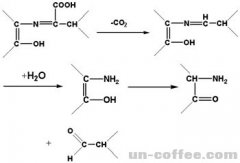
Chemical reaction in coffee roasting Maillard reaction
The roasting of coffee beans is formed by the interaction of different chemical reactions. Generally known as Maillard reaction, caramelization reaction and distillation reaction. Today, let's get a preliminary understanding of what the Merad reaction is. Maillard reaction translated into Chinese is: Merad reaction. Also known as non-enzymatic browning reaction.
Coffee roasting | what are the similarities and differences between caramelization and Maillard reaction
Professional coffee knowledge exchange more coffee bean information Please pay attention to the coffee workshop (Wechat official account cafe_style) during the roasting process, about 90% of the sucrose will be degraded during the baking process to form a variety of products, including: formic acid (formic acids), acetic acid (acetic acids). Some experiments show that the content of acetic acid can increase by about 20 times in the early stage of baking, and acetic acid will increase in the later stage of baking.

How does coffee roasting affect the alcohol thickness of coffee how should coffee beans be roasted
A friend of mine talked with me all day about the taste and mellow thickness of coffee. In his eyes, everyone who drinks coffee can easily tell whether the coffee is mellow or not. I disagree with this. As practitioners of the boutique coffee industry, we always want to lead consumers to taste aromas and tastes that they do not know. As far as we are concerned, to distinguish the subtle citrus aroma of coffee, a specific product.

What are the reactions during coffee roasting? What do caramel reactions and Maillard reactions refer to?
Before the coffee beans are roasted: the work that must be done is to make the water content inside the raw coffee beans more evenly distributed, which is why the raw beans are put in the warehouse after processing. Only coffee beans with a moisture content of about 12% and a stable state can be exported in coffee trade. Only when the water content of raw bean is uniform can the heat conduction and overall water evaporation be more uniform.

coffee roasting| How to understand coffee roasting curve What does roasting curve help roast coffee
What is a baking curve? Why is it so important? Baking curves help monitor baking by tracking the heat in the drum at critical times throughout the baking process. By demonstrating how the same amount of heat can be applied simultaneously to a batch of products, they can help the oven create guidelines that reproduce the outline of the oven. Roasting curves can help identify and track the order coffee goes through during roasting

What chemical reactions take place in the process of baking beans?
Coffee itself is a kind of plant, how to show its sour, sweet, bitter, salty and other ever-changing flavor? The answer is that the raw coffee beans need to be roasted, that is, the raw coffee beans are heated in the container (roaster, hand net, etc.), and finally reach the appropriate degree of baking. Coffee beans have undergone earth-shaking changes in the process of roasting, but not just stir-fry them.
How to get sweetness in coffee Maillard reaction of roasted coffee beans strawberry sweet flavor coffee
That's part of the reason why it's so important that pickers are well trained and paid. Only ripe cherries.

Analysis of main components of cooked Coffee beans in Yunnan
Follow Ka Pin (Wechat official account vdailycom) found that the beautiful cafe opened a small shop of its own-Shenyang, the birthplace of China, has a lot of authentic cuisine. There is a melting pot of culture. the ancient city with a history of more than 5000 years, the first capital of the Qing Dynasty, was once called Xishui, Fengtian, Shengjing and so on. There are Hui, Xian and Japanese communities there.

Roasting caffeine Maillard reaction and caramelization of Arabica and Robusta beans
Boutique coffee is fresh coffee. Whether it's food or drink, of course, the fresh the better, and so is boutique coffee. High-quality coffee should keep the coffee beans fresh before making, including the preservation of baked beans, and grind the coffee beans into powder before making, which is also to retain its original and best flavor. And the way of making hand-made coffee is such a way to make high-quality coffee.

Chemical changes in the reaction of coffee roasting which reactions are chemical changes in coffee bean roasting
Professional coffee knowledge exchange more coffee bean information please follow the coffee workshop (Wechat official account cafe_style) professional coffee roasting | coffee roasting is too complicated? A picture teaches you that there are two stages of change in the roasting process of raw beans after baking. 1 physical = volume, density, volume 2 chemical = smell, taste, taste intense coffee beans are roasted at high temperature.

Where does the sweetness in coffee come from? How to describe the sweetness in coffee beans? What is Maillard's reaction?
Mild, refreshing sweetness is the hallmark of ripe, roasted and brewed coffee. It shows that coffee is taken care of at every stage of the journey. That's what we're after. I know you may think coffee is bitter rather than sweet. I understand that many of us grew up in dark, bitter coffee and thought that was what it meant. But there are more coffees.
What is the "Mena reaction" and "caramelization" reaction in the baking process? the shadow of coffee.
Professional coffee knowledge exchange more information about coffee beans Please follow the reaction during the roasting process in the coffee workshop (Wechat official account cafe_style) Qianjie Coffee. The baking process is roughly divided into three stages, the first two of which can sometimes be merged. The first stage is the beans on the roaster, when the water overflows from the inside of the beans to the surface of the beans, and the coffee beans are dried. It is not possible to observe with the eyes at this stage.

How do you get the flavor of coffee? What is Maynard's reaction in baking?
Professional coffee knowledge exchange more coffee bean information please follow the coffee workshop (Wechat official account cafe_style) Mena reaction (Maillard reaction), also known as Maillard reaction, Maillard reaction, carbonylamine reaction, is a non-enzymatic browning reaction widely distributed in the food industry, refers to reducing sugars (carbohydrates) and amino acids / proteins in food at room temperature or added

Coffee bean roasting comparison table of roasting degree of eight kinds of coffee and the difference between moderate roasting and deep roasting
For more information on coffee beans, please follow the coffee workshop (Wechat official account cafe_style) Coffee roasting skills. | the purpose of coffee roasting and the characteristics of coffee beans. The taste of coffee depends largely on the raw beans and a small part of it is changed by roasting. After all, roasting is the only thing we can control. "

Caramelization (caramelization, oxidation and browning of sugars) during coffee roasting
Professional coffee knowledge exchange more coffee bean information please follow the coffee workshop (Wechat official account cafe_style) Qianjie coffee to share the caramelization reaction (caramelization, sugar oxidation and browning) and Mena reaction during coffee roasting. Most of the time we always say that coffee smells good, so where does the aroma of coffee come from? In fact, coffee beans themselves are rich in all kinds of

What chemical reaction changes will take place during the roasting process of coffee beans? What happened to the roasting of coffee beans
Professional coffee knowledge exchange more coffee bean information please follow the coffee workshop (Wechat official account cafe_style) coffee beans in the roasting process what chemical reactions will take place? What happened to the roasting of coffee beans? Sucrose: melting point 187.8 ℃-sugar? The conjugate = caramelization-water CO2 escapes to produce an explosive First Crack phenomenon. I measured the bean temperature 190 in the drum bean of the baking machine.

Boutique coffee beans | what is the reaction when coffee is roasted? why the coffee is rich in flavor
Do you know what happens when you bake coffee? What changes have taken place to turn mung beans into our favorite delicious, fragrant coffee beans? In the first part of this two-part series, we studied how the anatomical structure of coffee beans played an important role and outlined the physical changes that took place during roasting. Now, let's look at some chemical changes.