
"Traditional"
21781 article(s) found

Hiding a traditional coffee pot, Kuwait Cafe.
Long before coffee became popular in Europe, it was actually a social drink in the Arab world. Coffee originated from the Arabic Qahwa, and in the 17th century, the cultivation and production of coffee was monopolized by Arabs. Even today, you can still feel the strong local characteristics of drinking coffee in Arab countries. Coffee itself gives off the flavor of spices, and you have to follow specific procedures when drinking coffee.

Why do Sumatran coffee beans use wet planing? traditional semi-washing brings classic Mantenin flavor.
For the exchange of professional baristas, please follow the coffee workshop (official Wechat account cafe_style). The editor has previously introduced the Sumatran semi-washing method, that is, wet peeling, because of the treatment process, it often produces many different flavors, such as wood, soil, mildew, spice, etc., which may not be very pleasant to most people, but

Introduction of traditional wild G1 treatment methods and coffee bean flavor in Sidamo, Ethiopia
Professional baristas exchange please follow the coffee workshop (Wechat official account qianjiecoffee) Ethiopia Sidamo traditional wild G1 sun beans Ethiopia is the first country where coffee was discovered, coffee can be divided into two treatments. Washing treatment method II. Natural sun treatment. Nowadays, every producing area, cooperative and even small coffee farm in Ethiopia is produced at the same time.

What is the difference between anaerobic treatment and traditional treatment? Difference between anaerobic fermentation and anaerobic treatment
With the development of boutique coffee, there has been a great innovation in coffee treatment, such as anaerobic fermentation treatment of coffee set off a frenzy. What is the difference between anaerobic solarization, anaerobic washing, double anaerobic fermentation and carbon dioxide impregnation? Anaerobic fermentation treatment was first introduced by Australian contestant Sasa Sestic, the 2015 WBC champion.

The most expensive roaster is smokeless and tasteless to roast Italian coffee beans.
The owner of Ron Kleist from the United States, the new roaster loring, was passing through Beijing and had a close communication with Chinese coffee lovers. There were many friends and some familiar faces in the coffee industry. Mr. Ron Kleist introduced the basic principle of Loring roaster and its great difference from traditional roaster. [Ron Kl on the spot

A century-old traditional Chinese medicine shop has changed into a coffee shop to continue the old feelings from the Baizi cabinet.
In the downtown area, many buildings with historical and cultural characteristics are no match for the great wheel of the times. The Kowloon City District is full of old buildings, and in order to tie in with urban renewal, new and old buildings and culture can also co-exist. With a history of more than half a century, "Dahetang antler Medicine Company" has become a symbol of the area. Seeing the closure of the old historical shop, Shi Junkeng (Henry), a post-80s generation, decided to rent the shop and renovate it into a "Dahe Hall Coffee Shop"
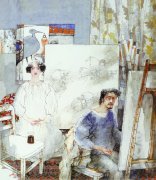
Bitter coffee (traditional Chinese painting)
Bitter coffee (traditional Chinese painting) by Wang Yingsheng

Coffee training equipment: subverting the traditional coffee machine
The coffee machine, called ScanomatTopBrewer, not only subverts the design of traditional coffee-combining the concept of an ordinary coffee maker with a simple and breathtaking sculpture design, but also with the technology of an iPhone/iPad control system.

Traditional cappuccino tastes different
At the beginning of the 20th century, Italian Archibucha invented steam pressure coffee machine, but also developed cappuccino coffee. Cappuccino is an Italian coffee that is blended with equal amounts of espresso and steam foam milk. I love cappuccino alone, not only because of its taste, but also because of its beauty. After the coffee maker skillfully pulls flowers and then carves cappuccino,

Characteristics and attributes of coffee in Guatemala traditional Atitlan
Atitlan is one of the five largest volcanic coffee producing areas in Guatemala, and its soil organic matter is the most abundant among the five volcanic coffee producing areas. 90% of the traditional Atilan coffee is grown on the violent volcanic slopes of Lake Attila, where the daily breeze stirs the lake, which is an important factor affecting the microclimate of the region. The area has accumulated excellent planting and processing techniques for a long time.

Yvlik-traditional Shierchi coffee
Fifth, Evelick-traditional Shierchi coffee [characteristics] the flow of Shiki coffee, steel called Evelick coffee utensils with long handles. [focus on extraction] cook three times, avoid the fire before boiling, and add a small amount of water. [program] 1. Prepare deep-roasted coffee beans (about 5 grams per person) and grind them into powder in a milk bowl or (mill). two。 Coffee according to the number of people needed

Non-traditional design hourglass coffee machine
Now see this hourglass coffee machine, is different from the traditional coffee machine design coffee machine. It requires that the ground coffee beans must be soaked in water for 12 hours before there is a delicious coffee to drink. Do you think this process is quite a long time? But you should know that such a long wait is good, so that the brewed coffee can effectively reduce acidity and reduce the thorn in the stomach.

Traditional design of non-coffee machine: hourglass coffee machine
Now see this hourglass coffee machine, is different from the traditional coffee machine design coffee machine. It requires that the ground coffee beans must be soaked in water for 12 hours before there is a delicious coffee to drink. Do you think this process is quite a long time? But you should know that such a long wait is good, so that the brewed coffee can effectively reduce acidity and reduce the thorn in the stomach.

The traditional Japanese Matsuya brewing method of the Lutian Coffee Research Society.
Lutianjia Coffee Institute address: Shanghai Huangpu District 88 Jiangyin Road 88 No. 33 1F business hours: please make an appointment in advance, 18616019635, preferably a week in advance, Lutianjia coffee is personally selected and baked by Mr. Nakajima. Every cup of coffee contains Mr. Nakajima's attitude towards life. Here you can drink hand-brewed coffee in the traditional Japanese Matsuya style.

New students in traditional Korean houses: COCO BRUNI SAMCHEONG
Sanqingdong in Seoul is home to many famous galleries and gallery. After watching the exhibition, you can consider going to this cafe, which is located close to the Jingfu Palace in Seoul and the National Contemporary gallery. COCO BRUNI is one of the famous coffee chains in Korea, famous for its delicious chocolate drinks and cakes. Each COCO BRUNI is commissioned by a different famous Korean interior designer. The characteristic of Sanqingdian is that it will show

Traditional Turkish coffee
Old-fashioned traditional coffee from Turkey. It is said that in Turkey, there is a habit of fortune-telling in coffee. After drinking coffee, the coffee grounds deposited at the bottom of the cup are covered on a plate to predict the fate of the day according to the appearance formed on it.

Would you like a cup of coffee when you stay up late? The traditional Chinese medicine doctor advised not to drink it.
Professional barista communication Please follow the coffee workshop (official Wechat account cafe_style) is out of spirits and stay up late to work overtime. Would you like a cup of coffee to cheer you up? Chinese medicine practitioners warn that, on the contrary, the more you drink, the worse the condition. What are the conditions to avoid drinking coffee: 1. Guo Zhe-Zhang, director of the new century traditional Chinese medicine clinic and a specially invited doctor of traditional Chinese medicine in Kaohsiung Rongmin General Hospital, said that he has seen a lot in clinical practice.
Traditional Coffee Culture in Singapore and Hainan people
The development of coffee in Singapore is closely related to the immigrants from Hainan. Early Hainan people came to Singapore by sea, because the highly profitable business opportunities such as trade were occupied by Fujian and Chaozhou people who emigrated earlier. In order to survive, many Hainan people worked as stewards or housekeepers in foreign families and learned the skills of pastry and coffee making in the West, so when he wanted to stand on his own feet.

The most traditional processing method of coffee beans
Drying is used for unwashed coffee beans. Wet treatment is used for thoroughly washed or semi-washed coffee beans. Except for the more common use of drying in Brazil and Ethiopia, most Arabica coffee beans are processed by wet treatment. In Indonesia, some Robart coffee beans are processed by wet treatment, but this is not common there. Drying method
Drying is the most traditional processing method of coffee beans.
Drying is used for unwashed coffee beans. Wet treatment is used for thoroughly washed or semi-washed coffee beans. Except for the more common use of drying in Brazil and Ethiopia, most Arabica coffee beans are processed by wet treatment. In Indonesia, some Robart coffee beans are processed by wet treatment, but this is not common there. Drying method