
"growing"
49101 article(s) found

Costa Rica's earliest coffee growing area-Central Valley
Professional coffee knowledge exchange More coffee bean information Please pay attention to coffee workshop (Weixin Official Accounts cafe_style)[Front Street Barista Notes] Costa Rica's earliest coffee planting area Central Valley Original: Front Street Coffee Front Street Coffee ▲ Click to pay attention| Focus on Coffee Roasting 6th Anniversary More Fine Coffee Beans Please Add Private WeChat Front Street, WeChat Signal: (Long Press Copy) qiannj

An introduction to the estates of Ethiopian coffee-producing areas with the natural conditions for growing coffee
Sustainable coffee culture Ethiopian coffee beans grow in close to the natural environment, after years of planting under the same growth conditions, Ethiopian coffee beans have gradually adapted to the environment here. More than 60% of coffee beans are grown in forests or semi-forests. The villages that grow coffee in large areas account for about the total amount of coffee produced in the country.

Which countries and regions can grow coffee? Why? Where does coffee come from? Coffee
Since coffee trees are tropical plants, they need to be planted in warm places. The main planting area is distributed between latitude 25 south and latitude 25 north with the equator as the center, so this area is also called the coffee belt. However, even in the coffee belt, Arabica and Robeska do not grow in exactly the same area, but grow up in an environment that is more suitable for their own growth.

Introduction to coffee growing area and growing environment in Port-au-Prince, Haiti
Most of the coffee produced in Haiti is grown in a purely natural state, which is not intentional but the result of material shortages because coffee farmers are too poor to buy fungicides, insecticides and fertilizers. On the contrary, this makes the coffee produced in Haiti the most natural and pollution-free. Haitian coffee has full grains, rich flavor, medium to low acidity and mild taste.

The growing environment of Kona coffee
The quality of the fine Kona coffee is suitable for the right geographical location and climate. Coffee trees grow on the slopes of volcanoes, and their geographical location ensures the altitude needed for coffee to grow; dark volcanic ash soil provides the necessary minerals for coffee. This is probably due to the fact that Kona Island is rich in volcanic black mud with moderate acidity, rich mineral content and suitable water content.
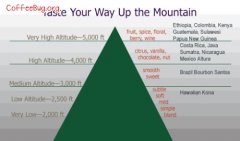
The relationship between altitude and Coffee Flavor
The influence of geographical location on the flavor of coffee beans is profound. All coffee grows in the tropics, and the altitude at which it grows has a profound effect on the taste of coffee. The tropical belt extends from 30 degrees north latitude to the equatorial regions of the southern mountains that produce the world's truly high-quality Arabica coffee. Central and South America, South Asia and some Pacific islands, south-central Africa is also the most important in the world.

The relationship between altitude and Coffee Flavor
The influence of geographical location on the flavor of coffee beans is profound. All coffee grows in the tropics, and the altitude at which it grows has a profound effect on the taste of coffee. The tropical belt extends from 30 degrees north latitude to the equatorial regions of the southern mountains that produce the world's truly high-quality Arabica coffee. Central and South America, South Asia and some Pacific islands, south-central Africa is also the most important in the world.

Effect of altitude on Coffee Flavor
The influence of geographical location on the flavor of coffee beans is profound. All coffee grows in the tropics, and the altitude at which it grows has a profound effect on the taste of coffee. The tropical belt extends from 30 degrees north latitude to the equatorial regions of the southern mountains that produce the world's truly high-quality Arabica coffee. Central and South America, South Asia and some Pacific islands, south-central Africa is also the most important in the world.
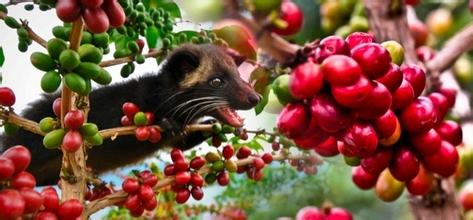
What is the growing environment of coffee beans? What conditions must be met to grow coffee beans?
Coffee is native to tropical Africa. The origin of the small seed species is the tropical plateau of Ethiopia. It is between 900 and 1800 meters above sea level with an average annual temperature of 19. C; the mid-grain species is native to the tropical rain forest of the Congo, with an average annual temperature of 2126 at an altitude of less than 900 meters. C . Their origins are shaded or semi-shaded forests and river valleys, so the formation of coffee requires calm wind, cool and wet.

The natural environment in which coffee trees grow. Planting conditions of coffee trees.
In botany, coffee trees belong to the evergreen trees of the subgenus Rubiaceae, and coffee beans, commonly known as coffee beans, are actually the seeds of the fruit of coffee trees, just because they are shaped like beans, so they are called coffee beans. Climate is the decisive factor for coffee cultivation. Coffee trees are only suitable for growing in the tropics or subtropics, so the zone between latitude 25 degrees south and north is the most suitable for growing coffee. And this...

Talk about the basic knowledge of growing fine coffee
Coffee is now widely grown in the ribbon between the Tropic of Cancer. Coffee grown in different regions has different flavors. The unique soil, climatic conditions and planting methods of a country make the coffee produced in that country have a unique flavor. French winemakers call this phenomenon regional style. Geographically, there are three global coffee growing areas
The influence of altitude on the flavor of coffee
The influence of geographical location on the flavor of coffee beans is profound. All coffee grows in the tropics, and the altitude at which it grows has a profound effect on the taste of coffee. The tropical belt extends from 30 degrees north latitude to the equatorial regions of the southern mountains that produce the world's truly high-quality Arabica coffee. Central and South America, South Asia and some Pacific islands, and south-central Africa are also the most important in the world.

Which countries in Latin America grow coffee?
Which countries grow coffee in Latin America? in 1721, French naval officer Gabriel Mathieu de Clieu brought the first coffee sapling from Africa to the Latin American island of Martinique, which is the origin of coffee cultivation in Latin America. Because France at that time was under the rule of the Bourbon dynasty.

The Dominican Republic grows coffee
In fact, according to Ms. Knudsen, people started drinking fine coffee, but later, due to the growing demand for coffee, the discovery and use of new coffee varieties led to the decline of coffee quality. later, people even began to dislike this bad coffee and began to turn to other drinks. In this case, Ms. Knudsen's re-recognition

Brief introduction of Santa Barara Manor in Honduras in selected Highland Coffee growing area
Brief introduction of Santa Barara Manor in Honduras in the specially selected Highland Coffee growing area Honduras is a large coffee grower in Central America. 15 of the country's 18 provinces have coffee plantations. More than 100000 coffee growers have created nearly a million jobs for the country. Honduran coffee can lead to multiple levels of flavor depending on the degree of roasting. Medium baking can

Coffee trees grow around the equator.
Coffee trees grow in tropical or subtropical agricultural gardens centered around the equator and called coffee belts. Most of the coffee production is between the Tropic of Cancer, 25 degrees north of the tropical or subtropical equator and 30 degrees south of the equator. An area with an annual average temperature of 16-25 degrees Celsius, no Frosts Descent and rainfall of 1600-2000 mm. At present, coffee is mainly produced by seven countries.

How long does it take to grow coffee?
How long does it take for coffee to grow? coffee trees can blossom in a few years, and when coffee trees blossom and bear fruit will be introduced to you by the editor. Coffee tree opposite leaves are long oval, smooth leaves, the end of the branch is very long, few branches, and the flowers are white, open at the base of the petiole connecting the branch. In fact, the Arabs began to grow coffee in 525 BC.

The production zone suitable for growing coffee beans in China can you grow coffee beans in China?
China's coffee producing areas are mainly in Hainan, Yunnan and Guangdong; the northern part of Hainan Island in China, the southern part of Yunnan Province, is located between 15 degrees north latitude and the Tropic of Cancer, which happens to be in this golden zone. The day and night temperature in its coffee is not too strong and bitter in South America, India and Africa, but strong but not bitter, fragrant but not strong, very unique. With a little fruit flavor, it is the top grade of coffee.

The influence of geographical location on the flavor of coffee beans is profound.
The influence of geographical location on the flavor of coffee beans is profound. All coffee grows in the tropics, and the altitude at which it grows has a profound effect on the taste of coffee. The tropical belt extends from 30 degrees north latitude to the equatorial regions of the southern mountains that produce the world's truly high-quality Arabica coffee. Central and South America, South Asia and some Pacific islands, south-central Africa is also the most important in the world.

Introduction to the method of flavor description and taste treatment of coffee raw bean grade G1 growing environment
Coffee raw bean grade G1 growing environment flavor description taste treatment method introduces the representative countries: Brazil, Indonesia, Ethiopia, Cuba, Peru and so on. The method is to randomly take 300 grams of samples and put them on black paper, and different defects correspond to different points, such as 1 point for 1 pebble, 5 points for 1 big pebble, 1 point for 5 broken beans, and 1 point for 5 pest beans.