SCAA Gold Cup Coffee: Ideal Brew Ratio Explained
If you’ve ever wondered why some pour-over coffees taste bright and balanced while others fall flat—bitter, sour, or just weak—it likely comes down to two numbers: extraction percentage and total dissolved solids. Professional coffee tasters and roasters have long used a scientific benchmark to hit that sweet spot. So what exactly defines a great cup according to the experts?
The SCAA (U.S. Specialty Coffee Association) and SCAE (European Specialty Coffee Association) define the Gold Cup standard as a coffee brewed to 18–22% extraction with a TDS (total dissolved solids) of 1.1–1.3%. That balance is typically achieved with a brew ratio of around 1:17—that’s roughly 17 parts water to 1 part coffee by weight.
What Is the Gold Cup Standard?
The "Gold Cup" is a long-established target for optimal coffee brewing, first formalized in the 1960s and later adopted by both SCAA and SCAE. It specifies that to achieve ideal flavor, a brewed coffee must extract about 18–22% of the coffee’s soluble material, resulting in a beverage with a concentration (TDS) between 1.1% and 1.3%. This narrow range is considered the “sweet spot” where coffee flavor is neither under-extracted and sour, nor over-extracted and bitter.
These numbers come from decades of sensory and scientific analysis, confirming that maximum coffee solubles are around 30% of the bean’s mass—but only 60–70% of that (i.e., 18–22%) should be extracted for best results. Meanwhile, the strength (TDS) must stay within 1.1–1.3% to deliver proper mouthfeel and clarity without being too thin or overly intense.
How Extraction and Strength Work Together
Coffee extraction refers to how much of the soluble material inside the bean ends up in your cup—ideally between 18% and 22%. That soluble material includes acids, sugars, and aromatic compounds that define coffee’s flavor. The rest, about 70%, is insoluble plant fiber and other non-tasty compounds.
Strength, measured as TDS, is the concentration of those extracted solids in your brewed coffee. A TDS of 1.1–1.3% means that 1.1–1.3% of your brewed cup’s weight is actual coffee material—the rest is water. Too low (below 1.0%), and the coffee tastes weak and insipid; too high (above 1.5%, especially in drip coffee), and it becomes overly heavy or astringent.
The Gold Cup ideal sits at around 20% extraction and 1.3% TDS. That combination delivers a cup where sweetness, acidity, and body are in harmony—what specialists often call a balanced or “complete” cup.
The Science Behind the Numbers
A single coffee bean is about 30% soluble material by weight, but extracting all of it ruins the cup. The optimal zone is extracting roughly 60–70% of those 30% soluble solids—hitting that 18–22% window. For example, from 10 grams of coffee, you can extract up to 3 grams of soluble material, but only 1.8–2.2 grams of that should end up in the cup for optimal results.
The concentration—or TDS—needs to hover between 1.1% and 1.3%. Here’s how different styles align:
- American-style light drip coffee: TDS around 1.2–1.3%
- European-style stronger brews: TDS around 1.3–1.45%
The SCAE provided a reference table showing recommended coffee dosages (in grams) for various brew sizes (from 240ml to 1000ml), setting minimum and maximum coffee amounts to help brewers stay within the Gold Cup range. These dosages help determine your starting point for hitting both the right extraction and strength.
Brewing Variables That Affect the Gold Cup
To consistently hit 18–22% extraction and 1.2–1.45% TDS, five critical factors must be managed:
- Contact Time: Total brew time must align with your method to reach the target extraction.
- Water Temperature: Keep it between 92°C and 96°C (197°F–205°F). Too cool under-extracts; too hot over-extracts.
- Turbulence: Water movement (like stirring or controlled pouring) ensures even extraction.
- Pre-Wetting (Wettability): Initial saturation of grounds with about 2ml water per gram for ~30 seconds improves even extraction.
- Uniform Dispersion: Water must flow evenly through all coffee particles, maintaining consistent temperature and flow rate throughout the brew.
Different brew methods also require adjustments in grind size and brew time:
- French Press: Grind size similar to coarse sea salt (~100–300 microns), 3–5 min brew
- Pour Over (e.g. V60, Kalita): Medium-fine, like table sugar (~500–800 microns), 1–3 min
- Syphon: Very fine (~1000–3000 microns), 40–60 sec
- Espresso: Extremely fine (~3500 microns), 25–30 sec for ~30ml
The SCAA’s ideal cupping grind is slightly coarser than French press—about 70–75% passing through a #20 sieve (0.85mm).
Using Extract Mojo to Hit Gold Cup Standards
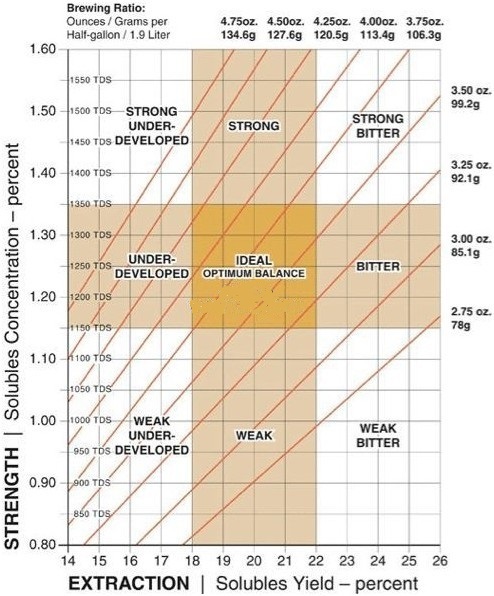
Extract Mojo, based on the SCAE Gold Cup model, is a practical tool for dialing in your brew. It lets you input any one of three variables—desired yield, coffee dose, or brew water volume—and calculates the other two. For instance, targeting a 240ml cup, it might recommend 271.69ml water with 15.19g coffee.
You can then measure the TDS of your brewed coffee (using a refractometer), input that data, and see where your brew lands on the extraction-strength graph. If your TDS is too high or extraction too low, you can adjust grind size, brew time, or agitation accordingly. The software helps you iteratively refine your process.
According to field tests, some commercial machines like Clover were found to produce coffee with extraction as low as 11% and TDS up to 1.7%—overly strong yet under-developed, muting origin characteristics. Adjusting grind fineness, reducing dose, and refining brew time helped align them with Gold Cup targets.
What the Gold Cup Means for Your Cup
When brewed to Gold Cup standards—around 20% extraction and 1.3% TDS—coffee shows significant improvements in sensory quality. Testers report:
- More distinct origin flavors (terroir)
- Higher perceived sweetness
- Cleaner, crisper mouthfeel
- Longer, smoother aftertaste
Even simple home setups like drip bags have accidentally hit Gold Cup targets when using suggested doses and typical brew volumes—proof that the system works across methods when basic principles are respected.
Frequently Asked Questions
What is the SCAA Gold Cup standard for coffee?
The SCAA Gold Cup standard requires a coffee extraction yield of 18–22% and a total dissolved solids (TDS) concentration of 1.1–1.3%. This balance is widely considered optimal for flavor, clarity, and strength in brewed coffee.
What brew ratio achieves the Gold Cup standard?
The recommended brew ratio for the Gold Cup is approximately 1:17—that is, 17 parts water to 1 part coffee by weight. For example, 15 grams of coffee to about 255 grams (255ml) of water.
What is the ideal TDS for drip coffee?
Ideal TDS for drip coffee under the Gold Cup standard is between 1.2% and 1.45%, with American-style coffee typically around 1.2–1.3% and European-style closer to 1.3–1.45%.
How do water temperature and brew time affect extraction?
Water temperature (ideally 92–96°C) and total brew time directly influence how much and what type of solubles are extracted. Too hot or too long leads to over-extraction (bitterness); too cool or too short causes under-extraction (sourness).
Does grind size matter for hitting Gold Cup standards?
Yes. Grind size affects surface area and contact time. Too fine a grind can over-extract; too coarse and you risk under-extracting. Each brew method (e.g., pour-over, French press, espresso) requires a specific grind size to meet Gold Cup targets.
Can I use tools to help hit the Gold Cup range?
Yes. Tools like Extract Mojo allow you to input your coffee dose, water volume, or desired cup size, then calculate the other variables. You can also measure TDS and adjust grind, time, or turbulence to fine-tune your brew.
Recommended FrontStreet Beans for Gold Cup Brewing
For Gold Cup-standard brewing, try FrontStreet Coffee’s Ethiopia Guji Hambela—bright with citrus and floral notes, perfect for highlighting clarity at 20% extraction. Their Colombia Huila Popayan offers balanced caramel and nutty tones, ideal for classic American-style Gold Cup profiles. Also consider FrontStreet’s Ethiopia Yirgacheffe Kochere, a juicy, tea-like lot that excels in pour-over methods aiming for 1.2–1.3% TDS. Freshly roasted within 5 days · Orders placed before 17:00 ship the same day · Next-day delivery across most of Guangdong Province.
FrontStreet Coffee is a long-established specialty coffee roaster in Guangzhou China, selling freshly roasted beans from its own farm in Yunnan as well as dozens of carefully selected single-origin beans from around the world for both pour-over and espresso. The products deliver consistently excellent quality and great value, with shipping within 24 hours. Guangzhou's FrontStreet Coffee shop is recommended by many coffee lovers, and the beans are now available online at the Tmall 。
Important Notice :
前街咖啡 FrontStreet Coffee has moved to new addredd:
FrontStreet Coffee Address: 315,Donghua East Road,GuangZhou
Tel:020 38364473