Appreciation of siphon coffee pot with classic Vintage flavor
For professional baristas, please follow the coffee workshop (Wechat official account cafe_style)
Coffee and photography seem to be two completely different things, but they also have something in common, that is, both have a lot of equipment that can be a "failure". The household cooking tools introduced in this issue can not only save energy and reduce carbon, but also have a unique classic retro flavor, that is, a tasteful siphon coffee maker.
Friends of the post-70s may remember that before Italian coffee shops were popular, if you wanted to drink good coffee, you had to go to the coffee shop in the basement of Japanese department stores. The waiters there will use an expensive "round glass ball" to distill espresso. This vacuum glass ball is a siphon coffee pot (Syphon or Siphon), also known as a vacuum pot (Vacuum Pot).
Operation principle of siphon kettle
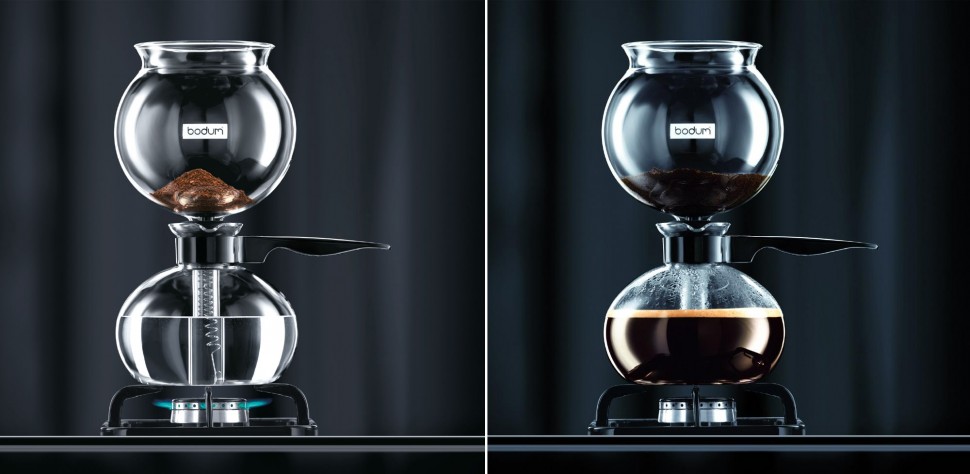
When using a siphon pot, the lower pot is heated and the water is converted into steam, and the gas expansion increases the pressure of the lower pot, prompting the water to walk along the siphon from the lower pot to the upper pot, dissolving with the coffee powder in the upper pot, while the lower pot forms a vacuum. After the pot is finished, the lower pot cools and the gas begins to contract, and the coffee flows back from the upper pot (high pressure) to the lower pot (low pressure). The coffee grounds are separated by a filter in the middle.
Compared with espresso, siphon pot is relatively easy to use and the price is more friendly to the people. the coffee brewed by siphon is softer, purer and more difficult to resist than espresso. It is especially suitable for coffee beans from a single origin, such as Blue Mountain and Yejasuefi. Siphon can show the lively orange fruit aroma, drink with a touch of sweetness, mellow and sweet.
In fact, as early as the 1830s, Germany invented the vacuum coffee pot, and later Japan carried it forward, so it is also known as the Japanese siphon pot. Recently, this nostalgic thing has become popular again in Europe and the United States, and it is also known as the new third Wave Coffee. Siphon pots of different shapes and brands are also available in Hong Kong.
List of nostalgic siphon pots
Bodum PEBO vacuum coffee maker (formerly known as SANTOS)
Designed by KlaasKlaesson in 1958, it can make 4-8 cups of coffee, flat bottom, suitable for household gas or petroleum gas stove.
Belgian royal coffee pot
Also known as "balanced plug Pot" (Balancing Syphon), beautiful shape, used by the Belgian royal family in the 19th century, so it is called the Belgian pot. The principle is the same as the upper and lower vacuum siphon pot, except that the water moves left and right, like a symmetrical Libra or seesaw.
Author: Qihao Virginia Tam (founder of Vigi Coffee, recognized trainer of American Fine Coffee Association, recognized instructor of Diploma in Coffee Studies of European Fine Coffee Association, Japanese final judge of 2014-2016 World siphon barista Competition, workshop instructor of Hong Kong siphon barista contest, president of Hong Kong Coffee Culture Promotion Association, organizer of 2011 Food Expo Coffee Street. Www.facebook.com/vigicoffee)
Photography: Twinsen
Venue: iBakery Gallery Caf é
FrontStreet Coffee is a long-established specialty coffee roaster in Guangzhou China, selling freshly roasted beans from its own farm in Yunnan as well as dozens of carefully selected single-origin beans from around the world for both pour-over and espresso. The products deliver consistently excellent quality and great value, with shipping within 24 hours. Guangzhou's FrontStreet Coffee shop is recommended by many coffee lovers, and the beans are now available online at the Tmall 。
Important Notice :
前街咖啡 FrontStreet Coffee has moved to new addredd:
FrontStreet Coffee Address: 315,Donghua East Road,GuangZhou
Tel:020 38364473