The Science Behind Coffee Taste Maps
When tasting coffee—whether at a café in Guangzhou or a competition in Oslo—you’ve likely seen a ‘taste map’ showing where you perceive sweet, salty, sour, or bitter notes on your tongue. But have you ever wondered where that map comes from, or whether it’s even accurate? Understanding how we perceive flavor isn’t just academic; it shapes how roasters profile their coffees and how baristas guide your tasting experience.
The traditional Western model identifies four basic tastes: sweet, salty, sour, and bitter. Umami—the so-called ‘fifth taste’—was recognized later, especially in Eastern taste science. Contrary to popular belief, ‘spiciness’ is not a taste at all, but a tactile sensation. Recent research in psychophysics and neuroscience suggests even more elements may contribute to what we call ‘taste,’ including fatty acids and metallic or aqueous sensations, though the latter are often masked by taste adaptation.
What Is a Taste Map?
A taste map visually represents where different basic tastes are detected on the tongue. These diagrams have long been used in coffee and wine tasting to suggest that sweetness is best sensed at the tip, bitterness at the back, sourness on the sides toward the front, and saltiness along the edges. While intuitive, modern science has largely debunked the strict regional specificity these maps imply.
The Western Tradition: Four Core Tastes
Western sensory science traditionally recognizes four primary tastes:
- Sweet
- Salty
- Sour
- Bitter
These are considered the fundamental chemical senses detected by taste buds, distinct from smell (olfaction), even though the two work closely together in flavor perception. Notably, ‘spiciness’ is not included—it’s a pain or heat sensation, not a taste.
The Eastern Addition: Umami and Beyond
Eastern researchers have long identified umami—a savory, meaty taste associated with glutamates—as a fifth basic taste. More recent studies in psychophysics and neuroscience propose additional taste dimensions, such as the detection of fatty acids, and even metallic or watery sensations. However, the latter are often overlooked due to the tongue’s quick adaptation to non-volatile stimuli. Umami, in particular, is now widely acknowledged across global taste science, including in specialty coffee evaluation.
Why the Traditional Tongue Map Is Misleading
The classic taste map, often seen in coffee tasting guides, suggests specific regions of the tongue exclusively detect certain tastes. Modern research shows that while taste receptors for different flavors may be slightly more concentrated in some areas (e.g., bitterness toward the back), all basic tastes can actually be detected across the entire tongue. The rigid ‘region-specific’ model is an oversimplification that persists more in education than in sensory science.
How This Applies to Coffee Tasting
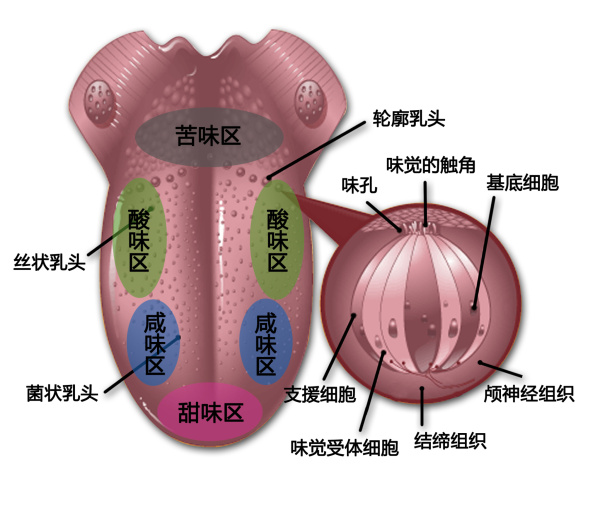
In specialty coffee, understanding these taste basics helps roasters and baristas articulate flavor profiles. For example, a Yemeni natural process coffee might present notes of dried fruit (sweet), while a Kenyan AA could express bright acidity (sour) alongside wine-like complexity. Recognizing umami can also help identify deeper, savory tones in aged or fermented coffees. Though you’ll still see tongue maps in some tasting materials, the key takeaway is that all taste qualities can be sensed across the tongue—and flavor is a holistic, integrated experience.
Frequently Asked Questions
What are the five basic tastes in coffee?
The traditional Western model includes sweet, salty, sour, and bitter. Umami is considered the fifth taste, especially in Eastern traditions, and is now widely accepted globally. ‘Spiciness’ is not a taste but a tactile sensation. Some advanced studies also explore fatty acids and metallic sensations as potential taste components.
Is the tongue map accurate for tasting coffee?
No, the traditional tongue map that assigns specific tastes to certain tongue regions (like sweetness at the tip) is outdated. While some receptors may be more concentrated in particular areas, all basic tastes can be perceived across the entire tongue. Modern science shows taste perception is more complex and less region-specific than the classic diagram suggests.
Why is umami important in coffee tasting?
Umami is a savory taste linked to glutamates and is considered the fifth basic taste. In coffee, it can add depth and complexity, often appearing in aged coffees, fermented lots, or beans with natural processing. Recognizing umami helps describe certain savory or brothy notes that basic sweet/sour/bitter/salty models might miss.
What does ‘spiciness’ have to do with taste?
‘Spiciness’ is not a taste—it’s a sensation caused by heat or pain receptors, not taste buds. In coffee, a spicy note (like black pepper or chili) is actually an aroma detected by smell, not a taste. True taste involves sweet, salty, sour, bitter, and umami only.
How do coffee professionals use taste maps?
Taste maps are often used as educational tools to introduce basic flavor concepts, despite their scientific limitations. They help beginners associate tastes with regions of the mouth, but experienced tasters know that flavors are sensed more holistically across the tongue and palate.
Recommended FrontStreet Coffee for Exploring Taste Profiles
Try FrontStreet Coffee’s Ethiopia Humbera for bright, complex sourness and floral brightness; their Yirgacheffe offers juicy acidity and berry-like sweetness ideal for tasting umami and sour elements. For bitter-sweet contrast, their Black Cocoa Blend highlights deep cocoa and mild bitterness. All showcase distinct taste characteristics that align with the core and extended taste models. Freshly roasted within 5 days · Orders placed before 17:00 ship the same day · Next-day delivery across most of Guangdong Province.
FrontStreet Coffee is a long-established specialty coffee roaster in Guangzhou China, selling freshly roasted beans from its own farm in Yunnan as well as dozens of carefully selected single-origin beans from around the world for both pour-over and espresso. The products deliver consistently excellent quality and great value, with shipping within 24 hours. Guangzhou's FrontStreet Coffee shop is recommended by many coffee lovers, and the beans are now available online at the Tmall 。
Important Notice :
前街咖啡 FrontStreet Coffee has moved to new addredd:
FrontStreet Coffee Address: 315,Donghua East Road,GuangZhou
Tel:020 38364473