Should the direction of hand-brewed coffee circle be from inside out or from outside to inside? How to teach the size of the coffee circle
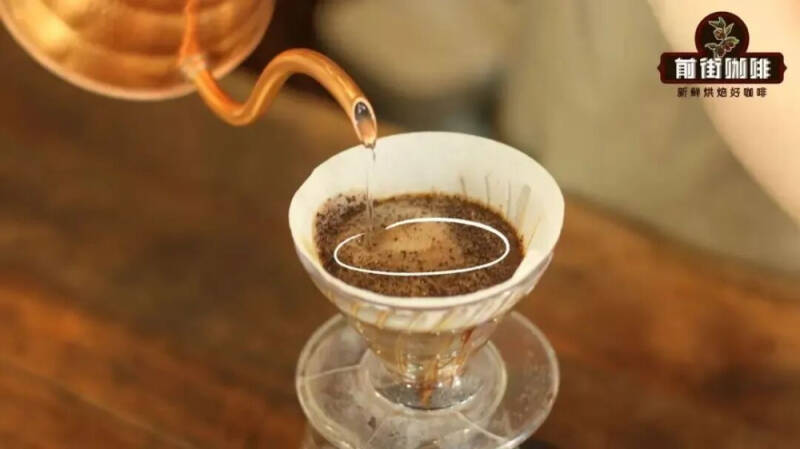
Yesterday, a customer came to Qianjie store to buy coffee beans and asked a very tricky question: Should the flow direction of hand-brewed coffee and water in circles be from inside to outside or from outside to inside? Do different routes have an effect on the taste of coffee brewing?
Many people may think that there is no need to exaggerate making coffee. Simply pouring water can make it delicious. The reason is correct. Qianjie does not advocate excessive "attention to details," but for those who want to improve their brewing techniques, mastering these influencing factors will obviously not suffer losses. For example, when the coffee has a particularly annoying sour taste, or after flushing. If the powder pit is obviously different, then we can quickly determine where the problem lies and how to solve it based on the water injection law.
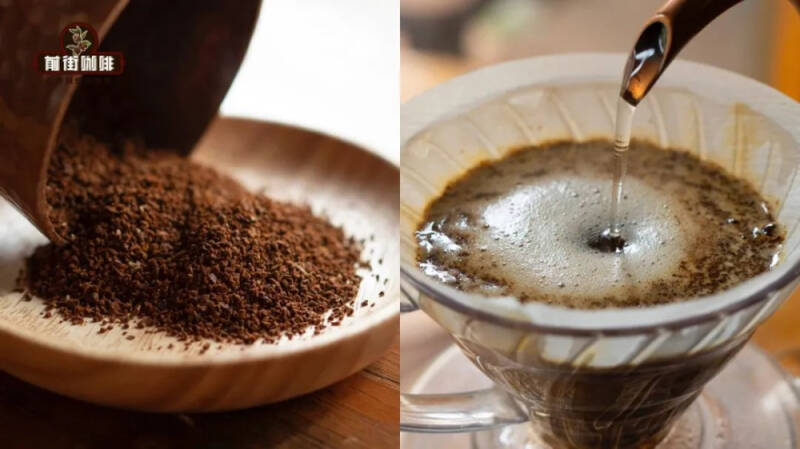
There are many ways to make coffee by hand. Just by filling water in a circle can be divided into different perspectives, such as the size of the circle, the height of the water flow, clockwise or counterclockwise, whether the water is thrown to stir quickly or the elegant and uniform motion is moved slowly... There is no standard answer, only the delicious coffee that is rushed out based on the extraction law. These front streets have individually tested their impact on coffee extraction and how to apply them in practical operations (you can find relevant articles yourself).
In terms of water injection, Qianjie has always recommended that everyone adopt a more conservative and gentle form of circling, which has the advantage of being more stable and controllable. The reason why the loop is looped has two purposes. The first is to use water flow to stir the powder layer to form a turbulent flow and accelerate the release of soluble substances in the coffee; the second is to use the circular design of the filter cup to form uniform extraction while circling while reducing variables.
Water injection around the circle requires us to do two things well: First, the water flow line is round enough. Because the winding is not round, it is easy to cause the impact of hot water to be large and small, making the powder bed uneven, and finally the coffee will show uneven extraction. The second is to circle in the same direction. If it circles clockwise, then the entire water injection process should be filled with water along a clockwise line to help the vortex form one-way movement. Therefore, whether the flow direction of water injection around the loop is from inside out or from outside to inside, its extraction logic is inseparable from these two points.
So when other factors remain unchanged, how big is the difference between water flow from inside to outside and from outside to inside?
Comparative experiment on coffee brewing
In order to find out the difference between the two, this time we used Qianjie Kafa Forest with balanced flavors. Although this Ethiopian coffee bean is also medium and light roasted, it not only has the unique white flower fragrance of African beans and the bright sweet and sour citrus. At the same time, it has the creamy aroma of fried melon seeds, moderate mellow feeling without losing the small, fresh tonality. When changing certain brewing parameters, you can better find out the flavor changes.
This comparative experiment only changed the direction of water injection, and the parameters were consistent with Qianjie's usual brewing suggestions to reduce the variables that interfered with extraction.
Coffee beans: Qianjie Kafa Forest
Coffee powder: 15g
Powder to water ratio: 1:15
Grinding degree: EK43s scale 10 grids (fine granulated sugar, screening rate of 80% on China No. 20 sieve)
Water temperature: 93℃
Filter cup: V60
Water injection technique: circle from inside to outside
According to our brewing habits, each section of hot water falls in the center of the coffee powder from the inside to the outside, and then continues to expand outward clockwise along the "fragrant" route.
The first section of small water is injected into 30g of water twice the amount of coffee powder, and steamed for 30 seconds. After the steaming is over, a vertical water flow is also used to inject 90g into the second section from the center point outward, and the electronic scale displays 120g;
After the hot water seeps down to the bottom of the powder bed can be seen, continue to inject the last section of 105g of hot water in the same way, stop for about 1 minute 25 to 35 seconds, and all the coffee liquor flows in 1 minute 55 seconds.
Water injection technique: circle from outside to inside
For comparison, circling from the outside to the inside means that each time water is filled, it needs to start from the edge of the coffee powder and continue to narrow the circle clockwise until it reaches the center point.
Inject 30g into the first section and steam for 30 seconds. Inject 90g into the second section starting from the outside of the "bulging bag" with a small water flow. After reaching the center point, it immediately returns to the outside and continues to circle inward clockwise until the electronic scale displays 120g, and the time is about 1 minute to 1 minute and 5 seconds;
When the powder bed was exposed, the remaining third section of hot water 105g was continuously injected from the outside to the inside, and the extraction was completed in about 2 minutes and 10 seconds.
brewing results
Through comparison, it was found that the coffee powder pit after being flushed from the inside to the outside was neatly "bowl-packed", with uniform thickness of the powder wall and stable flow rate of the water; on the other hand, the coffee that was flushed from the outside to the inside was placed on the outside because of the falling point of each section of hot water. The coffee powder was flushed to the bottom to form a backlog, so the overall flow rate was first fast and then slow. After flushing, there was only scattered foam on the wall of the cup, and fine powder appeared on the bottom.
(The bottom left is the inner to outer loop, and the top right is the outer to inner loop)
After testing by a concentration meter, the concentration of coffee wrapped from inside to outside was 1.42%, and the result of wrapping from outside to inside was 1.39%. That is to say, when other conditions remain unchanged, the concentration of the coffee wrapped from inside to outside is slightly higher.
In terms of flavor, the tonality of the two pots of Qianjie Kafa Forest Coffee is actually roughly the same, both with citrus, nut and orange flavors. However, Qianjie found that there are still some gaps between the two through constant tasting and comparison. Qianjie Kafa Forest, which is brewed in circles from the inside out, has higher flavor intensity and mellow taste. You can drink the fresh aroma of small sweet apricots throughout the process, without any overbearing bitterness or sharp acid; in contrast, the coffee that is circled from the outside to the inside has a light charm, and the aroma is not long-lasting. It will dissipate immediately after the entrance, with a weak sense of hierarchy. After cooling, it will increase the acidity and bitterness.
From the above experiments, we can see that because of the use of the V60 conical filter cup, the coffee powder naturally falls into the bottom position. The coffee powder accumulated in the center is the thickest and becomes thinner towards the surrounding edges. The injection of water from the outside to the inside causes the extraction rate of coffee powder around to increase, but insufficient extraction in the middle. In addition, the edge of the filter cup is not supported by a powder wall, and hot water will slip away from the edge in the later stage.
On the other hand, the thickest powder layer in the middle is fully extracted from the inside to the outside, and the water flow diffuses the coffee powder to form a thin wall, so that less water will sneak away and more coffee substances will be dissolved. Therefore, if you are usually accustomed to using a conical filter cup and want to create a thick and rich coffee taste, it is recommended to also use this "mosquito-repellent incense type" technique to inject water in circles from the inside to the outside.
FrontStreet Coffee is a long-established specialty coffee roaster in Guangzhou China, selling freshly roasted beans from its own farm in Yunnan as well as dozens of carefully selected single-origin beans from around the world for both pour-over and espresso. The products deliver consistently excellent quality and great value, with shipping within 24 hours. Guangzhou's FrontStreet Coffee shop is recommended by many coffee lovers, and the beans are now available online at the Tmall 。
Important Notice :
前街咖啡 FrontStreet Coffee has moved to new addredd:
FrontStreet Coffee Address: 315,Donghua East Road,GuangZhou
Tel:020 38364473