How Coffee Spread Across the World: From Ethiopia to Brazil
You’ve sipped your morning cup—but have you ever wondered how coffee made its way from a remote Ethiopian plateau to your local café? The story of coffee’s journey across continents isn’t just history; it’s the foundation of today’s global coffee culture.
Coffee originated in 7th–9th century Ethiopia, spread to Yemen by the 15th century, reached India by 1600, Java and the Dutch colonies by the late 1600s, Europe by 1700, and the Americas by the 1700s and 1800s—finally becoming a worldwide staple over 1,000 years.
The Birthplace: Ethiopia (7th–9th Century)
The earliest records of coffee consumption trace back to the forests of Kaffa in southwestern Ethiopia, between the 7th and 9th centuries. Legend says goats became unusually energetic after eating coffee cherries, leading to the discovery of coffee’s stimulating effects. While the story is likely apocryphal, Ethiopia is undisputedly the birthplace of Coffea arabica, with wild coffee still growing in the region today.
From Ethiopia to Arabia: Yemen (15th Century)
Coffee was cultivated and traded in Yemen by the 15th century, where Sufi monks first brewed it to stay alert during prayers. By the 16th century, Mocha (Al-Mukha)—a port city in Yemen—became the centre of the early coffee trade. The Arabs were the first to roast, grind, and brew coffee as we know it, strictly controlling its export by boiling or sterilising beans to prevent cultivation abroad.
Early Global Expansion (1600–1713)
Coffee’s global journey accelerated in the 17th century:
- India (1600): Baba Budan smuggled seven coffee seeds from Yemen to the hills of Karnataka (then part of Mysore), planting them near Chikmagalur—the origin of India’s first coffee cultivation.
- Dutch Colonies (1658–1696): The Dutch introduced coffee to Sri Lanka (then Ceylon) in 1658 and later to Java (Indonesia) between 1690 and 1696. They established some of the first large-scale European-run plantations outside Arabia.
- Europe (1700s): The Dutch brought a coffee tree to Amsterdam around 1706–1710. In 1713, Louis XIV of France received a coffee plant, which was cultivated in the Jardin des Plantes in Paris and later sent to French colonies.
- The Americas Begin (1713–1718): A coffee sapling from Louis XIV’s garden was sent to the French colony of Martinique around 1718, spreading coffee cultivation throughout the Caribbean and Central and South America.
Coffee Arrives in the Americas (1700s–1800s)
The 18th century saw coffee take root in the New World:
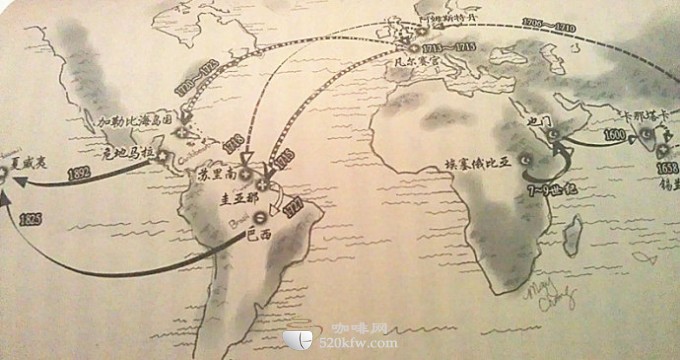
- Suriname & the Caribbean (late 1700s): Coffee spread from French colonies to Suriname and other Caribbean islands, then to British and Dutch colonies including Guyana.
- Brazil (early 1700s): Smuggled seeds from French Guiana helped establish Brazil’s coffee industry, which would later dominate global production.
- Central America (1800s): Guatemala began cultivating coffee in the early 1800s. Hawaii saw its first coffee plants arrive in 1825, with commercial growth beginning in 1892.
The Role of Bourbon Coffee Varieties
The French played a crucial role in spreading coffee via the Bourbon variety:
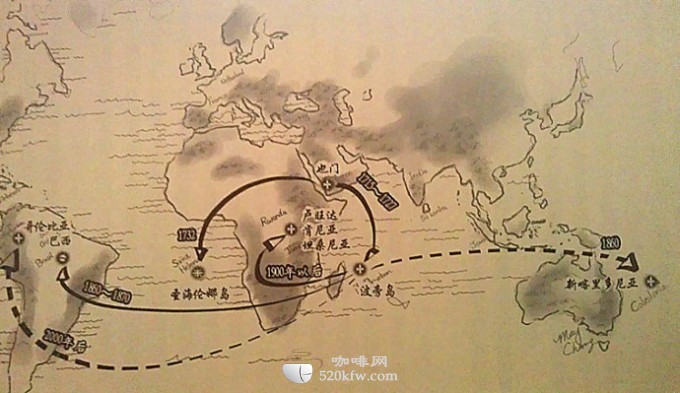
- Bourbon to Réunion (1700s): The French planted coffee from Yemen on Île de Bourbon (now Réunion), giving rise to the Bourbon cultivar.
- Bourbon to the Americas & Africa (1800s–2000s): By 1860, both tall ("round") and short ("slender") Bourbon varieties had spread to Brazil, and later to Rwanda, Kenya, Tanzania (by 1900), and Colombia (by 2000). The slender Bourbon also reached New Caledonia by 1860, while tall Bourbon was taken to Saint Helena by 1732.
Key Hubs in Coffee’s Journey
Beyond origin points, several cities became critical hubs:
- Mocha (Yemen): The original coffee export port.
- Amsterdam (Netherlands): Home to one of Europe’s first major coffee auctions and botanical specimens.
- Paris (France): Hosted the royal coffee plant that parented many New World trees.
- Martinique (French Caribbean): The gateway for coffee in the Americas.
Frequently Asked Questions
Where did coffee originate?
Coffee originated in the Kaffa region of Ethiopia between the 7th and 9th centuries. The earliest evidence of coffee consumption comes from this area, where legend attributes its discovery to the energising effect of coffee cherries on goats.
How did coffee spread from Ethiopia to the rest of the world?
Coffee was first cultivated commercially in Yemen in the 15th century. From there, it spread globally via trade and colonial expansion, reaching India by 1600, Dutch colonies like Java and Sri Lanka by the late 1600s, Europe by the 1700s, and the Americas in the 1700s and 1800s.
What role did the Dutch play in coffee’s global spread?
The Dutch introduced coffee to Sri Lanka in 1658 and Java in 1690–1696. They also transported a coffee tree to Amsterdam around 1706–1710, and later sent one to France, which became the parent of many New World coffee trees.
What is the significance of the Bourbon coffee variety?
The Bourbon variety originated on Réunion Island (formerly Bourbon) after French missionaries brought it from Yemen. It became foundational for many modern coffee cultivars, spreading to Brazil, Rwanda, Kenya, Tanzania, Colombia, and New Caledonia between the 1800s and 2000s.
When did coffee reach the Americas?
Coffee reached the Americas in the early 1700s, first via Martinique (around 1718), then spreading to Brazil, Central America, and the Caribbean. Hawaii’s first coffee plants arrived in 1825, with commercial production starting in 1892.
Which countries were early centres of coffee cultivation?
Early centres included Yemen (Mocha), Indonesia (Java and Sumatra), India (Karnataka), and France (Paris Jardin des Plantes). These regions played key roles in developing cultivation and trade practices.
FrontStreet Coffee Beans That Trace Coffee’s Global Roots
Explore the origins of coffee with FrontStreet’s single origins: Ethiopia Yirgacheffe offers bright citrus and floral tones, reflecting its status as coffee’s birthplace. Java from Indonesia provides earthy, spicy notes rooted in the Dutch-colonial era. For Bourbon-type heritage, try our Yellow Bourbon offering—rich and balanced, echoing the variety’s global journey since the 1700s. Freshly roasted within 5 days · Orders placed before 17:00 ship the same day · Next-day delivery across most of Guangdong Province.
FrontStreet Coffee is a long-established specialty coffee roaster in Guangzhou China, selling freshly roasted beans from its own farm in Yunnan as well as dozens of carefully selected single-origin beans from around the world for both pour-over and espresso. The products deliver consistently excellent quality and great value, with shipping within 24 hours. Guangzhou's FrontStreet Coffee shop is recommended by many coffee lovers, and the beans are now available online at the Tmall 。
Important Notice :
前街咖啡 FrontStreet Coffee has moved to new addredd:
FrontStreet Coffee Address: 315,Donghua East Road,GuangZhou
Tel:020 38364473