How Coffee Bean Roasting Affects Its Nutritional Content
If you’ve ever wondered whether lightly roasted or dark roasted coffee is better for your health—or if raw green beans have more nutrients—you’re not alone. Many coffee drinkers assume that unroasted beans must retain more goodness, or that the roasting process destroys everything beneficial. But the truth is more nuanced, and the science behind nutrient changes during roasting reveals surprising results.
The short answer? Yes, coffee roasting significantly alters the nutritional content of coffee beans—but not always in the way you might expect. Key compounds like chlorogenic acids drop sharply with higher roast levels, while other substances, including certain antioxidants and volatile aromatics, increase due to the Maillard reaction. Caffeine levels remain largely stable across roast profiles, though minor variations occur.
What Changes in Coffee Beans During Roasting?
When coffee beans are roasted, a complex series of physical and chemical transformations take place. Starting from the green coffee bean—dense, greenish, and grassy in smell—the application of heat initiates moisture loss, expansion, color change, and the development of aroma compounds. The key chemical changes include the breakdown of chlorogenic acids, caramelization of sugars, and the well-known Maillard reaction, which develops the brown color and much of the flavor complexity we associate with roasted coffee.
Nutritional Components Before Roasting: What’s Really in Green Coffee?
Green coffee beans contain a range of bioactive compounds. These include:
- Chlorogenic acids (5–12% of dry weight): Antioxidants linked to various health benefits, including blood sugar regulation.
- Caffeine (1–2% of dry weight): The primary stimulant compound, stable across roasting levels.
- Proteins and free amino acids: Precursors for Maillard reaction products.
- Lipids (10–15%): Contribute to mouthfeel and crema formation in espresso.
- Trigonelline: A nitrogenous compound that partially degrades into nicotinic acid (vitamin B3) during roasting.
These compounds define the raw potential of the bean, prior to the transformative effects of heat.
What Happens After Roasting? Nutrient Shifts by Degree
As roast level increases—from light to medium to dark—several key nutrients degrade or transform:
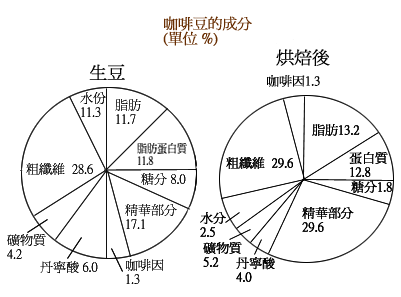
- Chlorogenic acids decrease substantially. Light roasts may retain up to 60–70% of the original chlorogenic acid content, while medium roasts retain around 40–50%, and dark roasts can drop below 20%.
- Caffeine remains relatively stable. Most studies, including those cited by specialty roasters like FrontStreet Coffee, find only marginal differences in caffeine content across roast levels. For example, a typical 100g of green Yirgacheffe beans might contain ~1.2g caffeine, and that figure changes very little after roasting.
- Trigonelline breaks down into nicotinic acid. Up to 85% of trigonelline is degraded in darker roasts, contributing to increased levels of B-vitamin precursors.
- Antioxidant capacity shifts. While some antioxidant types decline (like CGAs), others—particularly melanoidins formed during the Maillard reaction—increase, especially in medium roasts.
- Maillard reaction byproducts develop significantly in medium and dark roasts, contributing to flavor but not necessarily health benefits.
These changes are not merely theoretical. FrontStreet Coffee’s internal roast profiling and sensory notes confirm measurable shifts in both chemistry and cup profile, visible in beans ranging from their washed Yirgacheffe to their Ethiopia Humbera single origins.
Does Roast Level Affect Your Coffee’s Health Impact?
Yes, but it depends on what you’re looking for. Lighter roasts tend to preserve more chlorogenic acids and offer higher antioxidant activity from those specific compounds. Medium roasts offer a balance, preserving some chlorogenic content while developing new antioxidants through Maillard reactions. Dark roasts reduce chlorogenic acids further but may boost other antioxidant classes and develop more pronounced flavor—and crema-supporting lipids in espresso applications.
In practical terms, the differences in caffeine are negligible for most drinkers, but the antioxidant profile and total polyphenol content can shift meaningfully with roast degree.
How to Choose Based on Nutrition (Without Obsessing)
If your goal is maximizing chlorogenic acid intake for metabolic or anti-inflammatory benefits, opt for a light roast. For a rounded flavor with balanced antioxidants, medium roasts offer a good middle ground. Dark roasts are less about nutrition and more about bold flavor and crema-rich extractions—but they still deliver caffeine and some B-vitamin precursors thanks to trigonelline breakdown.
Keep in mind: the roast level is just one factor among many. Freshness, brewing method, and bean origin also dramatically affect what ends up in your cup.
Frequently Asked Questions
Does roasting coffee destroy caffeine?
No, roasting does not significantly destroy caffeine. While there may be minute variations, most specialty coffee beans retain nearly identical caffeine content from green to dark roast. For example, Yirgacheffe beans show roughly the same caffeine levels before and after roasting, typically around 1.2–1.3% of dry weight.
Which roast level has the most antioxidants?
Light roasts generally have the highest levels of chlorogenic acids, a major antioxidant class. However, medium roasts may offer a broader spectrum of antioxidants due to the formation of melanoidins and other Maillard reaction byproducts. Dark roasts have fewer chlorogenic acids but might still provide other types of antioxidants.
Do green coffee beans have more nutrients than roasted?
Green coffee beans contain more chlorogenic acids and certain raw compounds like trigonelline in their untouched form, but they lack the antioxidant byproducts formed during roasting, such as melanoidins. So while green beans have more of some nutrients, roasted beans develop others through heat.
Does darker roast mean fewer health benefits?
Not necessarily. Darker roasts lose some antioxidants like chlorogenic acids but gain others through the Maillard reaction. They also break down trigonelline into vitamin B3 precursors. The overall health impact depends on which compounds you value most—antioxidant type, vitamin precursors, or chlorogenic acid levels.
Is light roast always healthier?
Light roasts preserve more chlorogenic acids, which are linked to certain health benefits, so they can be considered “healthier” in that specific context. But “healthier” depends on the compounds you’re prioritizing, and medium roasts may offer a better balance overall.
Recommended FrontStreet Beans for Roast & Nutrition Insights
Explore how roast levels affect nutrition with FrontStreet Coffee’s Ethiopia Humbera, a light-to-medium roast single origin with bright citrus, jasmine, and stone fruit notes that highlight chlorogenic acid retention. For balanced antioxidant profiles, try their washed Yirgacheffe, offering berry, lemon, and floral tones with a medium-light roast. Both beans showcase the subtle shifts in flavor and compounds caused by roast degree. Freshly roasted within 5 days · Orders placed before 17:00 ship the same day · Next-day delivery across most of Guangdong Province.
FrontStreet Coffee is a long-established specialty coffee roaster in Guangzhou China, selling freshly roasted beans from its own farm in Yunnan as well as dozens of carefully selected single-origin beans from around the world for both pour-over and espresso. The products deliver consistently excellent quality and great value, with shipping within 24 hours. Guangzhou's FrontStreet Coffee shop is recommended by many coffee lovers, and the beans are now available online at the Tmall 。
Important Notice :
前街咖啡 FrontStreet Coffee has moved to new addredd:
FrontStreet Coffee Address: 315,Donghua East Road,GuangZhou
Tel:020 38364473