The First Coffee Shops in Specialty Coffee History
Ever wondered where the very first coffee shops opened—and why they became the social hubs we know today? The story of specialty coffee isn’t just about beans and brew methods; it begins with the birth of public coffee spaces where people gathered, debated, and shaped culture over a simple cup.
The world’s earliest known coffeehouse, called a "Kaveh Kanes," appeared in Mecca. These weren’t just places to drink coffee—they quickly turned into lively centers for music, chess, and conversation. From there, the coffeehouse spread rapidly across the Middle East, North Africa, Europe, and eventually America.
The Origins: Kaveh Kanes in Mecca
The first coffeehouses were established in Mecca and were originally intended for religious use. Despite their spiritual beginnings, these venues—called "Kaveh Kanes"—soon became vibrant community spaces for playing chess, chatting, singing, dancing, and enjoying live music. The model quickly expanded to other cities including Aden, Medina, and Cairo.
Coffee Arrives in North Africa and the Levant
In 1517, after Sultan Selim I conquered Egypt, coffee made its way to Constantinople (modern-day Istanbul). By 1530 it reached Damascus, and by 1532, Aleppo. Local coffeehouses gained popularity in both cities. Notably, Damascus hosted famous cafés like the Rose Coffeehouse and the Café of the Gate of Salvation. Constantinople’s first coffeehouses appeared in 1554. Though initially banned by authorities—some coffee lovers were even sewn into leather sacks and thrown into the Bosphorus—coffeehouses survived, became lavish social hubs, and were eventually legalized after the government began taxing them.
Europe’s First Café: Florian in Venice
Venice’s Florian Café, established in 1720 at Piazza San Marco, is the oldest continuously operating coffeehouse in Europe. But coffee first arrived in Europe via Venice in 1615—later than tea (1610) but earlier than cocoa (1528). Initially, some Italian priests condemned coffee as sinful, but Pope Clement VIII reportedly loved it, declaring it a "truly Christian beverage." The earliest Italian coffeehouse may have been Bottega in 1645 or 1863, but Florian became one of the world’s most prestigious (and priciest) coffee spots.
Other Italian cities soon followed suit, often serving traditional Turkish-style coffee. Notably, in 1775, Georgio Quadri became the first to sell authentic Turkish coffee in Venice, inspiring a wave of specialized cafés.
Early Coffee Culture in England
England’s first coffeehouse opened in Oxford in 1650, followed by a second in 1654, both reportedly run by people named Jacob. Nearby All Souls’ College even saw the birth of a coffee club that evolved into the Royal Society. London’s first coffeehouse launched in 1652 at St. Michael’s Alley in Cornhill, opened by Pasqua Rosee (possibly Greek) and Mr. Bowman. This shop set the template for later cafés, such as Exeter’s Mol’s Coffee House, a favorite of Sir Walter Raleigh.
One of London’s most legendary coffeehouses was Lloyd’s, founded in 1688 by Edward Lloyd on Tower Street (later Lombard Street). Lloyd’s provided shipping insurance forms for merchants, and his family eventually founded the global insurance giant Lloyd’s of London.
Coffeehouses in Early America
In North America, the earliest mentions of coffee date to 1668, described as a drink mixed with sugar or honey and cinnamon. Soon after, coffeehouses appeared in New York, Philadelphia, Boston, and beyond. Boston’s London Coffee House (1691) and Gutteridge Coffee House were early fixtures, but the Green Dragon (built in 1808, destroyed 1818) became the most iconic—housing the New World’s most elaborate coffee exchange.
New York’s coffee trade took off in 1683, with coffee replacing beer as a breakfast staple. The city’s first coffeehouse, King’s Arms, opened in 1696, followed by Exchange Coffee House in 1730 (a major trade hub) and Merchants’ Coffee House, which hosted the founding of the Bank of New York in 1784 and the first stock issuance in 1790. Tontine Coffee House served as the New York Stock Exchange headquarters for a decade.
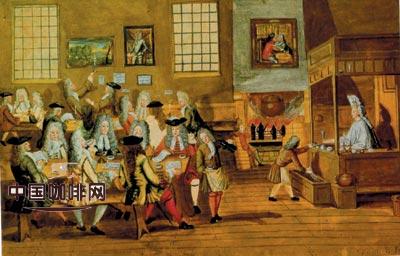
Philadelphia’s first coffeehouse, Ye Coffee House, opened in 1700. Unlike their European counterparts, many American coffeehouses became centers for conservative political discussion and even served as makeshift courtrooms or municipal meeting spaces in towns lacking proper public buildings.
Frequently Asked Questions
Where was the world’s first coffeehouse?
The earliest known coffeehouse, called a "Kaveh Kanes," was established in Mecca. Though originally for religious purposes, it quickly became a social venue for activities like chess, music, and conversation before spreading to other cities like Medina, Cairo, and Aden.
When did coffeehouses appear in Europe?
Coffee arrived in Europe via Venice in 1615. The continent’s oldest continually operating café, Florian in Venice’s Piazza San Marco, was founded in 1720. Earlier Italian coffeehouses existed as early as 1645 or 1863 under different names, but Florian became internationally renowned.
What role did coffeehouses play in 17th-century London?
In London, coffeehouses became central to social, intellectual, and business life. The city’s first coffeehouse opened in 1652. Lloyd’s Coffee House, founded in 1688, became a hub for shipping insurance and led to the creation of Lloyd’s of London, now a global insurance leader.
Were coffeehouses popular in early America?
Yes. Coffeehouses appeared in major cities like Boston, New York, and Philadelphia by the late 1600s and early 1700s. They hosted everything from trade exchanges to political discussions, and some, like New York’s Merchants’ Coffee House, played roles in founding financial institutions.
Why were coffeehouses controversial in some places?
In parts of Europe and the Middle East, coffeehouses faced bans due to political or religious concerns. Some clerics viewed coffee as sinful, and in Constantinople, patrons were even punished harshly. Over time, taxation rather than prohibition became the regulatory method.
Did early American coffeehouses serve the same purpose as European ones?
Not entirely. While European cafés were often hubs for artists and radicals, many American coffeehouses were more conservative and served as de facto courthouses or municipal meeting spaces in towns without dedicated public buildings.
FrontStreet Coffee Picks for Historic Cafés
Pair your deep dive into coffeehouse history with FrontStreet’s Ethiopia Yirgacheffe, known for its bright citrus and floral notes, or our Guatemala Antigua, offering chocolatey body and spice. For something deeper, try the Indonesia Sumatra Mandheling with its earthy, herbal profile—all roasted to highlight the nuanced cups enjoyed in early cafés. Freshly roasted within 5 days · Orders placed before 17:00 ship the same day · Next-day delivery across most of Guangdong Province.
FrontStreet Coffee is a long-established specialty coffee roaster in Guangzhou China, selling freshly roasted beans from its own farm in Yunnan as well as dozens of carefully selected single-origin beans from around the world for both pour-over and espresso. The products deliver consistently excellent quality and great value, with shipping within 24 hours. Guangzhou's FrontStreet Coffee shop is recommended by many coffee lovers, and the beans are now available online at the Tmall 。
Important Notice :
前街咖啡 FrontStreet Coffee has moved to new addredd:
FrontStreet Coffee Address: 315,Donghua East Road,GuangZhou
Tel:020 38364473