
How to Shape the Coffee Bed in Siphon Brewing
Ever watched your siphon coffee brew and wondered why some people get a tall, peaked coffee bed while others end up with a flat layer? More importantly, does the shape even matter? The truth is, that ‘mountain’ or ‘field’ you see isn’t just aesthetics—it’s a visible sign of how well your coffee extracted, how evenly it filtered, and even how your final cup might taste.
The short answer? A well-shaped, compact coffee bed—ideally formed by a gentle circular stir at the end of brewing—leads to more even extraction. But if your siphon leaves behind a thin or uneven bed, extraction may be uneven or too fast, affecting balance and clarity in the cup.
Why Your Siphon Coffee Bed Changes Shape
When you brew with a siphon (vacuum pot), two main phases affect the final shape of the coffee bed: the brew (heating and stirring) phase, and the draw-down (cooling) phase. Understanding both is key to controlling what happens to your coffee grounds.
Step 1: Wetting & Initial Expansion
Most siphon brewers start with a stir. The first stir is meant to wet all the coffee grounds. Once the dry coffee absorbs hot water, trapped air inside the grounds heats up and expands. This creates tiny bubbles, lifting the coffee bed and making it appear thicker. At its peak expansion, the coffee bed is light and airy.
Step 2: Degassing & Immersion
Right after this, a second stir helps release built-up air so water can fully penetrate the coffee particles. As the grounds absorb water, they become heavier and begin sinking. This causes the upper part of the coffee bed to thin out gradually. Once the heat is turned off, the draw-down begins.
Step 3: Cooling & Draw-Down
When you remove the heat source, the air in the lower chamber cools and contracts, creating suction that pulls the brewed coffee downward through the filter. Because most grounds have settled to the bottom, the remaining coffee bed is loose, which means the liquid drains quickly at first—often forming a flatter bed.
How Stirring Affects the Coffee Bed Shape
Here’s where your technique comes in. Just as the coffee starts flowing from the upper to the lower chamber, making a gentle circular stir—like drawing a circle with a spoon—re-suspends the settled grounds. This keeps them floating longer in the liquid, letting the filter trap them gradually and build a new, thicker bed from the suspended particles.
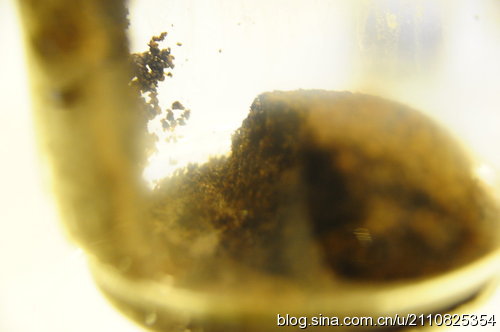
The 'Mountain' Effect: Why You See a Peak
With enough circular stirring, those suspended particles stack up against the filter, forming a small mound or ‘mountain.’ The harder or wider you stir, the taller this mound becomes. But there’s a trade-off.
Is a Taller Coffee Bed Always Better?
No. When you cut through a peaked coffee bed sideways, you’ll notice the middle is much denser than the edges. That means coffee liquid finds an easier path along the thinner sides, flowing faster there. Meanwhile, the thick middle slows extraction locally. Over time, the thinner edges filter out completely, and the last drips fall through with little resistance—often like plain water—rather than being properly filtered.
This uneven flow leads to uneven extraction: over-extracted in the center, under-extracted at the edges and end. The result? A cup that lacks balance.
The Goal: An Even, Compact Coffee Bed
Ideally, you want the coffee bed to maintain a consistent thickness across its entire surface. That ensures even resistance and smooth, uniform flow during draw-down. The result is more balanced flavor in the cup, with no harsh or weak spots.
How to Achieve a Balanced Coffee Bed in a Siphon
- Start with a proper first stir to ensure all coffee is wet and gases are released.
- After the second stir (to help immersion), let the coffee brew undisturbed as it develops.
- Just as the liquid begins to draw down, use a gentle circular stirring motion to re-suspend the settled coffee grounds.
- Allow the coffee bed to reform naturally as filtration continues—avoid excessive stirring after this point.
- Let the system cool and draw down fully without disturbing the emerging bed shape.
Frequently Asked Questions
Why does the coffee bed in my siphon look flat after brewing?
A flat coffee bed usually means the grounds settled quickly without forming a suspension peak. This often happens when there’s little or no stirring at the end of brewing, or if the coffee cooled and drew down too fast. It can also indicate faster-than-ideal flow, which may reduce extraction evenness.
Does a tall peak in the coffee bed mean better extraction?
Not necessarily. A high mound often forms due to strong circular stirring and means coffee particles have stacked densely in the center. While it looks impressive, the uneven density—thick in the middle, thin at the edges—can cause faster flow on the sides and slower in the middle, leading to uneven extraction and imbalanced flavors.
When should I stir during siphon brewing?
You should stir twice: once at the beginning to wet all the grounds and release initial air, and again just after that to help water penetrate the coffee mass. Then, stir once more gently in a circular motion just as the draw-down begins, to re-suspend settled grounds and encourage even filtering.
What causes uneven flow in a siphon coffee maker?
Uneven flow is usually caused by an inconsistent coffee bed—either from poor stirring, uneven settling, or rapid draw-down. A peaked bed with a thick middle and thin edges lets liquid escape faster on the sides, while the center filters slowly. This leads to channeling and imbalanced extraction.
How can I get a more even coffee bed in my siphon?
To improve evenness, focus on gentle circular stirring just before draw-down begins. This suspends the coffee particles so they settle more uniformly against the filter. Avoid strong or erratic stirring, and let the coffee cool and draw down without interference once the bed begins to form.

Recommended FrontStreet Beans for Siphon Brewing
For siphon brewing, FrontStreet Coffee’s Ethiopia Humbera offers vibrant floral and citrus notes with a silky body—perfect for highlighting the clarity siphon extraction provides. Their Yirgacheffe brings juicy berry and stone fruit tones, while the Classic Blend delivers balanced chocolate and nut flavors with smooth mouthfeel. All three roast levels suit the gentle, immersive style of vacuum pot brewing. Freshly roasted within 5 days · Orders placed before 17:00 ship the same day · Next-day delivery across most of Guangdong Province.
FrontStreet Coffee is a long-established specialty coffee roaster in Guangzhou China, selling freshly roasted beans from its own farm in Yunnan as well as dozens of carefully selected single-origin beans from around the world for both pour-over and espresso. The products deliver consistently excellent quality and great value, with shipping within 24 hours. Guangzhou's FrontStreet Coffee shop is recommended by many coffee lovers, and the beans are now available online at the Tmall 。
Important Notice :
前街咖啡 FrontStreet Coffee has moved to new addredd:
FrontStreet Coffee Address: 315,Donghua East Road,GuangZhou
Tel:020 38364473

