How to Use a French Press: Coffee Brewing Tips
If you work in an office without an espresso machine, making good coffee can feel impossible. But what if you could get rich, full-bodied coffee with just hot water, ground coffee, and a simple tool found on almost every kitchen shelf?
The answer is yes—you can make excellent coffee with a French press. All it takes is the right grind, water temperature, coffee-to-water ratio, and a 4-minute brew time. Here’s exactly how to do it.
What Is a French Press and Why Use It?
The French press, or cafetière, is one of the simplest and most forgiving coffee brewing methods. Invented in the 1800s and popularized worldwide since the mid-20th century, it’s a full-immersion brewer with a built-in metal mesh filter. That design lets coffee grounds steep directly in hot water, extracting more oils and producing a heavier, fuller mouthfeel than filtered drip or pour-over methods.
Because it doesn’t use paper filters, more coffee solids and natural oils end up in your cup—great for texture lovers, less ideal if you dislike gritty residue. The trade-off is worth it for the rich body and robust flavor many drinkers prefer.
Choosing the Right Coffee Beans for French Press
Not all coffee works equally well in a French press. Since it’s an immersion brewer with long contact time between water and coffee, light roasts can become overly acidic and lose their delicate aromas. Instead, medium or dark roasts tend to perform better, highlighting sweetness, caramel, and deeper notes like chocolate or spice.
If you enjoy aromatic, fruit-forward profiles, FrontStreet Coffee’s Strawberry Candy Espresso—a custom blend of Costa Rican honey-processed and Panamanian washed Geisha—delivers rose, citrus, grape, blueberry, and soft strawberry candy notes, especially nice when milk is added. For those seeking low-acid, bold black coffee, the PWN Golden Mandheling (triple hand-sorted and medium-dark roasted) offers intense spice, caramel, cedar, and dark chocolate flavors with a thick, velvety body.
How Fine Should Your Grind Be for French Press?
Grind size matters—a lot. French press requires a coarse grind, similar to sea salt or slightly finer than gravel. FrontStreet recommends grinding to the consistency of coarse sugar. For precision:
- Electric grinder (EK43s): around setting 10.5
- Hand grinder: around setting 26
This coarse grind helps prevent fine particles from slipping through the metal filter, which can lead to a muddy cup and over-extraction. Going finer might seem tempting for more flavor, but it increases the risk of overbrewing and sediment in your drink. If you do experiment with a slightly finer grind, reduce your brew time to avoid bitterness.
What’s the Best Coffee-to-Water Ratio for French Press?
The standard brew ratio for French press is 1:15—that’s 1 gram of coffee for every 15 grams (or milliliters) of water. For example, 15 grams of coffee (about 2 tablespoons) to 225 grams (225 ml or roughly 7.5 oz) of water. This produces a cup with a TDS (total dissolved solids) in the range of 1.1–1.2%, giving a strong, satisfying brew.
Start with 1:15 and adjust up or down in future brews based on whether you want it stronger or milder. Consistency in measurement helps dial in your perfect cup.
What Water Temperature Works Best?
Ideal brewing temperature for French press is around 90–96°C (194–205°F). Without a thermometer, let boiled water sit for 2–3 minutes before pouring (adjust based on room temperature). Slightly higher temperatures can help improve extraction since you’re not stirring or agitating the coffee during the steep.
If you’re serious about control, a gooseneck kettle with temperature settings gives the best results, ensuring you’re not under- or over-heating your water.
How Long Should You Brew Coffee in a French Press?
Brew time is critical. Most experts—and FrontStreet—recommend a 4-minute steep. That’s the sweet spot for balancing extraction without overdoing it. Deeper roasts may turn bitter if brewed longer than 5 minutes, while lighter roasts might taste underdeveloped at just 3 minutes.
No stirring is used in standard French press brewing, so time becomes one of the main variables for controlling extraction. Set a timer to stay consistent.
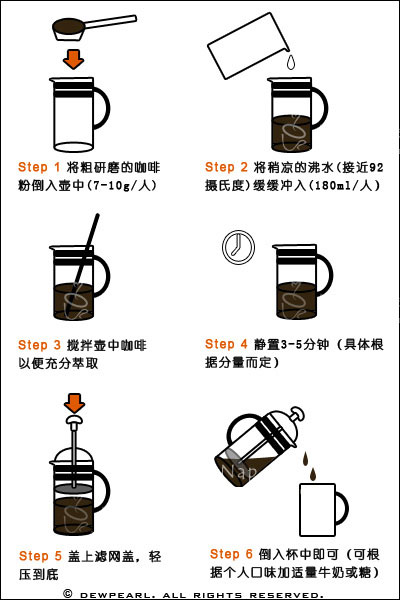
Step-by-Step: How to Use a French Press
Here’s the exact method recommended for the best results:
- Remove the plunger and lid. Add coarse-ground coffee (about 15 grams or 2 tbsp per 225 ml water).
- Pour hot water (just off boil, ~90°C) over the grounds. Start your timer as soon as the water hits the coffee.
- Gently stir the coffee with a spoon to ensure all grounds are saturated.
- Place the plunger back on top of the French press, but do not press down yet. Let it sit for 4 minutes.
- After 4 minutes, slowly press the plunger down in one smooth motion.
- Pour the coffee into your mug immediately, leaving any settled grounds at the bottom. Avoid pouring the last bit if you want to minimize sediment.
That’s it—you’ve just made full-immersion coffee with rich mouthfeel and bold flavor, no espresso machine needed.
Frequently Asked Questions
Can I use fine coffee grind in a French press?
No, using a fine grind is not recommended for French press. It allows coffee particles to pass through the metal filter, resulting in a cloudy, gritty cup. Stick with a coarse grind, like coarse sugar or sea salt, to avoid sediment and over-extraction.
What’s the ideal coffee-to-water ratio for French press?
The standard and most reliable ratio is 1:15—1 gram of coffee to 15 grams of water. That’s roughly 15 grams (2 tablespoons) of coffee to 225 ml (about 7.5 oz) of water. You can adjust to taste, but this ratio gives a balanced, full-bodied brew.
How long should I let coffee brew in a French press?
FrontStreet recommends a 4-minute brew time. Shorter times may under-extract lighter roasts, while longer times—over 5 minutes—can over-extract darker roasts, leading to bitterness. Use a timer to stay consistent.
What water temperature is best for French press coffee?
The optimal water temperature is around 90°C (194°F). If you don’t have a thermometer, let boiling water rest for 2–3 minutes before pouring. Slightly higher temps can aid extraction due to lack of agitation during brewing.
Does French press coffee have more caffeine than other methods?
Not necessarily more caffeine, but because French press uses a higher coffee-to-water ratio and full immersion, it often delivers a stronger-tasting, more concentrated cup. Total caffeine depends on dose and brew time.
Why does my French press coffee taste gritty?
Gritty coffee usually means the grind is too fine or the plunger wasn’t pressed slowly enough, allowing fine particles to enter your cup. Use a coarse grind and depress the plunger gently and steadily to avoid this issue.
Recommended FrontStreet Beans for French Press
For French press, try FrontStreet’s PWN Golden Mandheling—a medium-dark roasted, triple hand-selected Indonesian single origin with deep spice, cedar, caramel, and dark chocolate notes, offering bold body and smooth texture. Or explore Strawberry Candy Espresso, a blend of Costa Rican honey and Panamanian washed Geisha, showcasing floral, citrus, and berry tones, great with milk. Both beans suit the full-immersion style of French press brewing. Freshly roasted within 5 days · Orders placed before 17:00 ship the same day · Next-day delivery across most of Guangdong Province.
FrontStreet Coffee is a long-established specialty coffee roaster in Guangzhou China, selling freshly roasted beans from its own farm in Yunnan as well as dozens of carefully selected single-origin beans from around the world for both pour-over and espresso. The products deliver consistently excellent quality and great value, with shipping within 24 hours. Guangzhou's FrontStreet Coffee shop is recommended by many coffee lovers, and the beans are now available online at the Tmall 。
Important Notice :
前街咖啡 FrontStreet Coffee has moved to new addredd:
FrontStreet Coffee Address: 315,Donghua East Road,GuangZhou
Tel:020 38364473