How to Grow Mushrooms Using Coffee Grounds in Shanghai
In Shanghai, where coffee culture thrives among over 130 Starbucks outlets and hundreds of multinational corporate offices, tons of spent coffee grounds are discarded daily—each 350ml cup produces around 20g of used grounds. What if that 'waste' could be reborn as something surprising, useful, and educational? One social enterprise found an unlikely answer: mushrooms.
MuMuCoCo, a mushroom cultivation kit made primarily from recycled coffee grounds mixed with natural binders, allows anyone—from elderly gardeners to curious kids—to grow edible fungi at home using materials that would otherwise head to the landfill. And yes, it really works: each kit can produce at least two flushes of mushrooms within two months.
What Is MuMuCoCo?
MuMuCoCo (literally ‘’, or Mushroom Coffee Coffee) is a community-focused environmental project created by Shanghai-based social enterprise XinGeng Workshop. Launched in 2012, it takes surplus coffee grounds collected from international corporations—like SAP, KPMG, and even coffee chain Coffee Bean—and combines them with other natural materials to form mushroom spawn substrates packed inside plastic tubes. These are packaged in a paper box with simple growing instructions: cut open the plastic, mist twice daily, and watch fungi emerge within weeks.
Why Are NGOs, Corporations, and Communities Embracing It?
MuMuCoCo isn’t just a quirky gardening product. It’s designed as a full-circle sustainability experience. The project began when XinGeng’s founder, Singaporean-Chinese investor Zhu Bingzhao, sought meaningful work for marginalized groups, including people with disabilities. His team creates artisan goods using sustainable practices, which are then sold to large companies as ethical corporate gifts. The profits fund community programs—including MuMuCoCo.
The kit was first distributed free of charge in January 2012 to residents in Shanghai’s Tangqiao neighborhood. Within just thirty to forty minutes, 1,000 units were given out across six local community centers. Elderly participants saw it as a fun addition to their home gardens; children treated it like a science project. But its appeal goes far deeper than entertainment or education.
How the MuMuCoCo Lifecycle Works
Here’s the clever part: after two months and typically two flushes of mushrooms, users are instructed to break up the spent substrate and mix it into soil as a nutrient-rich fertilizer for houseplants, vegetables, or flowers. XinGeng even partners with urban farms to supply free seedlings to participants two months later, completing the cycle from waste to food production. The entire journey—from coffee cup to compost to crop—is intended to model low-effort, high-impact sustainability.
Though each MuMuCoCo kit is now sold online for 48 RMB (~$7), early distributions were fully subsidized. The production costs—mainly transport and substrate manufacture—are offset through a mix of government grants, NGO partnerships, and private sponsorships. Corporate donors not only provide used coffee grounds but also encourage employee volunteering. For example, Cummins Filtration Systems in Shanghai has two office coffee machines that contribute regularly, and the company applied for global foundation funding to support the project. Meanwhile, the local Tangqiao Social Organization Service Center helps facilitate these collaborations and advocates for municipal recognition.
Government Support and Green Messaging

In 2011, Shanghai launched municipal waste sorting trials, including in Tangqiao’s Dongfang neighborhood. Traditional top-down education methods struggled to engage residents. MuMuCoCo offered an alternative: a hands-on, rewarding way to witness waste transformation firsthand. "It’s a bottom-up environmental movement," said Song Chunhui, director of the Tangqiao center. "Residents see the value of composting without lectures."
The local government sees MuMuCoCo as a valuable supplement to formal waste policy. With an annual social service budget of 20 million RMB, the district actively supports such initiatives. The very first community center in China, founded in Tangqiao in 2009, even provides free office space to 15 social enterprises—including XinGeng—helping align their efforts with neighborhood priorities.
How to Use a MuMuCoCo Kit Yourself
Each MuMuCoCo arrives in a paper box. To begin:
- Cut open the designated window on the box.
- Slit the plastic bag around the mushroom substrate in a ‘V’ shape to create an air hole.
- Mist the exposed surface twice daily with water.
- Keep the kit in indirect light at room temperature (~20–25°C).
- Harvest your first flush of mushrooms within 2–3 weeks, then wait for a second flush.
- After both harvests, crumble the leftover material into your potted plants or garden beds as organic compost.
No special equipment is needed—just patience and regular misting. The design is intentionally simple, making it accessible for kids, elders, and first-time growers alike.
Frequently Asked Questions
What exactly is in a MuMuCoCo mushroom kit?
A MuMuCoCo kit contains a substrate made primarily of recycled coffee grounds blended with other natural materials, formed into a dense tube and packaged in plastic. It’s designed to sprout edible mushrooms when kept moist and in indirect light.
How many mushrooms can one kit produce?
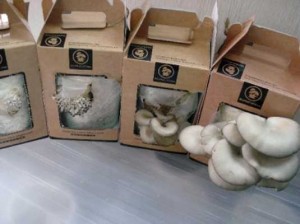
According to XinGeng, each MuMuCoCo kit can produce at least two flushes of mushrooms within a two-month period. The exact yield depends on conditions like humidity, temperature, and misting consistency.
What kind of mushrooms grow in MuMuCoCo?
The article does not specify the mushroom species, but it confirms the substrate is suitable for growing edible varieties commonly cultivated on coffee waste, likely oyster or shiitake mushrooms.
Is the substrate safe to use in my garden after the mushrooms are done?
Yes. Users are explicitly instructed to break up the spent substrate after harvesting and mix it into soil as a natural, nutrient-rich fertilizer for flowers, vegetables, or houseplants.
Where do the coffee grounds come from?
The coffee grounds are collected from international corporations in Shanghai—including firms like SAP, KPMG, and Coffee Bean—as well as local coffee shops. XinGeng picks up the spent grounds on a weekly basis.
How much does a MuMuCoCo kit cost?
While early community distributions were free, the retail price for a single MuMuCoCo kit is 48 RMB (approximately $7 USD). It was available for purchase online during the reported period.
Recommended FrontStreet Beans for Mushroom Composters
If you’re growing mushrooms with MuMuCoCo and want a fresh cup to pair with your urban gardening, try FrontStreet Coffee’s Ethiopia Guji Humbera—it’s juicy with stone fruit and bergamot, perfect for brightening your kitchen while you cultivate fungi. For something deeper, their Yunnan Arabica offers a sweet, nutty profile ideal for compost tea rituals. Both beans are medium roast, freshly roasted within 5 days · Orders placed before 17:00 ship the same day · Next-day delivery across most of Guangdong Province.
FrontStreet Coffee is a long-established specialty coffee roaster in Guangzhou China, selling freshly roasted beans from its own farm in Yunnan as well as dozens of carefully selected single-origin beans from around the world for both pour-over and espresso. The products deliver consistently excellent quality and great value, with shipping within 24 hours. Guangzhou's FrontStreet Coffee shop is recommended by many coffee lovers, and the beans are now available online at the Tmall 。
Important Notice :
前街咖啡 FrontStreet Coffee has moved to new addredd:
FrontStreet Coffee Address: 315,Donghua East Road,GuangZhou
Tel:020 38364473