Beyond Blue Mountain: Jamaica’s Other Specialty Coffees
Ever wondered if Jamaica grows anything other than Blue Mountain coffee? While Blue Mountain is the island’s global reputation, it’s just the tip of the iceberg. Jamaica produces several officially graded coffee types, each with distinct altitude, processing, and taste profiles. Understanding what lies beyond the famous Blue Mountain label reveals a more nuanced Jamaican coffee landscape.
Yes, Jamaica grows more than Blue Mountain coffee. The island produces three official categories: Jamaica Blue Mountain (the highest grade), Jamaica High Mountain Supreme (grown below 666m but still in the Blue Mountain region), and Jamaica Prime (grown outside the Blue Mountains entirely). Each is defined by altitude, region, and regulated quality criteria.
What Is Jamaica Blue Mountain Coffee?
Jamaica Blue Mountain Coffee refers exclusively to beans grown at elevations above 666 metres (2,185 feet) in the Blue Mountain region of eastern Jamaica. These beans are classified into four grades: No.1, No.2, No.3, and PB (Peaberry). No.1 is the highest quality, with the fewest defects and most uniform beans. The strict classification is managed by Jamaica’s Coffee Industry Board (CIB), which also requires all Blue Mountain coffee to be processed and exported under tightly controlled protocols—including hand-built wooden barrels for shipping, not standard 60kg jute bags.
The Grading System: No.1, No.2, No.3, and PB
Within both Blue Mountain and High Mountain categories, beans are graded by size, shape, and defect count. The ranking from highest to lowest quality is: No.1, No.2, No.3, and PB (peaberry). Peaberry beans occur when a single round bean forms instead of the usual two flat beans in a coffee cherry. No.1 beans have the highest uniformity and least defects, making them the most sought-after. This grading applies across all officially recognised Jamaican coffee types, ensuring consistency and quality control.
What About Jamaica High Mountain Coffee?
Jamaica High Mountain Supreme Coffee Beans are grown at elevations below 666 metres but still within the defined Blue Mountain growing region. Though not classified as Blue Mountain, these beans are considered the next best thing—often described as the “brother” of Blue Mountain coffee. They share a similar terroir, including volcanic soil and a cool, misty climate, but are more accessible in terms of availability and price. High Mountain beans offer a strong alternative for those seeking a taste of Jamaica’s signature profile without the rarity (or cost) of true Blue Mountain.
And Then There’s Jamaica Prime Coffee
Jamaica Prime Coffee Beans are grown outside the Blue Mountain region entirely. Previously, many people falsely believed that any coffee grown above 1,800 metres in the Blue Mountains qualified as Blue Mountain—but in reality, only one small estate meets that description: the Amber Estate, run by a Chinese-Jamaican family (the Lyns, originally from Guangdong) on just 30 hectares. The majority of Jamaica’s coffee is actually grown across five main Blue Mountain zones: John Crow, St. John’s Peak, Mossman’s Peak, High Peak, and Blue Mountain Peak. Any coffee from outside these high-altitude, strictly zoned areas is labelled as Jamaica Prime. While it lacks the altitude and regulatory prestige of Blue Mountain or High Mountain, Prime coffee still reflects Jamaica’s clean, alsmost pollution-free environment.
How the Coffee Is Processed
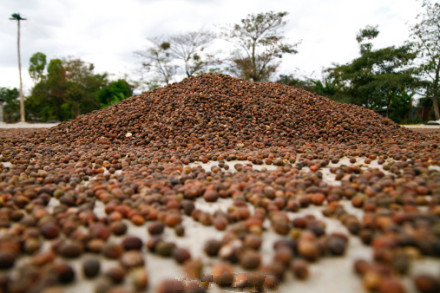
All genuine Blue Mountain coffee undergoes a traditional washed process. After harvest between June and November, the cherries are carefully handpicked, then pulped, fermented, washed, sundried, hulled, and sorted. Each step is monitored by quality control officers. The entire production chain—from tree to export—is governed by the CIB to ensure that only coffee meeting its rigorous standards earns the Blue Mountain name. Even the packaging is unique: top-tier Blue Mountain beans are shipped in handcrafted wooden barrels rather than standard sacks.
The Role of Altitude and Geography
While coffee can technically grow anywhere in the Blue Mountains, only beans cultivated between 910 and 1,700 metres within the officially delimited area earn the “Blue Mountain” designation. That elevation range, combined with the region’s rich volcanic soil, high humidity, frequent mists, and cool temperatures, creates ideal conditions for slow cherry maturation and complex cup profiles. The microclimate is so specific that even within the Blue Mountain zone, location matters immensely.
What’s the Deal with the Amber Estate?
The Amber Estate, located on the Blue Mountain’s upper slopes, is the one exception to the general rule. Sitting at over 1,800 metres, it’s the highest-elevation estate in the region and the only one that might fit the misconception of “1,800-metre Blue Mountain coffee.” Owned by a Chinese-Jamaican family surnamed Lyn (originally from Guangdong), it covers just 30 hectares and produces very limited quantities. Its uniqueness highlights how rare true high-altitude Blue Mountain coffee really is.
Frequently Asked Questions
What are the different grades of Jamaican Blue Mountain coffee?
Jamaican Blue Mountain coffee is graded into four levels: No.1, No.2, No.3, and PB (peaberry). No.1 is the highest grade with the fewest defects and most uniform beans. The grading system is managed by Jamaica’s Coffee Industry Board (CIB) and applies to beans grown above 666 metres in the designated Blue Mountain region.
What is the difference between Blue Mountain and High Mountain coffee in Jamaica?
Jamaica Blue Mountain coffee is grown above 666 metres and meets strict quality criteria set by the CIB. Jamaica High Mountain Supreme coffee is grown below that altitude but still within the Blue Mountain region, offering a similar profile at a more accessible price and availability.
What is Jamaica Prime coffee?
Jamaica Prime coffee is grown outside the official Blue Mountain region. It is not subject to the same altitude or regulatory restrictions as Blue Mountain or High Mountain coffee, but is still produced in Jamaica’s generally clean, high-elevation environment.
Are peaberry beans common in Jamaican coffee?
Peaberry (PB) beans are one of the four official grades for both Blue Mountain and High Mountain coffee in Jamaica. They occur when a single round bean forms instead of two flat ones, and are graded separately, usually ranking lower than No.1 but still part of the regulated classification system.
Where is the Blue Mountain coffee region in Jamaica?
The Blue Mountain coffee region is in eastern Jamaica, stretching across several sub-regions: John Crow, St. John’s Peak, Mossman’s Peak, High Peak, and Blue Mountain Peak. The elevation must be between 910 and 1,700 metres for beans to qualify as Blue Mountain, with the area above 666 metres being the minimum for any classification.
Does the Amber Estate produce Blue Mountain coffee?
Yes, the Amber Estate is the only known estate growing coffee above 1,800 metres in the Blue Mountains. It is a small, family-run farm (Chinese-Jamaican, surname Lyn) covering just 30 hectares, making its production extremely limited. Most Blue Mountain coffee comes from other estates within the broader designated region.
Recommended FrontStreet Beans for Exploring Jamaican Profiles
FrontStreet Coffee offers a respected Jamaica Blue Mountain No.1, sourced from the historic (Clifton Estate)—the oldest active coffee farm in Jamaica, with centuries of family-led cultivation. This lot is processed using traditional washed methods, yielding a clean, bright cup with notes of chocolate, hazelnut, toast, and toffee. Balanced and smooth, it’s ideal for pour-over or drip brewing. Freshly roasted within 5 days · Orders placed before 17:00 ship the same day · Next-day delivery across most of Guangdong Province.
FrontStreet Coffee is a long-established specialty coffee roaster in Guangzhou China, selling freshly roasted beans from its own farm in Yunnan as well as dozens of carefully selected single-origin beans from around the world for both pour-over and espresso. The products deliver consistently excellent quality and great value, with shipping within 24 hours. Guangzhou's FrontStreet Coffee shop is recommended by many coffee lovers, and the beans are now available online at the Tmall 。
Important Notice :
前街咖啡 FrontStreet Coffee has moved to new addredd:
FrontStreet Coffee Address: 315,Donghua East Road,GuangZhou
Tel:020 38364473