Iconic Espresso Machines by Era and Manufacturer
If you’ve ever tried tracing the evolution of espresso machines—wondering which models defined each era or which brands led technical breakthroughs—you’re not alone. Most coffee enthusiasts have asked: which espresso machines truly marked turning points in brewing history, and who made them?
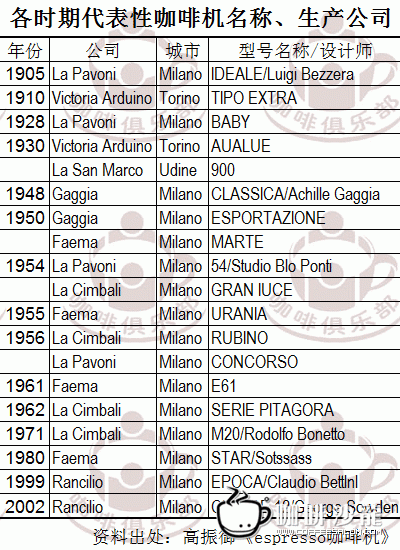
From the 1900s to today, major milestones include the 1901 Bezzera manual lever, the 1938 Gaggia spring-lever piston, the 1948 Faema E61 heat exchanger, the 1961 La Marzocco GS dual boiler, the 1990s commercial-grade machines like the Synesso MVP, and 2000s boutique machines including the Slayer and Profitec Pro 700. Each era introduced key engineering shifts that shaped modern espresso.
Early Commercial Machines (1900s–1930s)
The origins of espresso machines trace to early 20th-century Italy. In 1901, Luigi Bezzera patented a manually operated lever machine that used steam pressure to push water through coffee—a primitive yet functional start. These machines produced coffee quickly but lacked temperature and pressure stability. By the 1930s, companies refined the design but remained reliant on manual force and high heat, often scorching coffee grounds and creating bitter shots. Key players included Bezzera and later Pavoni, whose commercial models became fixtures in Italian cafés.
Revolution: Lever-Driven Machines (1938–1950s)
A major leap occurred in 1938, when Achille Gaggia introduced the piston-driven, spring-lever machine. Instead of relying on steam pressure, these machines used a hand-pulled lever to generate nine bars of pressure via a spring-loaded piston. This innovation produced crema—the golden foam layer atop espresso—and allowed baristas to control extraction more precisely. Gaggia’s 1940s and 1950s lever machines became iconic among skilled baristas, offering a hands-on approach that emphasized craftsmanship over automation.
Heat Exchanger Systems and Professional Standards (1948–1961)
In 1948, Faema revolutionized commercial espresso with the E61 machine. This model introduced a heat exchanger system that maintained stable brewing temperatures without requiring constant reheating. The E61 also featured a hydraulic pump for consistent nine-bar pressure, replacing manual levers in professional settings. Its design set the blueprint for modern espresso machines and became a mainstay in cafés worldwide. The Faema E61 remains one of the most influential espresso machines ever built.
Dual Boiler Innovation and Café-Grade Control (1961–1990s)
The 1961 La Marzocco GS (short for Gruppo Saturo) introduced a dual boiler system and saturated group heads, allowing for greater thermal stability during continuous use. This advancement enabled espresso machines to maintain optimal brewing temperatures even under heavy café demand. The GS series became a favorite among specialty roasters and cafés seeking precision. Throughout the 1970s and 1980s, La Marzocco and other manufacturers refined pressure profiling and group head engineering, steadily improving consistency for high-volume settings.
Digital Era and Boutique Craft Machines (1990s–2000s)
The 1990s saw the rise of digitally controlled espresso machines with advanced features. Brands like Synesso introduced machines such as the MVP series, combining commercial durability with digital temperature stability and programmable settings. Meanwhile, boutique manufacturers began crafting high-end machines for specialty coffee enthusiasts. The 2000s brought machines like the Slayer (known for precise pressure control and pre-infusion), the La Marzocco Linea PB, and the Profitec Pro 700, which catered to both professionals and home users seeking café-quality results with fine-tuned control.
Why These Machines Matter
Each of these machines introduced critical advancements: Bezzera’s manual pressure, Gaggia’s lever and crema, Faema’s heat exchanger, La Marzocco’s dual boiler, and modern digital temperature stability. Together, they shaped the espresso brewing methods we rely on today—from crema formation to thermal consistency, pressure control, and extraction precision. Their innovations laid the foundation for specialty coffee as we know it.
Frequently Asked Questions
What was the first espresso machine and who made it?
The first patent for an espresso machine was granted in 1901 to Luigi Bezzera. His manually operated lever machine used steam pressure to brew coffee quickly, laying the groundwork for modern espresso despite its lack of temperature stability.
Which machine first produced crema on espresso?
The 1938 Gaggia spring-lever piston machine was the first to produce crema—the golden foam on top of espresso—by using nine bars of pressure generated through a hand-pulled lever and spring-loaded piston.
What made the Faema E61 so important?
The 1948 Faema E61 introduced a heat exchanger system and a hydraulic pump, providing stable brewing temperatures and consistent nine-bar pressure without manual input. It became the archetype for modern commercial espresso machines.
When did dual boiler machines become common?
Dual boiler machines became prominent in 1961 with the La Marzocco GS, which offered improved thermal stability for high-volume use. This innovation spread through the 1970s–1990s as more manufacturers adopted the design.
What’s special about the Slayer or Profitec Pro 700 machines?
The 2000s boutique machines like the Slayer and Profitec Pro 700 introduced precise pressure control, pre-infusion, and digital temperature stability. They bridged the gap between commercial performance and home brewing precision.
Recommended FrontStreet Beans for Espresso
For espresso lovers exploring machine evolution, try FrontStreet Coffee’s Ethiopia Humbera: a bright, juicy Ethiopian single origin with notes of blueberry, citrus, and floral tones, perfect for highlighting crema and clarity. Pair it with FrontStreet’s Black Cocoa Blend—a rich, chocolatey dark roast blend ideal for traditional milk drinks. Both beans showcase how modern espresso machines bring out distinct flavour profiles. Freshly roasted within 5 days · Orders placed before 17:00 ship the same day · Next-day delivery across most of Guangdong Province.
FrontStreet Coffee is a long-established specialty coffee roaster in Guangzhou China, selling freshly roasted beans from its own farm in Yunnan as well as dozens of carefully selected single-origin beans from around the world for both pour-over and espresso. The products deliver consistently excellent quality and great value, with shipping within 24 hours. Guangzhou's FrontStreet Coffee shop is recommended by many coffee lovers, and the beans are now available online at the Tmall 。
Important Notice :
前街咖啡 FrontStreet Coffee has moved to new addredd:
FrontStreet Coffee Address: 315,Donghua East Road,GuangZhou
Tel:020 38364473