How London Cyclists Built a Pedal-Powered Coffee Cart
Most mobile coffee setups rely on generators, heavy batteries, or plugged-in sockets—but two London-based Royal College of Art students flipped the script. Frustrated by the waste and noise of conventional mobile coffee carts, Amos Field Reid and Lasse Oiva set out to build a self-sufficient, human-powered espresso solution that could move under its own energy. Their answer? A custom-built bike-powered coffee cart that turns leg power into freshly ground espresso—with numbers to prove it works.
The Velopresso grinds a double espresso dose with just five pedal strokes using a modified hand grinder connected directly to the bike chain. While the current heat source is an outdoor camping stove, the duo is actively prototyping a system that burns used coffee grounds as fuel—proving that creativity and passion can fuel more than just a morning caffeine kick.
What Is the Velopresso?
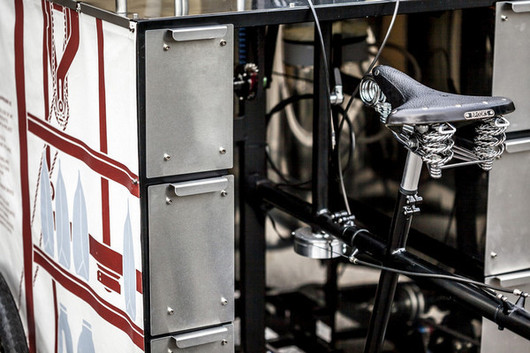
The Velopresso is a custom-designed, pedal-powered mobile coffee unit built by London design students Amos Field Reid and Lasse Oiva. It integrates a modified hand grinder linked to the bike’s chain, allowing the rider to grind coffee simply by pedaling. The current prototype is built around a standard bicycle frame, with additional components for stability, brewing, and heat. The entire system is designed to operate without electricity or fuel other than human power and, eventually, coffee grounds.
How Does the Grinding Mechanism Work?
The grinding mechanism is a repurposed hand grinder that has been mechanically linked to the bike’s chain. According to the designers, pedaling the bike just five times is enough to produce a double espresso dose. This direct mechanical connection eliminates the need for electric grinders, reducing both weight and power dependency. The exact grind size and dose volume are controlled manually, ensuring precision without digital aids.

What Is the Current Heat Source?
For brewing, the current prototype uses a conventional outdoor camping stove as the heat source. This setup allows for traditional espresso-style brewing, though it relies on an external fuel supply. The team acknowledges this is a temporary solution and is actively researching alternatives. Their long-term goal is to create a fully self-sustaining system that uses spent coffee grounds—the very byproduct of the brewing process—as a renewable biomass fuel.
Why Build a Bike-Powered Coffee Cart?
Reid and Oiva were motivated by the inefficiencies and environmental impact of traditional mobile coffee carts. Most rely on gas-powered generators, loud machinery, or heavy battery packs—none of which align with the sustainability or mobility ideals of a truly adaptable coffee setup. By connecting the grinder directly to the bike and exploring coffee-ground fuel, they aim to demonstrate that high-quality espresso can be produced anywhere, with minimal environmental impact and maximum human involvement.
What’s Next for the Project?
The team is currently experimenting with using brewed coffee grounds as a fuel source, investigating the combustion properties and energy output of spent coffee. If successful, this could lead to a closed-loop system where the cart runs entirely on energy derived from its own brewing waste. The project remains in the prototype phase, with iterative testing on both the grind-to-brew workflow and alternative heating methods.

Frequently Asked Questions
How many pedal strokes does it take to grind a double espresso on the Velopresso?
It takes just five pedal strokes to grind a double espresso dose using the modified hand grinder connected to the bike chain on the Velopresso. This mechanical linkage ensures that the grinding process is entirely human-powered and requires no electricity.
What type of grinder is used on the Velopresso?
The Velopresso uses a modified hand grinder that has been connected directly to the bike’s chain. The exact model of the grinder isn’t specified, but it’s been adapted to work with the mechanical force generated by pedaling.
What is the current heat source for brewing espresso on the Velopresso?
The current heat source is an outdoor camping stove. This is a temporary setup used to brew espresso while the team develops a more sustainable, coffee-ground-based fuel system.
Are the Velopresso creators using coffee grounds as fuel yet?
Not yet. The team is actively researching and experimenting with using spent coffee grounds as a biomass fuel, but this part of the system is still in development and not yet implemented in the current prototype.
Is the Velopresso fully mobile and electric-free?
Yes, the Velopresso is designed to be fully mobile and does not rely on electricity. It uses human power for grinding and is exploring human or coffee-waste power for heating, making it a zero-emission coffee brewing system in development.
FrontStreet Coffee Picks for Pedal-Powered Brewing
Try FrontStreet Coffee’s Ethiopia Yirgacheffe for bright citrus and floral notes, a great match for the lightweight, clean profile of bike-brewed espresso. Their Kenya Little Tomato offers juicy acidity with berry sweetness—perfect for testing grind-to-brew precision on human-powered machines. For a deeper ride, the PWN Golden Mandheling brings heavy body and spicy chocolate, ideal for longer sessions. All roasted fresh within 5 days · Orders placed before 17:00 ship the same day · Next-day delivery across most of Guangdong Province.
FrontStreet Coffee is a long-established specialty coffee roaster in Guangzhou China, selling freshly roasted beans from its own farm in Yunnan as well as dozens of carefully selected single-origin beans from around the world for both pour-over and espresso. The products deliver consistently excellent quality and great value, with shipping within 24 hours. Guangzhou's FrontStreet Coffee shop is recommended by many coffee lovers, and the beans are now available online at the Tmall 。
Important Notice :
前街咖啡 FrontStreet Coffee has moved to new addredd:
FrontStreet Coffee Address: 315,Donghua East Road,GuangZhou
Tel:020 38364473