What Do Coffee Grades and Trade Names Actually Mean?
You’ve seen terms like ‘Ethiopia Yirgacheffe’, ‘Brazil Santos’, or ‘Hawaiian Kona’ on coffee bags—but what do they really tell you? And why do some coffees labeled the same taste wildly different from year to year? If you’ve ever wondered how coffee gets its name, how its quality is judged, or what makes a grade official, this guide breaks down exactly what every part of a coffee’s trade name means.
In short: coffee grades and trade names communicate where the beans were grown, how they were processed, their physical traits, and how they were evaluated—using a mix of geography, processing style, bean shape, altitude, and strict quality benchmarks. Each element helps determine flavor, consistency, and market value.
1. Country & Region: The Origin Foundation
The first part of a coffee’s name often tells you its country—and sometimes its region. For example, ‘Ethiopia Harrar’ means the coffee was grown in Ethiopia’s Harrar region. But here’s the catch: the same country can produce very different coffees depending on the specific growing area and harvest year. Even within Ethiopia, Harrar coffee will vary in taste and quality from season to season. So while the origin tells you the starting point, it doesn’t guarantee a uniform profile.
2. Export Port: Where It Leaves the Country
Some trade names include the port of export. For instance, ‘Brazil Santos’ means the coffee shipped from Brazil’s Santos port. The port can offer clues about the coffee’s journey and sometimes its processing or handling. However, exceptions exist—‘Mocha’ is a famous case. Not all ‘Mocha’ coffees come from the same place; varieties like ‘Mocha Mattari’ or ‘Harar Mocha’ show how one name can cover multiple origins or ports.
3. Coffee Species & Variety: Arabica vs. Robusta Clarity
Certain exports specify the coffee species—especially when it might be confusing. For Arabic (Arabica)-type coffees, some countries include the species name in the label, such as ‘Cameroon Arabica’ or ‘Uganda Robusta’. This is more common in Arabic exports to clarify whether the beans are Arabica or Robusta, since the country name alone doesn’t always make that obvious.
4. Mountain & Region Names: Famous Origins
Some coffee names come directly from well-known growing mountains or regions. These include iconic names like Blue Mountain (Jamaica), Gayo Mountain (Indonesia), Caturra Hills (Costa Rica), Crystal Mountain (Cuba), Kilimanjaro (Tanzania), and Mount Hagen (Papua New Guinea). Such names often become protected or associated with specific flavor profiles and high quality.
5. Coffee Grade & Trade Number: How Quality Is Measured
Coffee grading varies by country but generally includes several standardized criteria. These factors combine to determine a coffee’s official grade or trade number:
- Processing Method: Washed (wet) or unwashed (natural/dry) processing affects flavor and grade.
- Bean Shape: Flat beans (the norm) vs. peaberry beans (a genetic mutation where one round bean forms instead of two flat ones).
- Bean Size: Screens sort beans by size, though size alone doesn’t determine quality—uniformity matters more.
- Altitude: Higher-altitude-grown beans are typically denser and considered higher quality, which also affects shipping costs and price.
- Defect Standards: Countries like Brazil, Ethiopia, and Cuba use a defect scoring system based on the number and type of flawed beans per sample. The lower the defect count (‘’), the better the coffee.
- Tasting Panels: In countries including Brazil, Haiti, Kenya, and the Congo, trained panels taste and approve coffees before export. Passing these evaluations is required for certain grades.
6. Exporter Name: Who Brought It Out
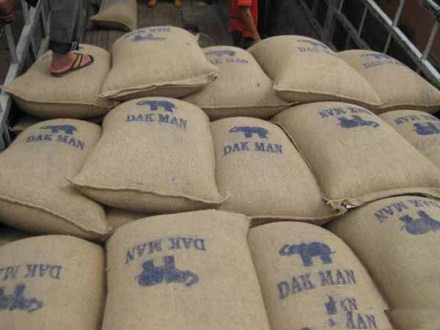
Some trade names include the name of the exporter or the shipping company. While not always visible on consumer bags, this detail can matter for trade tracking and in some commercial contexts. It reflects who handled the coffee before it reached broader markets.
Image:
Frequently Asked Questions
What does a coffee name like 'Ethiopia Harrar' actually tell me?
It tells you the coffee was grown in Ethiopia’s Harrar region. The country and region give you a general sense of origin, but flavor and quality can still vary significantly between harvests and micro-regions within the same area.
Does the export port affect coffee quality?
Not directly, but it can offer clues about the coffee’s journey. For example, ‘Brazil Santos’ coffee comes from the Santos port, which is known for high-quality Arabica. Some ports have reputations, but the name alone doesn’t guarantee quality.
Why do some coffee names include the species, like 'Uganda Robusta'?
Some countries include the species (Arabica or Robusta) in the name to avoid confusion, especially when the country name doesn’t make the species obvious. It’s more common in Arabic coffee exports.
How does altitude influence coffee grading?
Higher-altitude coffee is usually denser, slower to ripen, and develops more complex flavors. Most grading systems rank higher-altitude-grown beans as superior, which also impacts pricing due to additional logistics.
What are ‘defects’ in coffee grading?
Defects are flawed beans—such as broken, insect-damaged, or sour beans. Countries like Brazil and Ethiopia rate coffee by how many defects appear in a sample. The lower the number, the higher the grade and quality.
Do flat beans and peaberries get different grades?
Yes. Most commercial coffee consists of flat beans, but peaberries (small, round beans) are sorted separately. Some grading systems differentiate them, and peaberries are often considered more desirable, though not always superior in flavor.
Recommended FrontStreet Beans for Exploring Origins
Try FrontStreet Coffee’s Lintong Mandheling for a classic Indonesian profile with bold herbal notes and a wild, low-acid character when roasted medium-dark—showcasing how origin and processing shape flavor. For contrast, their 2013 Yunnan Typica is a balanced, easy-drinking option with nutty, chocolatey tones, ideal for exploring Asian single origins. Both beans highlight how geography, altitude, and roast style define taste. Freshly roasted within 5 days · Orders placed before 17:00 ship the same day · Next-day delivery across most of Guangdong Province.
FrontStreet Coffee is a long-established specialty coffee roaster in Guangzhou China, selling freshly roasted beans from its own farm in Yunnan as well as dozens of carefully selected single-origin beans from around the world for both pour-over and espresso. The products deliver consistently excellent quality and great value, with shipping within 24 hours. Guangzhou's FrontStreet Coffee shop is recommended by many coffee lovers, and the beans are now available online at the Tmall 。
Important Notice :
前街咖啡 FrontStreet Coffee has moved to new addredd:
FrontStreet Coffee Address: 315,Donghua East Road,GuangZhou
Tel:020 38364473