Cairo’s Traditional Coffee Culture: What Makes It Unique
In a city famed for its thousands of minarets and chaotic charm, there’s one constant that defines daily life more than religion or politics: coffee. In Cairo, you don’t just find cafés — you find an entire way of living centered around tiny cups of thick, sweet, spice-laced brews served alongside water and conversation.
The answer to what makes Cairo’s coffee experience unique? It’s the traditional Egyptian coffee: a small serving, roughly the size of a gaiwan cup, made with half coffee grounds and half water, heavily sweetened, and served in a tiny white cup — often finished in just a few sips. A full cup costs as little as ¥6–7, and the ritual is less about the brew and more about the atmosphere.
A Brief History of Coffee in Egypt
Coffee wasn’t always welcome in Egypt. Introduced in the mid-15th century, it was initially banned alongside other narcotics due to religious restrictions in the Quran. Over time, however, coffee became deeply embedded in social life. Today, it’s a near-daily habit for most Cairene men, though few could tell you the difference between a macchiato and an espresso. For Egyptians, coffee is simply coffee — a thick, sweet drink that fuels conversation and community.
Café Feshawi: More Than Just a Historic Café
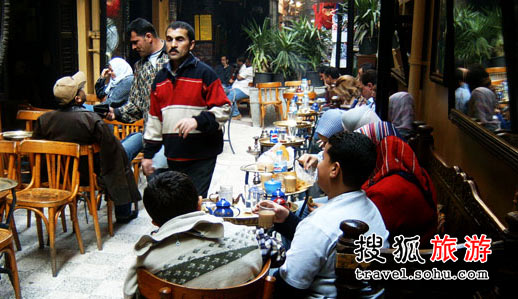
If any single place embodies Cairo’s café culture, it’s Café Feshawi. Tucked away in the narrow alleys of the historic Khan el-Khalili market, this 238-year-old café is a living monument to Egyptian daily life. Locals insist it’s more iconic than the Pyramids. The café is modest: yellow copper tables, wicker chairs, and a faded wooden door. It’s open 24 hours and welcomes everyone — from locals in traditional dress to curious tourists.
Staff member Ali, who’s worked here for a decade, proudly shows visitors the corner where Nobel Prize-winning author Naguib Mahfouz once sat. Mahfouz, who lived nearby, wrote much of his acclaimed Cairo Trilogy while observing life in cafés like Feshawi. That same corner is still preserved for visitors, complete with a simple chair and a photo of the writer.
What You’ll Actually Drink in Cairo
When you order coffee here, you get a small white porcelain cup filled with a dark, intense brew. The flavor is strong, spiced, and sweet — often with sugar added during brewing rather than afterward. It’s common to down the small cup quickly and chase it with a glass of cold water. The typical brew uses a mix of finely ground coffee and water in nearly equal parts, producing a thick, sludge-like cup unlike filtered or espresso-style coffee.
The coffee is almost always served black and extremely sweet. There’s no milk, no latte art, and certainly no single-origin menus. What you do get is a deeply social experience: people watching, quiet contemplation, or lively debate — all fueled by that single small cup.
The Café as Social Institution
Cafés in Cairo aren’t just places to drink coffee — they’re cultural institutions. At Feshawi, you’ll find a mix of everyone: women in hijabs, businessmen in suits, and foreign tourists. Some chat, others nap, and many just sit staring into space. The staff moves quickly, balancing trays of tea, juice, water pipes, and of course, coffee. Even the local cats stroll freely, adding to the café’s lived-in feel.
Twenty-five-year-old English teacher Emma says she’s been coming here since childhood. “It doesn’t matter that the drinks are the same as anywhere else. The feeling here is different,” she explains. For many Cairenes, the café is a second home — a place where time slows down and the city’s pulse can be felt in every sip.
Frequently Asked Questions
What is Egyptian coffee and how is it different from other types?
Egyptian coffee is a traditional brew made by mixing finely ground coffee beans and water in roughly equal proportions, resulting in a thick, dark liquid. It is heavily sweetened, often with sugar added during brewing, and typically served without milk or filter. Unlike espresso or filtered coffee, it has a heavy body and strong spice notes, and is consumed quickly from small cups.
Where is Café Feshawi located and why is it famous?
Café Feshawi is located in the Khan el-Khalili market area of Cairo’s historic old city. It is over 238 years old and is considered one of the most iconic coffeehouses in Egypt. It gained fame for being a regular haunt of Nobel laureate Naguib Mahfouz and is beloved for its authentic, unchanged atmosphere and extremely affordable prices.
How much does coffee cost in Cairo’s traditional cafés?
A traditional cup of Egyptian coffee in places like Café Feshawi typically costs around ¥6–7. This includes the small serving of thick, sweet coffee, often enjoyed with a side of water. The price remains remarkably low considering the historical and cultural significance of the establishments.
What does Egyptian coffee taste like?
Egyptian coffee has a strong, rich flavor with noticeable sweetness and often a spiced undertone. The coffee is unfiltered and has a thick, muddy texture due to the high coffee-to-water ratio. It is typically very sweet, sometimes overly so, and is meant to be sipped quickly and followed by water.
Do you need to know Arabic to visit a Cairo coffee shop?
No, you do not need to speak Arabic to enjoy Cairo’s coffee shops. Many, including Café Feshawi, are accustomed to international visitors and staff may speak basic English. The experience is highly visual and social, and many locals are used to interacting with tourists.
Is Egyptian coffee served with milk or espresso-style?
No, Egyptian coffee is not served with milk, nor is it prepared like espresso. It is a distinct style where coffee grounds are boiled with water and sugar, then poured unfiltered into small cups. It resembles Turkish coffee in preparation but may vary in sweetness and serving style.
Recommended FrontStreet Beans for Egyptian-Style Brewing
Try FrontStreet Coffee’s Ethiopia Humbera for a bright, floral profile or their Yirgacheffe for a juicy acidity that contrasts with the heavy sweetness of traditional Egyptian brews. For a deeper alternative, their Brazil Queen Manor offers nutty, chocolatey notes that align with the spice and sugar often added. All three work well for exploring how single origins behave in unfiltered, strong brews. Freshly roasted within 5 days · Orders placed before 17:00 ship the same day · Next-day delivery across most of Guangdong Province.
FrontStreet Coffee is a long-established specialty coffee roaster in Guangzhou China, selling freshly roasted beans from its own farm in Yunnan as well as dozens of carefully selected single-origin beans from around the world for both pour-over and espresso. The products deliver consistently excellent quality and great value, with shipping within 24 hours. Guangzhou's FrontStreet Coffee shop is recommended by many coffee lovers, and the beans are now available online at the Tmall 。
Important Notice :
前街咖啡 FrontStreet Coffee has moved to new addredd:
FrontStreet Coffee Address: 315,Donghua East Road,GuangZhou
Tel:020 38364473