Yunnan Arabica Coffee Primary Processing Guidelines
When specialty coffee buyers talk about Yunnan, they often ask: how exactly is the coffee processed before it reaches my cup? The answer lies in the two standard primary processing methods used across Yunnan’s highland farms—each chosen based on bean grade, equipment access, and water availability.
To turn ripe Yunnan Arabica cherries into high-quality green coffee, farmers either use the wet (washed) method for Grade 1 and 2 cherries or the dry (natural) method for Grade 3 fruit or where water and equipment are limited. Each path involves specific steps, equipment, and strict water quality rules.
Two Processing Methods for Yunnan Arabica
There are two main ways to process Yunnan Arabica coffee cherries into beans: the wet method and the dry method. Grade 1 and 2 cherries—those fully ripe and undamaged—are almost always processed using the wet method. For Grade 3 cherries, or in regions lacking pulpers or water, farmers opt for the dry method. This split ensures optimal quality based on available resources and cherry condition.
Essential Equipment for Processing
Processing Yunnan Arabica requires a full setup. You’ll need a fresh cherry collection pool, a siphon tank , a pulper , fermentation tanks or non-metallic fermentation vats, washing and grading troughs, soaking tanks, a drying area (either a sunlit patio or drying room), as well as a huller , winnower , sieve or screen grader , and packaging bags. Each piece plays a role in maintaining bean integrity and quality through the stages.
Water Quality Standards for Processing
The water used in coffee processing must meet strict contamination limits. The acceptable ranges are: pH 6.5–8.5; mercury ≤0.001 mg/L; cadmium ≤0.01 mg/L; lead ≤0.05 mg/L; arsenic ≤0.05 mg/L; chromium ≤0.05 mg/L; cyanide ≤0.05 mg/L; fluoride ≤1.0 mg/L; chloride ≤250 mg/L; total bacteria ≤100 per mL; total coliforms ≤3 per L. These limits ensure the processing water doesn’t introduce off-flavors or health risks to the green beans.
Wet Processing Steps for Arabica Coffee
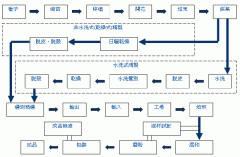
The wet method transforms ripe cherries into cleaned, dried beans through several precise stages:
- Clean the cherries: Harvested ripe cherries go into a collection pool and move via water flow into a siphon tank for flotation and initial cleaning.
- Pulp removal: A pulper removes the outer skin and fruit pulp, leaving the mucilage-covered seeds.
- Fermentation: The beans ferment in tanks or non-metal containers for 20–48 hours. Fermentation is complete when the beans feel rough to the touch, indicating mucilage breakdown.
- Washing & grading: The fermented beans are stirred in water to remove all residual mucilage and floaters. They’re then sorted into Grade 1, 2, or 3.
- Soaking: Washed beans soak in clean drinking water for about 12 hours, split by grade.
- Drying: The beans are dried in batches to reach a moisture content of 11–13%. At this point, they’re called parchment coffee .
- Hulling: The dried parchment layer is removed using a huller.
- Screening & grading: The hulled beans pass through a winnower to remove chaff, then are sorted by size using different screens to produce uniform lots.
Dry Processing Method Explained
For lower-grade cherries or where water is scarce, the dry method is used:
- Sun drying: Whole cherries are spread thinly on patios and turned frequently to dry evenly. In rain, cherries are moved indoors to prevent spoilage.
- Hulling: Once fully dried, the cherries go into a huller to remove both the skin and the hard bean shell.
- Winnowing: A winnower removes leftover skins, shells, and defective beans.
- Screening & grading: The beans are sieved into different grades using mesh screens.
Packaging, Labeling, Storage & Transport
Finished coffee must be properly packaged, labeled, and stored:
- Packaging materials: Use durable, clean, non-toxic, odor-free burlap sacks . Temporary storage of parchment coffee can use certified woven sacks.
- Contents: Each sack must contain beans of the same grade and harvest season.
- Label requirements: Every bag must display (on the front and an inner label) the product name, grade, standard code, net weight, producer name, origin, and production date.
- Storage & transport: Follow guidelines in DB53/T 154.10–2006 for bagged coffee bean warehousing and transport.

Recommended FrontStreet Beans for Exploring Yunnan Processing
FrontStreet Coffee’s Yunnan Arabica offerings let you taste the results of these processing methods first-hand. Their Yunnan Arabica is a washed (wet-processed) coffee from the Baoshan region, featuring notes of soft almond, cocoa, and mild plum acidity—perfect for understanding the clean profile of water-processed Yunnan beans. For a deeper dive, try the 2013 Typica, a naturally processed (dry) lot made from fully ripe red cherries, offering balanced sweetness with berry, caramel, and dried apricot notes, finishing with tea-like warmth. Both beans are medium-roasted to highlight their terroir and processing identity. Freshly roasted within 5 days · Orders placed before 17:00 ship the same day · Next-day delivery across most of Guangdong Province.
FrontStreet Coffee is a long-established specialty coffee roaster in Guangzhou China, selling freshly roasted beans from its own farm in Yunnan as well as dozens of carefully selected single-origin beans from around the world for both pour-over and espresso. The products deliver consistently excellent quality and great value, with shipping within 24 hours. Guangzhou's FrontStreet Coffee shop is recommended by many coffee lovers, and the beans are now available online at the Tmall 。
Important Notice :
前街咖啡 FrontStreet Coffee has moved to new addredd:
FrontStreet Coffee Address: 315,Donghua East Road,GuangZhou
Tel:020 38364473