How to Visually Judge Coffee Roast Levels with Audio and Smell Cues
Judging coffee roast level by eye alone is unreliable — especially when dark Sumatran beans sound like a City roast or Kenyan beans look darker than they really are. But with the right cues, you can get it right.
To accurately judge roast level, watch the bean color, listen for first and second cracks, and smell the aromas — not just the color. Visual cues alone often mislead, but combined with sound and scent, you’ll identify roast stages with confidence.
Why Visual Roast Judgement Fails Alone
Many roasters — and even some coffee ads — rely too much on color. But natural variations, processing methods, and roast styles make color an inconsistent indicator. For example, a fully developed Sumatra might enter second crack and still be mistaken for a City roast. Similarly, Kenyan and some Brazilian naturals often look darker than their actual roast level. Natural-processed beans are especially tricky due to inherent color differences. None of this affects cup quality — taste, not appearance, determines a great coffee.

What “Optimal Roast” Really Means
The term “optimal roast” gets thrown around a lot — often meaning “dark” or “slow-roasted” without technical grounding. In reality, the best roast highlights the coffee’s origin traits. That often means stopping at or just after first crack — typically associated with City roast. While deeper roasts (like City+) may look more even or appealing, they risk masking origin flavors with “roast character.” Go too far — into French or Carbonic territory — and the coffee’s unique profile all but disappears.
How This Roast Guide Was Made
These roast stages were recorded using a Probat 12kg roaster, which includes sample probes for mid-roast evaluation. Note: temperatures here reflect environmental readings, not bean core temps, and may differ by machine. Roast times are included for reference only — focus on the temperature ranges and visual changes. What follows is a detailed, stage-by-stage visual and sensory guide to coffee roasting from green to carbonized.
Stage-by-Stage: From Green Bean to Carbonized
1. Green Bean (0:00 — 75°F / 23°C)
This is a mixed batch of organic beans, now several months old. Exact origin details are lost, though it likely includes some Kona. Appearance is inconsistent — not what you’d expect from high-grown beans.

2. Beginning to Turn White (4:00 — 270°F / 132°C)
At this early stage, beans may resemble traditional Typica or Mundo Novo. No uniformity yet — samples are taken when visual change is obvious, not at fixed intervals. Large drum roasters take time to show surface changes. This roast isn’t optimized, just browned enough for documentation.

3. Early Yellow Phase (6:00 — 327°F / 164°C)
Beans are losing moisture via evaporation, but haven’t expanded physically. Heated air roasters reach this faster. A damp grassy smell emerges. All pre-first-crack phases are endothermic — beans absorb heat, building energy for the first audible reaction.
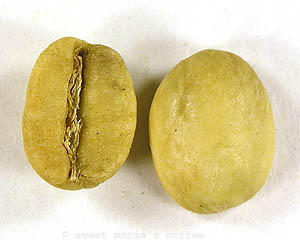
4. Yellow-Brown Stage (6:30 — 345°F / 174°C)
Beans turn yellow-brown with faint marble patterns. Still no expansion. A slightly humid baked-wheat aroma develops. Some beans, like Costa Rica or Mexico origins, may appear brighter at this stage.

5. Light Brown Stage (8:00 — 370°F / 188°C)
Approaching first crack. Some beans show slight expansion, middle cracks begin opening, and silver skin starts to loosen.
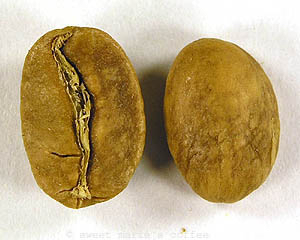
6. Brown Stage (9:00 — 393°F / 200°C)
Nearing first crack. Beans rapidly darken due to caramelization and, more critically, the Maillard reaction (the same one that browns steak).

7. First Crack Begins (9:20 — 401°F / 205°C)
Listen for sporadic, light popping — like popcorn. This is first crack. It’s distinct from the later, louder second crack. Internal bean temp here is ~356°F, though external thermometers read 401°F.

8. First Crack Ongoing (10:00 — 415°F / 213°C)
Beans expand, midline opens fully, and remaining silver skin detaches. Steam escapes. First crack is exothermic — beans cool slightly, then reheat. If your roaster can’t compensate, you risk a stalled reaction and off-flavors (like baked or astringent notes) due to interrupted sugar polymerization. Sucrose melts at 370°F.

9. First Crack Ends (10:40 — 426°F / 219°C)
This is the City roast stage. Surface is smoother but still shows fine dark markings. Expansion comes from CO₂ and steam release.

10. City+ (11:05 — 435°F / 224°C)
A brief endothermic phase just before second crack. Wood fiber structure weakens. Color darkens quickly, but temperature rise slows.

11. Light Vienna / City++ (11:30 — 444°F / 229°C)
Approaching second crack. Light dark roasts hover near the edge. Fiber reactions vary by origin, density, and bean structure. Ordered fibers react more predictably than disordered ones.

12. Deep City+ / Beginning of Second Crack (11:50 — 454°F / 234.5°C)
Second crack is imminent. Color darkens fast. Compare this to earlier City+ stages — the difference is clear. Sound, not color, is the better indicator.

13. Vienna to Light French (12:15 — 465°F / 240.5°C)
Here, origin character begins fading behind roast flavors. Some beans still shine, but most complexity gives way to roast texture. Italian-style espresso often lands here (core temp 440–446°F). Southern Italian espressos may match lighter French roasts.

14. French Roast (12:40 — 474°F / 245.6°C)
Sugars heavily caramelize and break down. Wood structure carbonizes. Weight drops as volume increases. Aroma compounds burn off, creating smoke. 474°F exceeds normal Probat limits; 465°F is safer.

15. Fully Carbonized (13:00 — 486°F / 252°C)
Over 25% of beans are ash. The rest are burnt husks. Avoid this stage. Often wrongly labeled as “Spanish” or “Italian” roast.

16. Ignition Point (13:30 — 497°F / 258°C)
Beans are near combustion. With enough airflow, flames can ignite when discharged. For large batches, consult fire services before attempting this temp.

FAQ
How can I tell roast level by sight alone?
Don’t rely only on color — it’s inconsistent due to bean variety, processing, and roast style. Instead, combine visual cues with audio (first and second cracks) and aroma (grassiness, toastiness, burning). Even then, some beans (like dark Sumatrans or Kenyans) may mislead visually.
What’s the difference between City and City+ roast?
City roast ends at first crack (~401–426°F / 205–219°C), with a smoother surface and mild origin notes. City+ is a few degrees past first crack (up to ~435°F / 224°C), just before second crack begins — still light but slightly darker and bolder.
When does second crack start?
Second crack usually begins around 444–454°F (229–234.5°C), after a brief endothermic pause. It sounds like Rice Krispies — faster and sharper than first crack — and signals a shift to darker French and beyond.
Does roast color always match roast level?
No. Natural-processed beans, certain origins (like Kenya or Sumatra), and roast inconsistencies can make beans look darker or lighter than they really are. Always confirm with sound and aroma.
What roast level best shows origin flavor?
Most specialty roasters aim for City to City+ (first crack to just past it), where origin traits are brightest and roast impact is minimal. Darker roasts emphasize roast flavors over bean characteristics.
Is there a “best” roast for all coffees?
No single roast style suits all beans. Lighter roasts highlight acidity and origin; darker roasts emphasize body and sweetness but can mask terroir. The optimal roast depends on the coffee’s profile and the roaster’s goal.
FrontStreet Coffee Picks for Roast-Level Exploration
Try FrontStreet’s Ethiopia Yirgacheffe for bright citrus and floral notes in a City roast, or their Colombia Huila for balanced caramel and nuttiness ideal at City+. For darker profiles, their Sumatra Mandheling showcases earthy spice tones that develop well into Vienna and light French ranges. Freshly roasted within 5 days · Orders placed before 17:00 ship the same day · Next-day delivery across most of Guangdong Province.
FrontStreet Coffee is a long-established specialty coffee roaster in Guangzhou China, selling freshly roasted beans from its own farm in Yunnan as well as dozens of carefully selected single-origin beans from around the world for both pour-over and espresso. The products deliver consistently excellent quality and great value, with shipping within 24 hours. Guangzhou's FrontStreet Coffee shop is recommended by many coffee lovers, and the beans are now available online at the Tmall 。
Important Notice :
前街咖啡 FrontStreet Coffee has moved to new addredd:
FrontStreet Coffee Address: 315,Donghua East Road,GuangZhou
Tel:020 38364473