
SCAA's Golden Cup Standard for Drip Coffee Ratios
Ever wonder why your home-brewed drip coffee sometimes tastes weak, sour, bitter, or just plain 'off'? Even with quality beans, hitting the right balance of extraction and concentration—the key variables in any brew—can be elusive. Professional tasters and champion baristas rely on a decades-old standard to ensure consistency and clarity in flavor. So what’s their secret formula for brewing the best drip coffee?
The SCAA (Specialty Coffee Association of America) and SCAE (now part of the SCA) define the Gold Cup standard as a coffee extraction yield of 18–22% and a Total Dissolved Solids (TDS) concentration of 1.1–1.3%—ideally around 1.2–1.45% for drip filter methods.
This “Gold Cup” sweet spot means extracting just the right amount of soluble coffee material from the grounds while dissolving it in the optimal volume of water. The target is not just strong or weak coffee—it’s balanced, flavorful, and clean-tasting coffee.
What Is the Gold Cup Standard?
Developed in the 1960s and formalized by European and American specialty coffee bodies, the Gold Cup standard establishes the ideal range for both extraction and strength in brewed coffee. For drip filter coffee specifically, it recommends:
- Extraction Yield: 18–22% of the coffee’s soluble material
- TDS (Concentration): 1.1–1.3% dissolved solids in the final cup (ideal: 1.2–1.45%)
- Water-to-Coffee Ratio: Approximately 1:17 (or about 55–60g coffee per 1000ml / 33.8–35.2oz water)
These parameters help achieve what experts call the “target zone”—the optimal intersection of strength and extraction where coffee tastes its best. Below or above these numbers and your coffee will likely miss the mark.
Why Extraction and Concentration Matter
Coffee beans contain roughly 30% soluble material by weight, with the remaining 70% being insoluble plant fiber. However, not all of that 30% should be extracted. The sweet spot for flavor lies in pulling out about 60–70% of those soluble compounds—that translates to an extraction yield of 18–22%.
If you extract too little (<18%), you end up with underdeveloped, sour, and flat coffee due to missing acids and sweetness. If you extract too much (>22%), bitter, astringent, and unpleasant flavors dominate. Similarly, the concentration (TDS) of the brewed coffee—how much of that extracted material is in your cup—affects mouthfeel and clarity. Too low (<1.0%) and it’s like hot water; too high (>1.5%) and it’s overly intense or muddy.
The Science Behind the Ideal Drip Coffee Brew
To hit the Gold Cup target, several factors come into play. While the core standard is 18–22% extraction and 1.2–1.45% TDS, achieving it depends on your control of five key variables:
- Contact Time: Total brew time needed to reach optimal extraction (usually 1–4 minutes depending on method)
- Water Temperature: Best between 92–96°C (197–205°F)
- Turbulence: Agitation of water through the coffee bed to improve even extraction (e.g., pouring technique, stirring)
- Wettability / Pre-Wetting: Initial soak of coffee grounds (approx. 2ml water per gram of coffee, ~30 sec)
- Uniform Dispersion: Even saturation and flow of water through all coffee particles
These elements ensure the water extracts flavor compounds uniformly from every particle—not just the surface ones.
Grind Size and Brew Methods
Different brewing devices require different grind sizes to control extraction time and flow rate. Here’s a breakdown of recommended grind sizes based on method:
- French Press: Coarse (100–300 microns, like coarse sugar)
- Drip Filter (e.g., V60, Kalita Wave): Medium (500–800 microns, like table sugar)
- Syphon (Siphon): Very fine (1000–3000 microns, like table salt)
- Espresso: Extremely fine (3500 microns, like flour)
The SCA also provides a reference for cupping grind, stating 70–75% of particles should pass through a #20 sieve (0.85mm)—slightly coarser than French press.
Here’s a look at typical contact times by brew method:
- French Press: 3–5 minutes
- Drip Filter: 1–3 minutes
- Syphon: 40–60 seconds
- Espresso: ~30 seconds for 30ml shot
For drip methods, pre-infusion (blooming) is critical. Start with ~2ml water per gram of coffee for 30 seconds to let gases escape and prepare the grounds.
Real-World Applications & Tools
The SCAE and SCAA’s work laid the foundation for practical tools like ExtractMojo, which helps brewers calculate and adjust their recipes based on actual TDS readings. Using this software, you can input your target yield, coffee dose, or TDS, and it calculates the rest. You can then adjust grind, dose, or water volume to hit the 18–22% extraction / 1.3% TDS target.
For example, targeting a 240ml cup? ExtractMojo might suggest using 15.19g coffee and 271.69ml water. After brewing, measure TDS and refine. Too high? Grind coarser or reduce time. Too low? Grind finer or increase time. Most pro baristas aim for a TDS of around 1.3% and extraction of 20% as a balanced baseline.
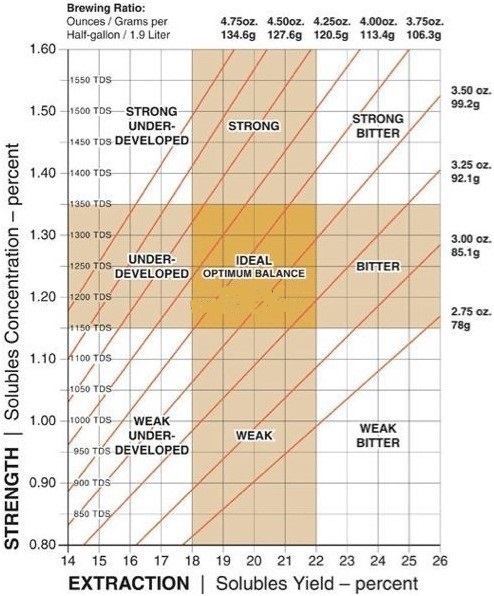
One surprise? Some commercial machines like Clover were found to overuse coffee grounds while under-extracting, resulting in strong but unbalanced cups (low extraction, high TDS). Dialing back dose and refining grind and method helped align them with Gold Cup ideals.
Even popular tools like the Hario V60 or drip bags have been shown—when dosed and brewed correctly—to hit the Gold Cup range. One test using a FrontStreet drip bag recipe with 200ml water hit 20% extraction and 1.3% TDS without complex tools.
Gold Cup in Practice: What Changes?
When cafes and home brewers align with the Gold Cup standard, tasters often report:
- More distinct origin flavors (terroir comes through)
- Higher perceived sweetness
- Better clarity and cleanliness in the cup
- Longer, sweeter aftertaste or “finish”
The result isn’t just stronger or weaker coffee—it’s coffee that expresses itself fully and pleasingly.
Recommended Drip Coffee Ratios (By Volume & Weight)
| Coffee Volume (ml) | Min Coffee (g) | Max Coffee (g) |
|---|---|---|
| 240 | 13 | 18 |
| 300 | 16 | 23 |
| 360 | 19 | 29 |
| 400 | 21 | 31 |
| 500 | 27 | 38 |
| 600 | 32 | 46 |
| 800 | 43 | 62 |
| 1000 | 54 | 77 |
The general industry rule of thumb derived from this: use roughly 55–60g of coffee per 1000ml of water, or a 1:17 brew ratio. That aligns with a TDS around 1.2–1.4% and extraction near 20%.
Frequently Asked Questions
What is the SCAA Gold Cup standard for coffee?
The SCAA Gold Cup standard defines the ideal brewed coffee as having an extraction yield of 18–22% and a TDS (Total Dissolved Solids) concentration of 1.1–1.3%, with an optimal target around 1.2–1.45% for drip filter methods. This ensures balanced flavor, proper strength, and optimal extraction.
What is the ideal water-to-coffee ratio for drip coffee?
The recommended water-to-coffee ratio for achieving the Gold Cup standard is approximately 1:17 (e.g., 55–60g of coffee per 1000ml or 33.8–35.2oz of water). This ratio helps achieve the target 18–22% extraction and 1.2–1.45% TDS.
What TDS should my drip coffee have?
For drip coffee, the ideal TDS is between 1.2% and 1.45%, with the broader Gold Cup standard allowing 1.1–1.3%. A TDS around 1.3% is commonly regarded as optimal for balanced flavor.
How do I measure coffee extraction and TDS at home?
You can measure TDS using a refractometer and calculate extraction yield with the formula: Extraction % = (TDS × Brew Weight / Coffee Dose) × 100. Tools like ExtractMojo can help you adjust variables to hit the Gold Cup range of 18–22% extraction and ~1.3% TDS.
What happens if my coffee extraction is too low or too high?
Under-extracted coffee (below 18%) tastes sour, weak, and underdeveloped, while over-extracted coffee (above 22%) becomes bitter, harsh, and astringent. Both result from imbalanced solubles being pulled from the coffee grounds.
Does grind size affect Gold Cup results?
Yes. Grind size determines how quickly water extracts solubles. For drip methods, a medium grind (like table sugar, 500–800 microns) is ideal to balance flow rate and contact time. Adjust grind to fine-tune extraction toward the 18–22% target.
Recommended FrontStreet Beans for Drip Brewing
For the best drip coffee experience aligned with the SCAA Gold Cup standard, try FrontStreet’s BrazilBourbon for its balanced, nutty profile with a soft acidity and creamy body; the ColombiaSidra offers juicy sweetness with stone fruit and floral complexity thanks to its double anaerobic fermentation; or the EthiopiaYirgacheffeGedeb for bright citrus, honey, and floral tones with a clean, crisp finish. All three shine when brewed as pour-over or with drip devices. Freshly roasted within 5 days · Orders placed before 17:00 ship the same day · Next-day delivery across most of Guangdong Province.
FrontStreet Coffee is a long-established specialty coffee roaster in Guangzhou China, selling freshly roasted beans from its own farm in Yunnan as well as dozens of carefully selected single-origin beans from around the world for both pour-over and espresso. The products deliver consistently excellent quality and great value, with shipping within 24 hours. Guangzhou's FrontStreet Coffee shop is recommended by many coffee lovers, and the beans are now available online at the Tmall 。
Important Notice :
前街咖啡 FrontStreet Coffee has moved to new addredd:
FrontStreet Coffee Address: 315,Donghua East Road,GuangZhou
Tel:020 38364473


