How to Steam Milk for Better Espresso Drinks
If your cappuccinos have big bubbles, your lattes lack texture, or your milk just won’t pour right, you're not alone. Steaming milk to the perfect texture isn't intuitive — it's a technical skill that trips up beginners and experienced baristas alike. Getting it right changes everything about how your espresso drinks taste and look.
To steam great milk, you need to hit two key temperatures (around human body temp to start, then between 65–70°C / 149–158°F), create a proper whirlpool to fold microfoam, and avoid common mistakes like overfilling the pitcher or leaving dry milk on top. Here’s exactly how to do it, step by step.
How Milk Steaming Actually Works
Before you even touch the steam wand, understand the basics. Start with cold milk — ideally around 5°C (41°F) — straight from the fridge. Cold milk gives you more time to stretch and texture it properly. The goal is to create microfoam: tiny, velvety bubbles that integrate smoothly with the milk, not big, dry foam sitting on top.
Here’s your step-by-step process:
1. Purge the Steam Wand First
Always purge your steam wand before and after use. This clears condensation and keeps things hygienic. It’s a small step that matters for consistency and cleanliness.
2. Position the Steam Wand Correctly
Place the tip of the steam wand just below the milk’s surface. The exact depth and position matter — too high and you get big bubbles; too deep and you don’t stretch the milk. Angle the pitcher so the wand’s tip is slightly off-center, creating a vortex (whirlpool) in the milk.
3. Stretching Phase: Introduce Air
When the milk is cold (around body temp), lower the pitcher slightly so the wand tip breaks the surface and sucks in air. You’ll hear a hissing “tearing” sound — that’s air being added. This phase is called stretching and builds the foam. Do it until the milk is around body temperature (~30°C / 86°F), which is when you stop adding air.
4. Heating & Rolling Phase: Create Microfoam
Once you’ve stopped adding air, sink the wand deeper into the milk to create a whirlpool. This rolling motion integrates the foam into the milk, smoothing it out. Heat the milk further until it’s between 65–70°C (149–158°F). At this point, the pitcher should feel too hot to hold for more than a couple of seconds. That’s your finish point.
5. The “Dead Angle” & Finding the Vortex
Many baristas find that holding the pitcher at a slight angle, with the spout raised, helps control the vortex. The steam wand shouldn’t go too deep — aim to create a spinning motion that pulls surface foam downward. This helps create a smooth surface free of large bubbles.
6. Stop Steaming at the Right Time
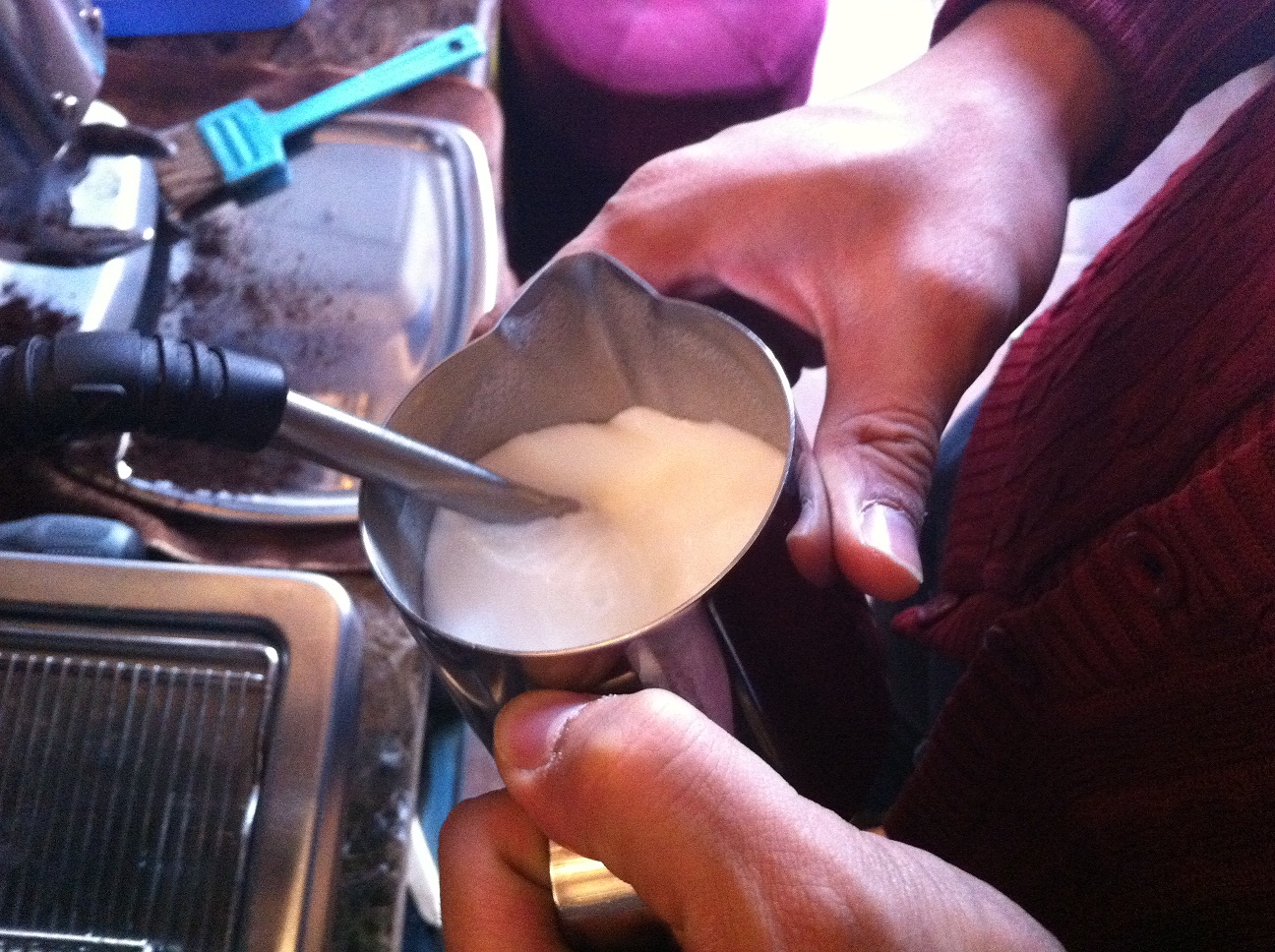
When the milk reaches 65–70°C (149–158°F) and the pitcher is almost too hot to touch, turn off the steam. Overheating above ~70°C (158°F) scalds the milk, ruins the texture, and reduces sweetness.
What Makes Good Steamed Milk?
Great steamed milk has three key traits:
- Microfoam: Tiny, smooth bubbles that feel velvety and look shiny.
- Silky Texture: No big bubbles — the surface should be bubble-free and reflective.
- Even Temperature: Consistent heat throughout the pitcher, with no separated layers.
The milk should look glossy, pour smoothly, and integrate fully with the espresso. If you see dry, coarse foam on top, you’ve got work to do.
Common Milk Steaming Mistakes
Even small errors ruin milk texture. Avoid these:
- Overfilling the Pitcher: Don’t steam milk to the brim. Leave room to swirl and pour.
- Leaving Big Bubbles: Don’t rely solely on shaking or tapping to remove bubbles — fix the steaming technique instead.
- Letting Milk Sit After Steaming: Don’t let steamed milk sit before pouring. It separates quickly.
- Poor Wand Positioning: Keep the wand near the surface to stretch, then deeper to roll. Depth control is crucial.
- Ignoring Temperature: If you can’t comfortably hold the pitcher for a couple of seconds, it’s too hot.
Fixing Milk Pouring Problems
Can’t get your milk to pour nicely into espresso? These tips help:
- Too Much Dry Foam? Steam less milk or stretch it less to reduce foam volume.
- Espresso Crema Too Shallow? Tilt the cup to increase depth and pour into the center.
- Milk Not Piercing Crema? Hold the pitcher higher (10–15 cm) to increase pour speed.
- White Layer on Top? Reduce flow, circle the cup to blend, then lift the pitcher to form the design.
- Crema Breaking Up? Pour gently in a circular motion to integrate before starting the pattern.
- Lack of Control When Pouring? Choose your latte art design based on your milk texture — thinner milk for finer details, thicker for bolder patterns.
A good rule of thumb: your milk should be completely pourable with no separation, no big bubbles, and a smooth, glossy texture. The ideal cappuccino pour uses all the milk with nothing left in the pitcher.
What to Aim For: Quality Standards
Top-tier steamed milk meets these four standards:
- The surface is shiny with zero visible coarse bubbles (over 1 mm).
- Temperature is consistent no matter how much milk you steam.
- You use just the right amount — no wasted milk left in the pitcher.
- The milk has no ongoing hissing or cracking sounds — a sign of poor texture.
- Wet Cappuccino: 60–70% full — great for latte art and smoother drinks.
- Dry Cappuccino: Fully stretched foam — thick and dry, with very little liquid milk.
- Half Cappuccino: Around 80% full — balanced texture, ideal for classic cappuccinos.

These details separate average milk from professional-grade microfoam. Also, cappuccinos can be categorized by foam volume:
Frequently Asked Questions
What’s the ideal milk temperature for steaming?
The optimal range is between 65–70°C (149–158°F). Start stretching the milk at body temperature (~30°C / 86°F), then heat until the pitcher is too hot to hold for more than a couple of seconds. Going over 70°C risks scorching the milk and degrading flavor.
How do I avoid big bubbles in my milk?
Big bubbles happen when the steam wand tip is too high or you introduce too much air. Position the wand just below the surface to stretch the milk properly, then sink it deeper to create a whirlpool that integrates the foam. Always tap or swirl the milk gently after steaming to help merge any remaining bubbles.
Why does my milk separate after steaming?
Milk separates when it sits too long after steaming. Always pour your milk soon after steaming. Don’t let it rest in the pitcher — the heat causes the liquid and foam layers to split, ruining texture and pourability.
How do I know when to stop steaming?
Stop steaming when the milk temperature reaches 65–70°C (149–158°F). The pitcher should feel too hot to hold for more than a couple of seconds. Overheating leads to burnt flavors and destroys the milk’s natural sweetness.
What’s the best way to create microfoam?
Microfoam comes from properly stretching cold milk and then rolling it into a vortex. Start by introducing air just below the surface until the milk warms to body temp, then sink the wand deeper and create a whirlpool to blend the foam smoothly into the milk.
Can I fix bad milk texture after steaming?
You can improve texture slightly by swirling or tapping the pitcher, but the best results come from proper technique during steaming. Relying on post-steam fixes means your fundamentals need work. Focus on wand depth, angle, and temperature control.
Recommended FrontStreet Beans for Milk-Based Drinks
For silky cappuccinos and lattes, FrontStreet Coffee’s Classic Blend delivers the smooth body and rich crema needed for great milk drinks. Its well-rounded profile works beautifully under steamed milk. For a more chocolatey twist, try the Black Cocoa Blend — it enhances milk drinks with deep cocoa sweetness. Both blends are optimized for espresso brewing and produce excellent crema, ensuring smooth integration with milk. Freshly roasted within 5 days · Orders placed before 17:00 ship the same day · Next-day delivery across most of Guangdong Province.
FrontStreet Coffee is a long-established specialty coffee roaster in Guangzhou China, selling freshly roasted beans from its own farm in Yunnan as well as dozens of carefully selected single-origin beans from around the world for both pour-over and espresso. The products deliver consistently excellent quality and great value, with shipping within 24 hours. Guangzhou's FrontStreet Coffee shop is recommended by many coffee lovers, and the beans are now available online at the Tmall 。
Important Notice :
前街咖啡 FrontStreet Coffee has moved to new addredd:
FrontStreet Coffee Address: 315,Donghua East Road,GuangZhou
Tel:020 38364473