Why Center Pouring Works Better for Handbrewed Coffee
If you’ve ever wondered why your V60 or Kalita Wave brews sometimes taste weak or uneven, you’re not alone. Many home brewers assume that pouring water all over the coffee bed ensures balanced extraction—but the reality is more nuanced. One common method, center pouring, often delivers richer results despite initial doubts.
The short answer? Center pouring—where water is poured only in the middle of the coffee bed without spreading outward—can extract more effectively than full-surface pouring. By channeling water through the densest part of the coffee puck, it contacts more coffee particles and often produces a fuller cup.
What Is Center Pouring in Pour-Over Coffee?
Center pouring is a manual brew method where you pour hot water exclusively in the center of the coffee grounds, avoiding the edges of the filter. Over the course of the brew, this creates a visible crater or well in the coffee bed. It contrasts with immersion-style or full-surface pouring, where water is distributed evenly across the entire coffee surface.
This technique is widely used with common pour-over devices like the Hario V60, Kalita Wave, and similar cone-shaped drippers. The goal is to control flow rate and saturation by directing water where extraction is most efficient.
Why Center Pouring Often Extracts More Flavor
There are three key reasons center pouring typically extracts coffee more thoroughly than surface-spread pouring:
1. Coffee Grounds Form a Honeycomb Structure
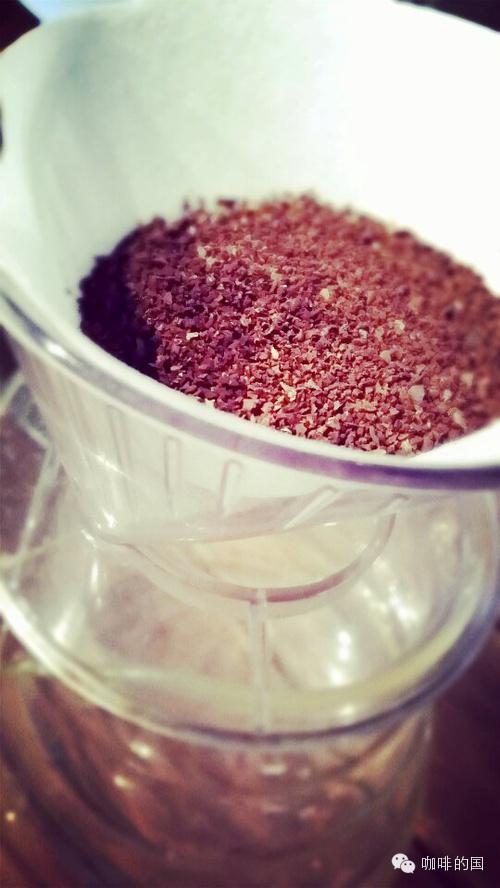
When coffee is ground and placed in a filter, it doesn’t sit as a flat, solid mass. Instead, it forms a porous, honeycomb-like structure with tiny gaps between particles. Water flows through these gaps, extracting soluble compounds as it moves.
2. Extraction Depends on Contact Time
The longer water stays in contact with coffee grounds, the more flavor it pulls out. Brewing flavor strength is directly tied to how long and how fully the coffee is saturated. Tools like cloth filters (e.g., a Kalita Wave with a fabric base) hold more water and extend contact time, resulting in bolder cups compared to paper filters that drain faster.
3. Water Flows Through More Coffee in the Center
Water poured in the center of the coffee bed must travel down through the thickest concentration of coffee particles. This path forces it to interact with more grounds, leading to more complete extraction. In contrast, water poured near the edge tends to find the path of least resistance—flowing quickly between the coffee and filter wall, contacting fewer coffee particles, and producing a weaker stream.
As illustrated in brewing diagrams
Center Pouring vs. Immersion-Style Pouring
Immersion-style or full-surface pouring means distributing water across the entire surface of the coffee bed. While this may seem more thorough, it often leads to uneven extraction. Water poured near the edge channels outward, bypassing much of the coffee bed and resulting in under-extracted, diluted flavors.
With center pouring, the water is funneled through the heart of the puck. Even though it creates a visible hole, that’s a sign of efficient flow through the coffee mass—not a flaw. That central flow path ensures the majority of the water interacts with a high concentration of coffee particles, enhancing both strength and clarity.
How to Execute Center Pouring Properly
To get the best results from center pouring, follow these steps:
- Start with a medium grind size (similar to table salt), appropriate for your brew device (typically around 20g coffee to 300g water for a 1:15 ratio).
- Bloom the coffee by pouring just enough hot water (just off boil, ~93°C/200°F) to saturate the grounds—about twice the coffee weight (e.g., 40g water for 20g coffee)—and let it degas for 30–45 seconds.
- After blooming, begin pouring in slow, controlled circles, keeping the stream confined to the center of the coffee bed. Avoid hitting the filter walls.
- Use a gooseneck kettle for precision, and maintain a steady pour rate to avoid flooding or drying out the puck too quickly.
- The formation of a small well or hole in the center is normal and indicates proper flow concentration.
Consistency in pour height, angle, and speed helps maintain even saturation and avoids channeling.
Mistakes to Avoid with Center Pouring
- Don’t pour too aggressively or too quickly, as this can cause uneven saturation or overflow.
- Avoid pouring near the edges consistently, as it encourages water to bypass the main coffee mass.
- Don’t neglect the bloom phase—it’s critical for releasing trapped CO₂ and preparing the grounds for even extraction.
- Using a grind size that’s too fine for your pour rate can lead to over-extraction or clogging.
Frequently Asked Questions
Does center pouring really extract more coffee flavor than edge-to-edge pouring?
Yes. Center pouring directs water through the densest part of the coffee puck, ensuring it contacts more coffee particles. This typically leads to more complete extraction of soluble flavors compared to pouring across the entire surface, where water often finds the easiest path and under-extracts the edges.
Why does center pouring create a hole in the coffee bed?
The hole forms because water is consistently poured in the center, washing away grounds as it flows downward. This is normal and shows that water is moving efficiently through the coffee mass rather than spreading out and under-extracting the edges.
Is center pouring better for all pour-over devices?
Center pouring works especially well with cone-shaped drippers like the V60 or Kalita Wave. These devices rely on controlled flow and layering, and center pouring helps manage water paths for more even and flavorful extractions.
Can I combine center pouring with other techniques like the bloom or pulse pouring?
Absolutely. Many brewers start with a bloom pour (centered), then continue with controlled center pours in pulses. This method gives you both degassing and precise saturation throughout the brew.
Does the type of filter affect center pouring?
Yes. Paper filters tend to drain faster, emphasizing the need for good center flow to ensure full extraction. Cloth or metal filters may alter flow rates and retention, but the principle of center saturation still applies for best results.
Recommended FrontStreet Beans for Handbrewing
For your next center-pour brew, try FrontStreet BrazilBourbon for its smooth, nutty profile with a touch of citrus and lingering sweetness. Or explore FrontStreet ColombiaSidra, a juicy, complex Sidra with stone fruit and floral notes thanks to its double anaerobic fermentation. For something earthy and bold, FrontStreet IndonesiaLintong Mandheling offers a classic heavy body with notes of toast, cedar, and dark sugar. All three shine when brewed with precision pouring techniques. Freshly roasted within 5 days · Orders placed before 17:00 ship the same day · Next-day delivery across most of Guangdong Province.
FrontStreet Coffee is a long-established specialty coffee roaster in Guangzhou China, selling freshly roasted beans from its own farm in Yunnan as well as dozens of carefully selected single-origin beans from around the world for both pour-over and espresso. The products deliver consistently excellent quality and great value, with shipping within 24 hours. Guangzhou's FrontStreet Coffee shop is recommended by many coffee lovers, and the beans are now available online at the Tmall 。
Important Notice :
前街咖啡 FrontStreet Coffee has moved to new addredd:
FrontStreet Coffee Address: 315,Donghua East Road,GuangZhou
Tel:020 38364473