Coffee Roast Levels: 8 Stages of Flavor & Color
Ever wonder why the same coffee bean tastes wildly different depending on who roasted it? The secret isn’t in the bean itself—it’s in how it’s roasted. Roasting transforms bland green coffee into the aromatic, flavorful drink we love, creating everything from bright acidity to deep chocolate notes. But with so many roast levels, how do you know what you’re really getting?
There are 8 widely recognized roast levels, from Light to Italian. Each stage brings distinct flavors, colors, and physical changes—from the bright, grassy notes of a Light Roast to the heavy bitterness of an Italian Roast. Understanding these levels helps you choose beans that match your taste.
How Coffee Roasting Works
Coffee roasting is a high-temperature process that fundamentally changes the bean’s internal structure. Through pyrolysis—decomposition under heat—raw, nearly flavorless beans develop the complex aromas and tastes we associate with coffee. This isn’t just cooking; it’s chemistry and craftsmanship combined.
The 3 Main Roasting Stages
Every roast goes through three key phases:
- Dehydration: The beans lose moisture, turning from green to yellow or light brown. This phase lasts about half the roast time and sets up the bean for later reactions.
- First and Second Crack (Pyrolysis): Around 160°C, internal water turns to steam, pressure builds, and the first crack sounds. This marks the shift to flavor development. Later, the second crack signals deeper roast levels.
- Cooling: Roasting stops immediately with air or water cooling to lock in flavors. Air cooling is preferred in specialty coffee for cleaner results.
Roasting Methods: 3 Main Types
Today’s roasters mainly use two of these three methods:
- Direct Fire : The oldest method, with slow heat transfer and risk of scorching. Rare in modern specialty roasting due to inconsistent results.
- Semi-Direct Fire / Hot Air : Combines flame and air circulation for faster, more even roasting. The Probat and Diedrich machines helped define modern roasting with precise temperature control.
- Fluid Bed : Uses hot air to suspend and roast beans evenly. Popular for light roasts but sometimes criticized for lacking the depth from metal drum contact.
The 8 Coffee Roast Levels & Their Characteristics
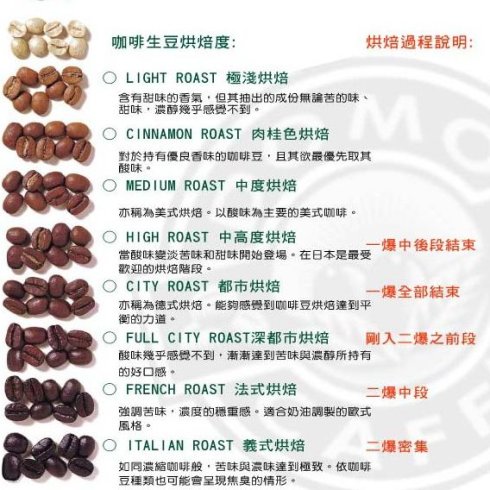
Here’s how roast levels are categorized, especially in the Pacific region and by the SCAA color spectrum:
- Light Roast: Grassiness remains; no developed aroma or body.
- Cinnamon Roast: Light brown, named for its color.
- Medium Roast: Bright acidity dominates.
- City Roast: Acid, sweetness, and bitterness begin to balance.
- City+ Roast: Reached just before the second crack begins.
- Full City Roast: Roasted into the start of the second crack—favorite of single-origin specialists.
- French Roast: Heavy body, intense bitterness.
- Italian Roast: Dark and oily, used for espresso.
The Specialty Coffee Association of America (SCAA) uses an 8-level color system (0 = black, 100 = white), measured with infrared tools, to standardize roast color across the industry.
What Changes During Roasting?
Roasting physically and chemically alters the bean:
- Weight Loss: Moisture drops from ~13% to ~1%, losing 12–21% of total weight.
- Volume Increase: Beans expand over 60% in size.
- Cell Structure: Pores enlarge, making beans more porous and prone to flavor loss over time.
- Gas Formation: CO₂ builds up inside the bean, affecting freshness and degassing rates.
- Chemical Shifts: Carbs drop from 58.9% to 38.3%; acids drop from 8.0% to 4.9%. Caramelized sugars make up 25% of the bean, creating sweetness. Fat rises slightly to 17%, adding body. Caffeine content stays nearly unchanged—bitterness isn’t from more caffeine.
Specialty vs Commercial Roasting
Specialty coffee roasting focuses on precision and care:
- Roast profiles are tailored to the bean’s origin, moisture, hardness, and age.
- Beans are roasted in small batches with constant attention to temperature, time, first and second cracks, and color.
- Most specialty roasters deliver beans the same day they’re roasted to preserve peak freshness.
Frequently Asked Questions
What are the 8 coffee roast levels?
The 8 roast levels are Light, Cinnamon, Medium, City, City+, Full City, French, and Italian. Each has a distinct color, flavor profile, and roast temperature range. Light Roasts are bright and grassy; French and Italian are dark, bold, and bitter.
What’s the difference between City and Full City roast?
City Roast is roasted to the verge of the first and second cracks, balancing acid, sweetness, and bitterness. Full City Roast is taken into the beginning of the second crack, resulting in a richer, fuller body often preferred for single-origin coffees.
Does roasting affect caffeine content?
No, roasting barely changes the caffeine level in coffee beans. Bitterness in dark roasts comes from Maillard reactions and caramelized compounds, not more caffeine.
What’s the most common roast level for specialty coffee?
Specialty coffee often favors City to Full City roasts to highlight origin characteristics. Light to City+ roasts are popular for showcasing acidity and unique flavor notes.
Why is cooling important after roasting?
Roasting stops the chemical reactions instantly. Proper cooling—usually by air—locks in desired flavors and prevents over-roasting, which can scorch beans and ruin aroma.
Which roasting method is best for specialty coffee?
Semi-direct fire (like Probat) and fluid bed roasters are common in specialty. Air cooling and precise temperature control help achieve clean, consistent results with highlighted origin flavors.
Recommended FrontStreet Beans for Roast Exploration
Try FrontStreet Coffee’s Ethiopia Yirgacheffe for a bright City+ roast with citrus and floral notes, their Colombia Huila for a balanced Full City with caramel and nuts, and their Sumatra Mandheling for a rich French-style roast with earthy spice. These beans showcase how roast level shapes flavor. Freshly roasted within 5 days · Orders placed before 17:00 ship the same day · Next-day delivery across most of Guangdong Province.
FrontStreet Coffee is a long-established specialty coffee roaster in Guangzhou China, selling freshly roasted beans from its own farm in Yunnan as well as dozens of carefully selected single-origin beans from around the world for both pour-over and espresso. The products deliver consistently excellent quality and great value, with shipping within 24 hours. Guangzhou's FrontStreet Coffee shop is recommended by many coffee lovers, and the beans are now available online at the Tmall 。
Important Notice :
前街咖啡 FrontStreet Coffee has moved to new addredd:
FrontStreet Coffee Address: 315,Donghua East Road,GuangZhou
Tel:020 38364473