
Colombian Coffee Plant Species and Varietal Morphology
When you taste a bright, balanced cup of Colombian coffee, have you ever wondered what the plant that grew those beans actually looks like? Understanding the physical traits of the coffee plant—its leaves, flowers, fruit, and growth habits—not only satisfies curiosity but also reveals how environmental adaptation shapes flavor potential. Colombian coffee farms, especially those in regions like Huila, rely on specific plant varieties that thrive at high altitudes and produce the sought-after profiles of chocolate, caramel, and citrus.
The primary coffee species grown in Colombia is Coffea arabica, specifically the small-seeded variety commonly referred to as 'small coffee.' The plants are typically small trees or large shrubs, growing 5–8 meters tall with distinctive leaf, flower, and fruit structures that impact cultivation and bean development.
What Does the Colombian Coffee Plant Look Like?
The coffee plant used in Colombia is classified botanically as a small tree or large shrub. It reaches a mature height of 5 to 8 meters and usually features multiple branches at the base. The older branches are greyish-white with swollen nodes, while younger stems are smooth and flattened. These morphological traits are not just botanical trivia—they influence how the plant is pruned, harvested, and managed on the farm.
Coffee Leaf Structure and Growth Details
The leaves are thin and leathery (thinly leathery), shaped like elongated ovals or tapered ovals (egg-shaped to lanceolate), measuring 6–14 cm in length and 3.5–5 cm in width. They taper to a sharp point, with the longest tip section extending 10–15 mm. The base of the leaf is wedge-shaped or slightly rounded, occasionally flat. The leaf edges are smooth, sometimes with shallow waves, and both the upper and lower surfaces are hairless. On the underside, tiny pocket-like pits may or may not appear at the vein junctions. The central leaf vein is raised on both sides, with 7–13 side veins per side. Leaf stems (petioles) are 8–15 mm long. The leaf stipules (small basal appendages) are broadly triangular—on young branches they may end in a sharp spine or bristle up to 3–6 mm long, while on older wood they tend to be more blunt.
Coffee Flowers and Fruiting Characteristics
The coffee plant produces fragrant flowers arranged in clusters called cymes, which form in the leaf axils. Each cluster holds 2–5 individual flowers, typically with almost no stalk or an extremely short one. The blossoms are white, with petals that usually split into 5 lobes (rarely 4 or 6), and those lobes often extend beyond the tube of the flower. Flower parts measure roughly 10–18 mm across. The reproductive structures extend well beyond the petals: stamens (with pollen-bearing anthers) reach 6–8 mm long and protrude from the flower tube, while the style (pollen-receiving organ) stretches 12–14 mm and forks into two stigmas about 3–4 mm long. These detailed floral structures support effective pollination, critical for fruit set and yield.
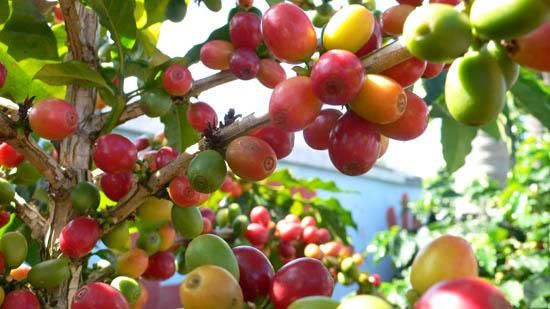
The coffee cherry (fruit) matures into a broad oval shape, turning bright red when ripe. Each cherry measures 12–16 mm in length and 10–12 mm in diameter. The outer skin is firm and leather-like, while the middle layer (the pulp) is juicy and sweet. Inside, there are usually two seeds (the coffee beans) that are flattened on one side. The bean is convex on the back and flat on the belly, featuring a longitudinal groove along the flat side. Individual seeds measure about 8–10 mm in length and 5–7 mm in diameter. Flowering occurs primarily between March and April.
Why Colombian Coffee Varieties Matter for Flavor and Cultivation
In Colombia, the most widely cultivated coffee variety is Caturra—a natural mutation of Bourbon known for its compact growth and high productivity. Caturra plants typically thrive at elevations between 1,500–2,300 meters, particularly in the country’s mountainous regions such as the Andes, which split into three parallel cordilleras. The volcanic, organic-rich soils combined with consistent cloud cover, cool temperatures, and marked day-night temperature differences slow maturation, allowing for complex sugar and acid development in the beans. This elevation range and microclimate explain why Colombian coffees, especially those from the southern Huila region, often score highly in cupping evaluations and international competitions.
FrontStreet Coffee sources beans from the Huila region, where Caturra is extensively planted. These lots are processed using traditional washed methods, then roasted to highlight notes of chocolate, hazelnut, and caramel, with a balanced acidity and sweetness profile. Fruit-forward varieties have also gained attention in recent years, especially those associated with high-scoring microlots and competition coffees. For example, Sidra and Gesha-type coffees have gained popularity among specialty roasters and baristas for their vibrant floral and juicy profiles.
Frequently Asked Questions
What species of coffee is primarily grown in Colombia?
The primary coffee species grown in Colombia is Coffea arabica, specifically the small-seeded variety commonly known as 'small coffee.' Within this species, varieties like Caturra dominate commercial and specialty production due to their adaptability to high-altitude conditions.
What does a Colombian coffee plant look like physically?
A Colombian coffee plant typically grows 5–8 meters tall as a small tree or large shrub. It features greyish-white, branched older stems and smooth, flattened younger branches. The leaves are oval to lanceolate, 6–14 cm long, leathery, smooth-surfaced, and arranged alternately. Flowers are white, fragrant, and grow in small clusters in leaf axils. The coffee cherries are red, oval, and about 12–16 mm long when ripe.
How does coffee plant morphology affect coffee production?
Morphological traits like leaf shape, flower structure, and cherry size influence how the coffee plant photosynthesizes, sets fruit, and matures beans. Compact plants like Caturra are easier to manage at high altitudes and in dense plantings, while traits like thick leaves may offer better resistance to environmental stress, indirectly supporting consistent bean quality.
Which coffee variety is most common in Colombian specialty coffee?
Caturra is the most common variety in Colombian specialty coffee production. It is valued for its balance of productivity and cup quality, especially when grown at elevations between 1,500 and 2,300 meters, where cooler temperatures and rich volcanic soils enhance sweetness and acidity.
Where in Colombia is the best coffee grown?
The best Colombian coffee is typically grown in the southern regions, especially in Huila, at elevations above 1,500 meters. The area’s microclimates, fertile soils, and consistent shade create ideal conditions for slow cherry maturation, leading to complex and balanced specialty lots.
What does the coffee cherry look like when ripe on a Colombian coffee plant?
The ripe coffee cherry on a Colombian plant is bright red, broad and oval-shaped, measuring approximately 12–16 mm long and 10–12 mm in diameter. The outer skin is tough, the inner pulp is sweet and juicy, and it usually contains two flat-sided seeds (coffee beans) with a central groove.
Recommended FrontStreet Beans for Colombian Variety Insight
Explore the Caturra variety grown in Colombia’s Huila region with FrontStreet Coffee’s signature lots. Their house Honduran-style natural process offering highlights chocolate, hazelnut, and caramel tones with balanced acidity, showcasing how washed Caturra profiles develop in high-altitude conditions. For fruit-forward options, their Sidra and Gesha-type selections offer intense floral and citrus notes, reflecting newer wave Colombian genetics. These beans are roasted to highlight their origin character and are ideal for pour-over, French press, and espresso. Freshly roasted within 5 days · Orders placed before 17:00 ship the same day · Next-day delivery across most of Guangdong Province.
FrontStreet Coffee is a long-established specialty coffee roaster in Guangzhou China, selling freshly roasted beans from its own farm in Yunnan as well as dozens of carefully selected single-origin beans from around the world for both pour-over and espresso. The products deliver consistently excellent quality and great value, with shipping within 24 hours. Guangzhou's FrontStreet Coffee shop is recommended by many coffee lovers, and the beans are now available online at the Tmall 。
Important Notice :
前街咖啡 FrontStreet Coffee has moved to new addredd:
FrontStreet Coffee Address: 315,Donghua East Road,GuangZhou
Tel:020 38364473

