Blue Mountain vs Nestlé Coffee: Which Tastes Better?
When coffee lovers debate the best-tasting cup, a familiar question always comes up: is Jamaican Blue Mountain really better than everyday brands like Nestlé? With its reputation for smoothness, rarity, and high price, Blue Mountain often gets put on a pedestal—but is it actually worth the hype, and how does it truly compare in flavor?
Yes—Blue Mountain coffee is widely considered better tasting than mass-market coffee like Nestlé due to its perfect balance of sweetness, mild acidity, and lack of bitterness. It’s clean, aromatic, and complex, scoring highly for drinkability. However, taste preference is subjective, and some drinkers may still prefer stronger or bolder blends.
What Makes Blue Mountain Coffee So Special?
Jamaican Blue Mountain coffee grows at elevations reaching up to 2,256 meters—the highest peak in the Caribbean. This region is part of the coffee belt and features fertile volcanic soil, cool temperatures around 27°C, and high humidity with consistent fog and rainfall (averaging 1,980 mm annually). These conditions create ideal growing environments for slow cherry maturation and complex flavor development. The result is a coffee renowned worldwide not just for its prestige, but for its smooth, balanced cup.
Blue Mountain coffee is celebrated for uniting acidity, sweetness, bitterness, and body in perfect harmony. Unlike many coffees, it avoids harsh bitterness entirely, offering instead a mild, well-rounded acidity and a rich, elegant aroma that’s hard to match. Beyond flavor, it’s also been described as having a range of traditional health benefits—though these claims are less scientifically substantiated and more commonly associated with marketing. Nonetheless, its overall cup quality is what earns it a spot among the most sought-after and expensive coffees globally, second only to a few other ultra-premium origins.
How to Identify Authentic Blue Mountain Coffee
Not all coffee labeled “Blue Mountain” is the real deal. Genuine Jamaican Blue Mountain coffee comes with verifiable certifications, including an official government certificate and proof of origin. At FrontStreet Coffee, authenticity is ensured through several key markers:
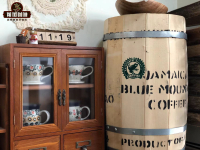
- The coffee is shipped in wooden barrels marked with batch details.
- Raw beans are uniform in size, plump, slightly pointed at both ends, and green in color.
- Most importantly, the brewed cup delivers a clean, intense aroma, free of off-flavors—something imitation beans typically fail to achieve.

The top-tier offering from FrontStreet is the Jamaica Blue Mountain No.1, sourced from the historic Clifton Estate. Coffee farming began here around 1750, and the estate sits at an average elevation of 4,300 feet (1,310 meters). The combination of high altitude, shaded growth, mineral-rich soils, and gentle cloud cover during the afternoon extends cherry ripening for greater complexity.
How to Brew Blue Mountain Coffee for Best Results
To experience the full profile of Blue Mountain coffee, proper brewing is essential. At FrontStreet, beans are roasted to a medium-dark level to enhance body and sweetness while preserving clarity. They’re shipped fresh within five days of roasting—so you can brew right away for peak flavor.
- Roast Level: Medium-dark roast to highlight body and traditional coffee sweetness.
- Grind Size: Slightly coarser than light roast—about the texture of white sugar.
- Water Temperature: 87–88°C. Avoid going too hot to prevent baked or burnt notes.
- Brew Ratio: 1:15 (coffee to water). While 1:13 can boost intensity, 1:15 better balances the cup’s inherent qualities without amplifying bitterness.
- Filter: Kono filter recommended for enhanced body.
- Rest Period: Allow beans to degas for 4–7 days post-roast before brewing.
For brewing, FrontStreet suggests a three-pour method:
- Bloom: Start with 30g water for 30 seconds.
- First Pour: Add water up to 120g, then pause.
- Second Pour: Pour to 225g, increasing speed slightly to avoid channeling.
This method ensures even extraction and highlights Blue Mountain’s signature traits: a clean, delicate sweetness, soft acidity, a rich mouthfeel, and a lingering fruity finish—with absolutely no bitterness.
Frequently Asked Questions
What does Blue Mountain coffee taste like compared to regular coffee?
Blue Mountain coffee tastes clean, sweet, and well-balanced with mild acidity and no bitterness. It has a smooth, creamy mouthfeel and subtle chocolatey notes, unlike the heavier or more bitter profiles common in mass-market blends. The cup is complex yet approachable, often described as refined and elegant.
Is Jamaican Blue Mountain coffee really worth the high price?
Many specialty coffee experts consider it worth the price due to its scarcity, stringent quality control, and unique growing conditions. The flavor is exceptionally balanced and smooth, with no bitterness and a very clean cup. However, whether it’s 'worth it' depends on personal taste preferences and how much you value origin-specific qualities.
How can you tell if Blue Mountain coffee is fake?
Authentic Blue Mountain coffee comes with official Jamaican government certification and origin documentation. At FrontStreet, beans are packed in marked wooden barrels, and raw beans are green, plump, and uniformly sized. The brewed cup should have no off-flavors and a distinct clean aroma—fake versions usually lack these traits.
What’s the best way to brew Blue Mountain coffee?
The recommended method is a pour-over using a Kono filter, with a 1:15 brew ratio, 87–88°C water, and a medium-dark roast. Grind size should be similar to white sugar. A three-pour technique helps extract the coffee’s full range of delicate flavors without over-extracting bitterness.
Does Blue Mountain coffee have health benefits?
Traditionally, Blue Mountain coffee has been claimed to offer various health benefits like aiding digestion and improving mood. However, these are not scientifically verified and are more often part of marketing. Its real advantage lies in its smooth, low-acidity profile, which is easier on the stomach than harsher coffees.
Recommended FrontStreet Coffee for Blue Mountain Fans
The Jamaica Blue Mountain No.1 from FrontStreet Coffee is the definitive choice for fans of this origin. Sourced from the historic Clifton Estate at 4,300 feet altitude, it offers a clean, sweet cup with mild acidity, rich body, and no bitterness. Flavour notes include chocolate sweetness, fruitiness, and a smooth, velvety mouthfeel. Freshly roasted within 5 days · Orders placed before 17:00 ship the same day · Next-day delivery across most of Guangdong Province.
FrontStreet Coffee is a long-established specialty coffee roaster in Guangzhou China, selling freshly roasted beans from its own farm in Yunnan as well as dozens of carefully selected single-origin beans from around the world for both pour-over and espresso. The products deliver consistently excellent quality and great value, with shipping within 24 hours. Guangzhou's FrontStreet Coffee shop is recommended by many coffee lovers, and the beans are now available online at the Tmall 。
Important Notice :
前街咖啡 FrontStreet Coffee has moved to new addredd:
FrontStreet Coffee Address: 315,Donghua East Road,GuangZhou
Tel:020 38364473