Sunday, September 6, 2026 · Leading English Source for Global Coffee Industry

Coffee Knowledge

Latest articles, industry insights and brewing guides

The world's boutique coffee is produced in Tanzania.

The world's boutique coffee is produced in Tanzania.

Gourmet coffee has soft acidity and attractive aroma, which is absolutely worth enjoying. Coffee exports from Tanzania (Tanzania) play an important role in the whole national economy. Bean-shaped berry coffee is very productive and is said to be more fragrant than ordinary coffee. Generally speaking, the coffee beans in Tanzania have an extraordinary quality. For example, in the neighborhood of Kilimanja

The world's fine coffee is produced in South Africa.

The world's fine coffee is produced in South Africa.

It is fragrant with less acidity, reminiscent of coffee beans from Central America. Coffee production in South Africa (South Africa) is mainly in the northeast of the country, from Natal between Transvaal and Mozambique, extending northward to Transvaal, with the southernmost limit of latitude 30 south; further south, coffee cannot be grown due to the harm of early frost.

The Democratic Republic of Sao Tome and Principe, the world's boutique coffee producer

The Democratic Republic of Sao Tome and Principe, the world's boutique coffee producer

Arabica coffee beans with small quantity and high quality, soft and rich taste. The Democratic Republic of Sao Tome and Principe (Sao Tom and Principe), a volcanic archipelago, is the second smallest independent country in Africa and was once a Portuguese colony, which did not win independence until 1975. The equator crosses the archipelago, where the climate is hot and humid, the land is fertile, the irrigation is good, and coffee is rich. In 1800 the country

St. Helena, the world's boutique coffee producer

St. Helena, the world's boutique coffee producer

According to Boron, the only good thing from this island is coffee. St. Helena (St Helena) is located in the Atlantic Ocean, 2000 km from Africa and 3500 km from Brazil, with a population of about 5000. Of course, the island is famous because Napoleon was exiled after the Battle of Waterloo in 1815 and died on the island in 1821. Coffee was first planted on St. Helena in 1732

Coffee common sense drink Turkish coffee without stirring

Coffee common sense drink Turkish coffee without stirring

Drinking Turkish coffee is different from other coffee, first tell the waiter your taste, divided into bitter, slightly sweet and sweet. Wait for the coffee to come up, wait 2-3 minutes before drinking, let the coffee grounds precipitate, do not stir. Next, sip slowly until the bottom of the cup is precipitated. You can also use the residual coffee residue marks to predict the luck of the day, adding to the mystery after drinking coffee.

Mediterranean coffee mixed with coffee

Mediterranean coffee mixed with coffee

Mediterranean coffee is a blend of coffee, chocolate syrup and various spices. The mixed spices are like the multicultural features of the Mediterranean, with the wild nomads of northern Africa, the long history of Arabs in West Asia, and the sunny character of southern Europeans. So, if you want to create a special atmosphere on a special day, Mediterranean coffee is you.

Rwanda, the world's finest coffee producing area.

Rwanda, the world's finest coffee producing area.

From washed Arabica coffee beans, the coffee has a unique and perfect flavor. Rwanda coffee is absolutely high quality in the form of washed Arabica beans. As far as Africa is concerned, its coffee industry attracts attention because the country thrives mainly by producing the best possible coffee beans. The taste of Rwandan coffee is described as a grassy aroma with tropical climate characteristics.

Madagascar, the world's finest coffee producing area.

Madagascar, the world's finest coffee producing area.

Madagascar (Madagascar) is basically a producer of Robbins Coffee, but plans to increase the cultivation of Arabica beans. Since 1989, the coffee industry on the island has been privatized and many regulations have been lifted, with a total output of about 1 million bags a year. As Malagasy people like to drink coffee, the domestic consumption of coffee is very high. The country's Robbins Teka.

The world's boutique coffee is produced in C ô te d'Ivoire

The world's boutique coffee is produced in C ô te d'Ivoire

One of the largest producers in the world. C ô te d'Ivoire te dlvoire has never produced the best quality coffee, and it rarely comes from Arabian coffee trees. In the early 1980s, it was the world's third-largest coffee producer, with an annual output of 5 million bags. Even today, it is still the fifth largest coffee producer in the world, with an annual output of 4.4 million bags. With regard to the production of Robbins special coffee

Ethiopia, the producer of world boutique coffee.

Ethiopia, the producer of world boutique coffee.

The birthplace of coffee-Ethiopia. The coffee tree originated in Ethiopia, which was originally a wild plant here, and the name coffee comes from the Ethiopian town of Kaffa. In fact, many coffee trees in Ethiopia are still wild plants, and the coffee grown on this coffee tree is full-grained and slightly alcoholic. Humans may have lived as early as the 9th century

Cameroon, the producer of fine coffee in the world.

Cameroon, the producer of fine coffee in the world.

Deep-roasted coffee beans for espresso. The cultivation of Arabica coffee trees in Cameroon (Cameroon) began in 1913 as the Blue Mountain Coffee from Jamaica, but the country also produces large quantities of Robbins coffee. The quality and characteristics of Cameroon coffee is similar to that of coffee from South America. The best coffee in the country comes from Bamileke and Bamoun in the northwest.

Burundi, the world's boutique coffee producing area

Burundi, the world's boutique coffee producing area

Coffee with strong fragrance and soft taste. Burundi has the most diverse and successful coffee industry in the world, and has its own characteristics. Coffee in this country was introduced by Belgian colonists in 1930 and is now grown only on small farms. Unfortunately, many of these farms are located on the border with war-torn Rwanda, which is used for coffee production.

Suriname, the world's boutique coffee producer

Suriname, the world's boutique coffee producer

Suriname (Surinam) was the first country in South America to grow coffee, and Norway was once a major importer of coffee products. However, the country's output is very small today, and it is mentioned here only for historical reasons. The Dutch, who settled in Suriname in 1667, introduced coffee trees from Java in the early 18th century. The first batch of coffee trees was given by the mayor of Asmstedan.

Venezuela, the producer of fine coffee in the world.

Venezuela, the producer of fine coffee in the world.

The distinctive manor coffee comes from this oil-rich country. Oil was once considered to be the main export of Venezuela. Although coffee trees were introduced from Martinique in 1730 and Venezuela, coffee production was almost abandoned at the height of the oil industry. Recently, coffee plantations have begun to recover, with the original planting of Tipica and

Galapagos Islands, the world's boutique coffee producing area

Galapagos Islands, the world's boutique coffee producing area

Coffee is grown in San Cristobal (Saint Crstbal). St. Cristobal is a larger island in the Galapagos Islands (Galapagos Islands) and the only one in the archipelago with plenty of fresh water. At an elevation of 410m above sea level, there is a small lake called El.Junco, which forms several streams along the rocks on the southern slope of the island

Colombian coffee beans from the world's finest coffee production area

Colombian coffee beans from the world's finest coffee production area

The largest producer of quality coffee in the world! The traditional deep-roasted coffee has a strong and memorable flavor. In 1808, coffee was first introduced to Colombia, which was brought by a priest from the French Antilles via Venezuela. Today, the country is the second largest producer after Brazil, with an annual output of 13 million bags of 60 kg each.

Ecuador coffee beans

Ecuador coffee beans

Probably the highest arabica coffee growing country in the world. Arabica coffee trees were first introduced to Ecuador in 1952, and their coffee quality is very good, especially when harvested in early June. Ecuadorian coffee beans can be divided into Galapagos (Galapagos) and Gigante (Gigante) two varieties, both have large particles, heavy portions of characteristics. Ecuadorian coffee by quality

Brazilian coffee beans from the world's fine coffee production area

Brazilian coffee beans from the world's fine coffee production area

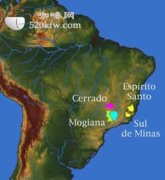
The low-acidity, moderately roasted coffee beans from the World Coffee Center are vividly compared to the giants and monarchs of the coffee world. There are about 3.97 billion coffee trees there, and small farmers now grow 75% of the country's coffee. The number of coffee producers in Brazil is twice or even three times that of Colombia, the second largest coffee producer in the world. With