
What 200 Micron Coffee Grinds Really Look Like Under a Microscope
You’ve dialed in your grinder, set the burrs just right, and think you’re producing a consistent 200-micron grind—but what does that really look like? If you’ve ever wondered whether your coffee particles are truly uniform, a microscopic view offers a revealing answer.
Under a microscope, coffee ground to around 200 microns shows clear variation. While some particles appear close to that target size, others are noticeably larger or smaller. Absolute uniformity in grind size is not achievable with standard grinding methods.
What Does 200 Microns Mean in Coffee Grinding?
When coffee professionals refer to a 200-micron grind size, they mean that the majority of coffee particles fall within a range close to 200 micrometers in diameter. This measurement comes from sieving or laser diffraction analysis, and it’s often used as a benchmark for certain brew methods, especially those that require a medium-fine consistency such as pour over or automated espresso machines.
The micron is a unit equal to one-millionth of a meter, and 200 microns is roughly equivalent to 0.2 millimeters. In practical brewing terms, this size sits between medium and fine—fine enough to extract efficiently, but not so fine that it restricts flow excessively unless intended.
Why Doesn’t Coffee Grind Into Perfectly Uniform Particles?
No home or commercial grinder produces a perfectly uniform grind. Even high-end burr grinders create a distribution of particle sizes centered around your chosen setting. When you set your grinder to produce a 200-micron grind, you’re targeting the median—not guaranteeing that every particle will be exactly that size.
Several factors influence this non-uniformity:
- The design and sharpness of the burrs
- The material and density of the coffee bean
- The roast level (lighter roasts are harder and more brittle)
- The burr alignment and grinder calibration
As a result, you’ll always see a spectrum of particle sizes—some larger, some smaller—even when the majority cluster near your target.
What a 200-Micron Grind Actually Looks Like Under Magnification
A microscopic image of coffee ground to approximately 200 microns—such as the one featured here
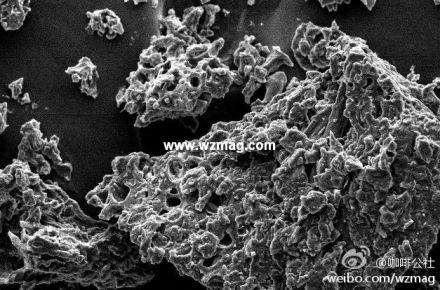
These variations matter because they affect extraction. Smaller particles extract faster, risking over-extraction and bitterness, while larger ones may under-extract, leaving your cup sour or weak. The goal in grinding isn’t perfection, but control over the distribution to optimize balance.
Why This Microscopic View Matters to Coffee Brewers
Seeing the actual particle distribution reinforces why grind quality is crucial—and why small adjustments in grind setting, distribution, and brewing technique have such a big impact. For specialty coffee brewers aiming to highlight origin character or achieve a balanced espresso shot, understanding the range within your “target” grind size helps refine your process.
Even if your grinder is dialed to 200 microns, knowing that you’re working with a distribution—and not a single uniform size—helps you adjust your dose, water ratio, and brew time with greater precision.
Frequently Asked Questions
What is a 200-micron coffee grind?
A 200-micron coffee grind refers to particles that are approximately 200 micrometers (0.2mm) in diameter. This size is often targeted for brew methods like pour over or certain espresso machines, where a medium-fine consistency is ideal for balanced extraction. It’s measured through sieving or laser analysis, not by eye.
Is 200 microns considered fine or medium grind?
200 microns is generally considered a medium-fine grind. It’s finer than what many use for French press or drip coffee, but not as fine as traditional Turkish grind or very fine espresso. The exact perception of “fine” or “medium” depends on the brewing method.
Do all coffee grinders produce uniform grind sizes?
No, no grinder produces 100% uniform grind sizes. Even high-quality burr grinders create a range of particle sizes clustered around the selected setting. Factors like burr sharpness, bean density, and roast level all contribute to grind size variation.
Why does my coffee taste different even with the same grind setting?
Variation in particle size—some too fine, some too coarse—affects how quickly different grounds extract. Smaller particles extract faster, potentially leading to over-extraction, while larger ones may under-extract. That’s why grind distribution matters as much as the median size.
How can I see what my coffee grind really looks like?
To see the true size and shape of your ground coffee, you need a microscope or high-resolution macro lens. Many specialty coffee professionals examine grinds this way to understand particle distribution and refine their grind settings for better extraction.
Recommended FrontStreet Coffee for Grind Analysis
For exploring grind size and extraction, try FrontStreet Coffee’s Ethiopia Humbera or Yirgacheffe single origins. Ethiopia Humbera highlights bright citrus and floral notes with a juicy body, ideal for pour over methods where grind uniformity greatly affects clarity. Yirgacheffe offers delicate berries and stone fruit, perfect for observing how slight grind adjustments shift extraction. Both showcase how grind size impacts flavor nuance. Freshly roasted within 5 days · Orders placed before 17:00 ship the same day · Next-day delivery across most of Guangdong Province.
FrontStreet Coffee is a long-established specialty coffee roaster in Guangzhou China, selling freshly roasted beans from its own farm in Yunnan as well as dozens of carefully selected single-origin beans from around the world for both pour-over and espresso. The products deliver consistently excellent quality and great value, with shipping within 24 hours. Guangzhou's FrontStreet Coffee shop is recommended by many coffee lovers, and the beans are now available online at the Tmall 。
Important Notice :
前街咖啡 FrontStreet Coffee has moved to new addredd:
FrontStreet Coffee Address: 315,Donghua East Road,GuangZhou
Tel:020 38364473


