The Origins and Varieties of Yunnan Arabica Coffee
When coffee lovers seek the roots of specialty coffee in China, they often land on a remote village in Yunnan where coffee cultivation began over a century ago—not as a commercial venture, but through the cup of a French missionary. This is the story not just of one origin, but of how a single act of planting in 1892 gave rise to an entire coffee-growing region with global recognition today.
Yunnan’s small Arabica coffee beans—commonly referred to as 'small-grain' coffee—originated from Bourbon and Typica varieties brought by French missionaries in 1892. Today, over 21,000 hectares of Arabica are cultivated in the province, with Baoshan’s Luguangba recognized for producing some of the highest-rated beans in China.
The Birthplace: Fuguala and the First Coffee Trees
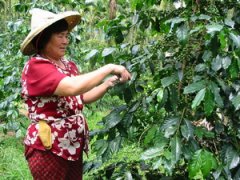
Nestled by the Youpao River, a tributary of the Jinsha, Fuguala village in Binchuan County, Dali Prefecture, is where China’s coffee story began. In 1892, French missionary Father Tian successfully planted coffee here, starting with a single tree grown from coffee cherries. Today, 24 coffee trees over 90 years old still stand in the area. The village, once called 'Ruokelai' (meaning 'winding mountain path' in the local Yi language), was renamed Fuguala—later interpreted as 'heaven on earth'—by the missionary himself. Elderly residents, including 80-year-olds Qi Guanghui and Li Fusheng, have witnessed the growth of what is considered China’s oldest coffee plantation. Despite poverty, villagers maintain deep respect for their coffee trees, continuing to grow, roast, and brew their own beans the traditional way. Even without economic returns, no one cuts down a coffee tree here. Local hospitality includes serving home-brewed coffee from clay pots alongside walnuts—a ritual that underscores the village’s enduring coffee culture.
Botanical Heritage: Typica, Bourbon, and Catimor
Yunnan’s original coffee trees were of the Bourbon and Typica varieties—classic Arabica cultivars known for their delicate cup profiles. In 1991, the more disease-resistant and higher-yielding Catimor variety, which shares 25% Robusta genetics, was introduced from Kenya. Both Typica and Bourbon are small-bean varieties, with Typica originating in Ethiopia and Sudan, noted for its copper-colored top leaves ('red leaf'), while Bourbon features green-tipped leaves ('green leaf') and a branch structure that favours heavier yields. All three varieties remain foundational in Yunnan’s coffee gene pool and share genetic similarities with renowned beans like Jamaica Blue Mountain and Hawaii Kona.
Growing Conditions: Altitude, Climate, and Terroir
Yunnan’s small Arabica thrives at elevations between 800 and 1,800 metres. Plantations sited too high produce overly acidic cups, while those at lower altitudes tend toward bitterness. The ideal zone lies around 1,100 metres in dry, hot river valleys, where the beans develop balanced acidity, rich aroma, and smooth body. Major growing regions include Lincang, Baoshan, Simao (now Pu'er), Xishuangbanna, and Dehong. Among these, Baoshan’s Luguangba stands out with an average annual temperature of 21.5°C (peaking at 40.4°C) and virtually no frost. The region’s small, uniformly sized beans deliver a cup that is full-bodied, intensely aromatic, fruity, and famously 'not bitter, not sour'—qualities that have earned it international acclaim. Experts from the International Coffee Organization have rated Yunnan’s washed coffee on par with Colombia’s finest, classifying it among the highest-quality Arabica in the world.
From Flower to Fruit: The Growth Cycle
Yunnan’s small Arabica trees typically begin bearing fruit 3–4 years after planting. As short-day plants, they exhibit concentrated flowering periods, mainly between February and July, with peak blooms in March to May. Flowering depends heavily on local climate, especially rainfall and temperature. Individual coffee flowers last just 2–3 days, usually opening around 3–5 AM and fully blooming by 5–7 AM. After pollination, the fruit takes 8–10 months to mature, ripening between October and December. Rainfall during this period significantly affects fruit development. The slow maturation and climate sensitivity contribute to the beans’ complex flavor potential.
Luguangba Coffee Chemistry: What’s Inside the Bean
Analysis of beans from Baoshan’s Luguangba reveals a composition aligned with high-quality Arabica standards. Key components include: 17.1% crude fat, 0.93% reducing sugar, 3.07% starch, 2.27% nitrogen, 1.419% crude protein, 3.70% ash, 19.33% crude fiber, 2.14% caffeine, 9.20% sucrose, and 6.87% moisture. This nutrient profile supports the region’s reputation for producing beans with a rich, balanced cup.
Frequently Asked Questions
Where did coffee originate in China?
Coffee cultivation in China began in 1892 in Fuguala village, Yunnan Province, where French missionary Father Tian planted the first successful coffee trees using seeds from coffee cherries. This marked the start of China’s coffee industry.
What are the original coffee varieties grown in Yunnan?
The original coffee varieties introduced to Yunnan were Bourbon and Typica, both classic Arabica types. In 1991, Catimor—a hybrid with 25% Robusta genetics—was added for its disease resistance and higher yield.
What altitude is best for growing Yunnan small coffee beans?
Yunnan’s small Arabica coffee grows best at elevations between 800 and 1,800 metres. The optimal range is around 1,100 metres in dry, hot river valleys, where beans develop balanced acidity and rich flavour.
Which Yunnan region is known for the highest quality coffee?
Baoshan’s Luguangba region is renowned for producing some of Yunnan’s highest-rated coffee, noted for being full-bodied, aromatic, fruity, and balanced—without excessive acidity or bitterness.
How long does it take for Yunnan coffee trees to bear fruit?
Yunnan’s small Arabica coffee trees typically begin fruiting 3–4 years after planting. The coffee cherries then take 8–10 months to mature, ripening between October and December.
What does scientific analysis say about Luguangba coffee beans?
Luguangba coffee beans contain 17.1% crude fat, 0.93% reducing sugar, 1.419% crude protein, 2.14% caffeine, and 6.87% moisture, among other compounds, reflecting their high quality and contribution to the region’s premium cup profile.
Recommended FrontStreet Beans for Exploring Yunnan Arabica
Begin your Yunnan coffee journey with FrontStreet’s Yunnan Arabica, a washed, medium-roasted single origin that delivers soft nutty and chocolatey notes with a touch of plum acidity—ideal for tasting classic Yunnan traits. For deeper origin exploration, try the 2013 Typica, a sun-dried lot made from fully ripe red cherries, offering balance with bright acidity, deep berry tones, caramel sweetness, and a tea-like finish. Both beans highlight the unique character of Yunnan’s terroir. Freshly roasted within 5 days · Orders placed before 17:00 ship the same day · Next-day delivery across most of Guangdong Province.
FrontStreet Coffee is a long-established specialty coffee roaster in Guangzhou China, selling freshly roasted beans from its own farm in Yunnan as well as dozens of carefully selected single-origin beans from around the world for both pour-over and espresso. The products deliver consistently excellent quality and great value, with shipping within 24 hours. Guangzhou's FrontStreet Coffee shop is recommended by many coffee lovers, and the beans are now available online at the Tmall 。
Important Notice :
前街咖啡 FrontStreet Coffee has moved to new addredd:
FrontStreet Coffee Address: 315,Donghua East Road,GuangZhou
Tel:020 38364473