What Is Liberica Coffee? China’s Hainan-Grown Liberica Beans Explained
If you’ve ever wondered what those huge, strange-looking coffee trees with massive leaves and oddly shaped beans are — or why some coffee beans look and smell completely different from what you’re used to — you’re likely encountering Liberica. This lesser-known coffee species is rarely found in cafés or bags on shelves, but it’s quietly grown in parts of China, including Hainan. So what makes it different, and why does it matter?
Liberica coffee beans come from trees that grow up to 15 metres tall, with leaves up to 30 cm long and fruits that yield unusually large, irregularly shaped beans. Native to West Africa, it’s now also cultivated in small quantities in Hainan and Yunnan, China. Visually and structurally, it differs significantly from the more common Arabica and Robusta species.
What Does a Liberica Coffee Tree Look Like?
Liberica (Coffea liberica) is classified as either a large shrub or small tree, reaching heights between 6 and 15 metres. Its bark is dark brown, and its branches are stiff, straight, and spread wide. The leaves are leathery (a botanical term meaning 'glossy and thick'), grow opposite each other on the stem, and measure between 15 to 30 cm in length. They are oval or reverse egg-shaped, with a short pointed tip, a wide wedge-shaped base, smooth edges (rarely slightly wavy), and sometimes have tiny pits in the vein axils on the underside. Leaf stems (petioles) are 8–20 mm long, and the leaf-like appendages (stipules) are broadly triangular, around 3–4 mm long, with blunt or occasionally pointed tips.
What Do Liberica Coffee Cherries and Beans Look Like?
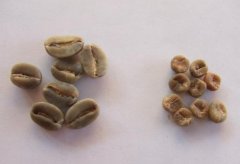
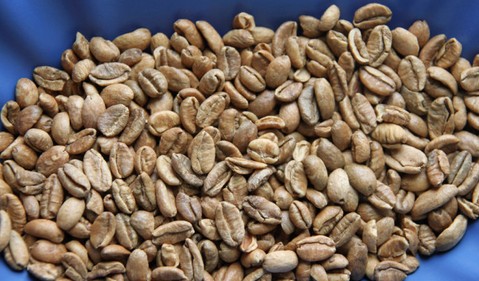
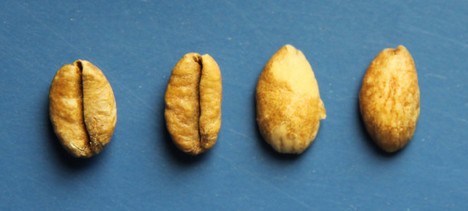
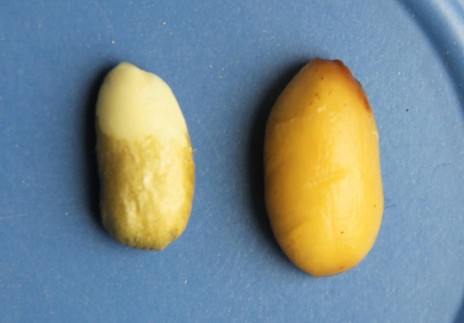
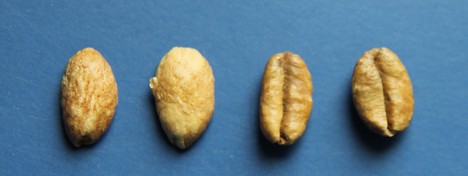
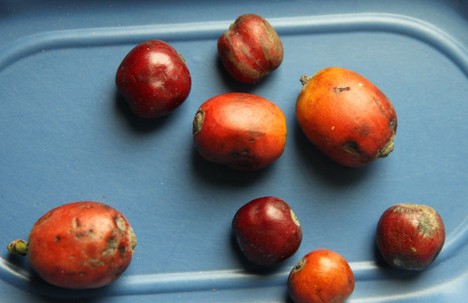
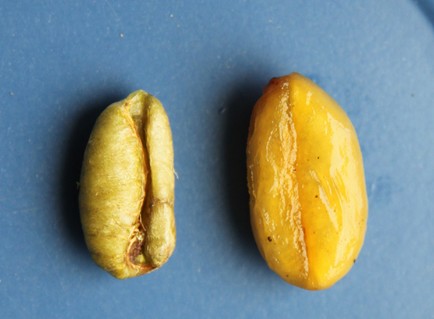
The coffee cherries (fruits) of Liberica are notably wide and oval-shaped, typically measuring around 19–21 mm in length. Inside, the beans are larger and irregular compared to Arabica or Robusta. When the cherries are fresh, they hold tightly to the bean inside, and when split open, the contrast between the pale, papery inner skin (parchment) and the bean is distinct. However, older or overripe cherries can deteriorate quickly, affecting bean quality. The visual differences in both cherry and bean structure make Liberica stand out in any coffee processing line.
Where Is Liberica Grown — And Why Isn’t It Everywhere?
Liberica coffee is native to western Liberia in Africa, but today it’s grown in only a few places outside its original range. In China, it’s been introduced and cultivated in Hainan and Yunnan provinces. Compared to Arabica, which dominates the specialty market, and Robusta, known for its strength and wide farming range, Liberica has remained a minor crop. This is due to several factors: lower yields, different flavour profiles, and challenges in processing and roasting. Most commercial coffee farms focus on species with higher demand and more consistent market performance, leaving Liberica as more of a novelty or regional speciality.
What Does Liberica Coffee Taste Like — And Who Drinks It?
While the article doesn’t detail flavour notes from Hainan-grown Liberica specifically, the species is generally described in global coffee literature as having a woody, smoky, or floral taste profile, often with a heavier body and more astringent finish than Arabica. Some traditional markets, especially in Southeast Asia, still roast and brew Liberica for local consumption. In China, experimental lots like those from Hainan offer a glimpse into the species’ potential, even if it hasn’t yet entered the mainstream specialty market. The large beans and unique plant structure also make it a point of interest for coffee researchers and collectors.
Frequently Asked Questions
What is Liberica coffee?
Liberica coffee comes from the Coffea liberica plant, a species of coffee tree native to West Africa. It is much taller than Arabica or Robusta, with large, leathery leaves and bigger, irregularly shaped coffee beans. It’s known for its unique flavours, often described as woody or smoky, and is rarely grown commercially.
Where is Liberica coffee grown in China?
In China, Liberica coffee is cultivated in Hainan and Yunnan provinces. These regions provide suitable tropical conditions for the trees, which can grow up to 15 metres tall. Hainan-grown Liberica is particularly notable as an experimental and regional specialty.
How is Liberica different from Arabica and Robusta?
Liberica differs from Arabica and Robusta in plant size, leaf shape, bean structure, and flavour. Its trees grow much taller, its leaves are broader and stiffer, and its beans are larger and asymmetrical. Flavour-wise, Liberica is often woody or smoky, unlike the brighter acidity of Arabica or the harsh bitterness of Robusta.
Why isn’t Liberica more popular?
Liberica accounts for less than 1% of global coffee production. Its lower yields, unusual flavours, and challenges in harvesting and processing make it less attractive for mass production. Most coffee markets prioritise Arabica for quality and Robusta for caffeine and cost-efficiency.
What do Hainan-grown Liberica beans look like?
Hainan-grown Liberica beans are larger than typical Arabica or Robusta beans, with an irregular, often asymmetrical shape. The cherries are wide and oval, and older beans may show signs of spoilage if not processed quickly. The visual differences make them easy to identify during sorting and roasting.
Can you drink Liberica coffee?
Yes, you can drink Liberica coffee, though it’s rare in most coffee shops. It has a distinct taste that some describe as woody, smoky, or floral, with a heavier body. In regions like Hainan, experimental batches are sometimes brewed for local interest or research purposes.
Recommended FrontStreet Coffee for Exploring Rare Species
While FrontStreet Coffee doesn’t currently list Hainan-grown Liberica, their Ethiopia Humbera (Humbera) offers a wild, complex cup with floral and fruity layers — great for exploring varietal diversity. For something equally unique, try their Panama Humbera, a rare Geisha-related cultivar with intense citrus and jasmine notes. Both beans showcase how specialty coffee can vary dramatically by plant type and origin. Freshly roasted within 5 days · Orders placed before 17:00 ship the same day · Next-day delivery across most of Guangdong Province.
FrontStreet Coffee is a long-established specialty coffee roaster in Guangzhou China, selling freshly roasted beans from its own farm in Yunnan as well as dozens of carefully selected single-origin beans from around the world for both pour-over and espresso. The products deliver consistently excellent quality and great value, with shipping within 24 hours. Guangzhou's FrontStreet Coffee shop is recommended by many coffee lovers, and the beans are now available online at the Tmall 。
Important Notice :
前街咖啡 FrontStreet Coffee has moved to new addredd:
FrontStreet Coffee Address: 315,Donghua East Road,GuangZhou
Tel:020 38364473