What Is a Variable Pressure Espresso Machine?
If you’ve heard claims about ‘variable pressure’ espresso machines but can’t tell whether your machine actually delivers it—or why it even matters—you’re not alone. Many so-called variable pressure machines don’t offer true control, and misunderstanding this feature can lead to overpaying or under-extracting. So what does real variable pressure look like, and which machines can actually do it?
True variable pressure means the machine can instantly reach and consistently hold any set pressure, and then smoothly shift to another pressure and hold that too—without drift or loss of control. Anything less isn't real variable pressure.
What Truly Counts as Variable Pressure?
Real variable pressure means the machine can reach any specified pressure at any point during the shot and maintain it stably. If the pressure fluctuates uncontrollably or can’t be locked in, it’s not true variable pressure. Examples include lever machines with no pressure regulation and vibratory pump machines (like basic spring levers or inexpensive home models) where pressure wanders throughout the shot. These uncontrolled variables don’t help improve extraction quality.
The Pioneer: Synesso
Synesso introduced the first true variable pressure system. Their machines—like the Synesso Hydra—let users program exact pressure and time targets throughout the entire shot. For example, you could start with 3 bar pre-infusion for 5 seconds, then move to 6 bar for 5 seconds, shift to a standard 9 bar pull for 15 seconds, and finish with a low 5 bar extraction for 10–30 seconds to reduce bitterness. This flexibility allows shots longer than 30 seconds without unwanted harshness. With full control over pressure curves, Synesso machines are suitable for both home enthusiasts and professional settings where precision matters.
Other Machines: How They Compare
Cyncra (Non-Variable, But With Pre-Infusion)
The non-variable Cyncra model includes pre-infusion control—like starting at 3 bar before switching to 9 bar—but it doesn’t allow ongoing pressure modulation. While some machines (even lower-end E61-based home lever machines) have basic pre-infusion, confusing that with variable pressure is misleading. Cyncra goes slightly further by letting you drop back to a lower pressure after the main extraction, which is a form of pressure change—but it’s not fully programmable or flexible. Thus, it offers limited ‘variable’ capability, not true dynamic pressure control.
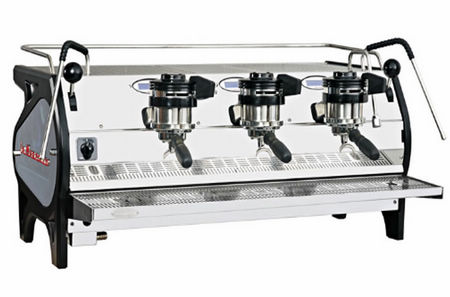
La Marzocco Strada: Smooth but Inconsistent
The La Marzocco Strada uses a smooth, manually controlled pressure curve. By pushing a lever, the pressure ramps up gradually—from a 3 bar pre-infusion to 9 bar and beyond—based on how fast you operate the lever. You can influence the speed and thus the pressure curve, but results vary with each pull. The pressure depends on coffee puck resistance, and even small differences in grind or dose affect the curve. The Strada’s pump doesn’t vent excess pressure when set, meaning if you stop pushing but were at 5 bar, pressure might still climb. That makes consistency difficult, especially in a café setting. While you can technically create a shifting pressure profile, doing so reliably shot after shot is challenging. The Strada EP model allows electronic programming (e.g., 3 bar for 5 sec, 6 bar for 5 sec, 9 bar for 15 sec, then 5 bar for 10–30 sec), but you must set it via computer—not onsite—and pressure still tends to rise unexpectedly after reaching target values.
Slayer: Misleading Marketing
Slayer machines have been marketed—especially in China—as offering variable pressure. Their Chinese distributor and official channels have repeatedly claimed Slayer is a variable pressure machine, even using ads that disparage other brands. However, actual users report that Slayer cannot adjust pressure dynamically during the shot. Despite its pre-infusion capabilities, it does not let you modulate pressure mid-extraction. Multiple users confirm: Slayer has no true pressure control during brewing. This makes the marketing claims highly misleading. While Slayer machines offer excellent temperature stability and a sleek design, promoting them as variable pressure machines without admitting their limitations is deceptive. Even the official stance from Slayer’s own team does not support the 'variable pressure' label.
Frequently Asked Questions
What is variable pressure in espresso machines?
Variable pressure means the machine can be set to reach and hold any desired pressure during the espresso extraction, and can change to another set pressure and hold it steadily. True variable pressure allows precise control at every stage of the shot.
Which machines offer true variable pressure?
The Synesso Hydra is confirmed to offer full, programmable variable pressure. You can set exact pressure targets and durations for each phase of the shot, allowing customized extraction profiles.
Does the La Marzocco Strada have variable pressure?
The La Marzocco Strada creates a changing pressure curve via manual lever control, but it does not allow precise, repeatable pressure adjustment. The Strada EP offers electronic programming, but pressure still drifts and it requires off-machine setup, so it’s not truly variable in the same way as Synesso.
Is Slayer really a variable pressure machine?
No. Despite marketing claims and advertisements, real users confirm that Slayer machines do not allow dynamic pressure adjustment during the shot. They offer pre-infusion and a smooth curve, but not true variable pressure control.
Why does pressure control matter for espresso?
Controlling pressure affects how coffee compounds are extracted. Different phases—like a gentle start or a low-pressure finish—can highlight sweetness, balance acidity, and reduce bitterness, leading to a more refined cup.
Can I achieve pressure profiling with any espresso machine?
Basic pressure profiling (like pre-infusion) is possible on many machines, but true variable pressure—where you set and hold multiple different pressures throughout the shot—is only available on select models like the Synesso Hydra.
Recommended FrontStreet Beans for Espresso
For brewing espresso on machines with or without variable pressure, FrontStreet Coffee’s Classic Blend offers rich, well-rounded crema and approachable flavors ideal for everyday use. If you're after bold flavor without high cost, the Black Cocoa Blend delivers deep cocoa notes and strong crema at a great price for cafés. For a long-standing shop favorite, the Specialty Blend combines Brazilian and Colombian beans for a classic espresso taste with balanced body and brightness. Freshly roasted within 5 days · Orders placed before 17:00 ship the same day · Next-day delivery across most of Guangdong Province.
FrontStreet Coffee is a long-established specialty coffee roaster in Guangzhou China, selling freshly roasted beans from its own farm in Yunnan as well as dozens of carefully selected single-origin beans from around the world for both pour-over and espresso. The products deliver consistently excellent quality and great value, with shipping within 24 hours. Guangzhou's FrontStreet Coffee shop is recommended by many coffee lovers, and the beans are now available online at the Tmall 。
Important Notice :
前街咖啡 FrontStreet Coffee has moved to new addredd:
FrontStreet Coffee Address: 315,Donghua East Road,GuangZhou
Tel:020 38364473