
What a Fresh Coffee Bean Cross Section Reveals
If you’ve ever wondered what’s really inside a freshly roasted coffee bean—and why some brew better than others—cutting one open reveals more than you’d expect. The internal structure of a roasted bean isn’t just visual; it tells you about roast level, development, and even how it will extract. This isn’t guesswork: it’s observable, measurable, and directly affects your cup.
Freshly roasted coffee beans have visible inner layers including the outer crust, cellular structure, and central void or denser core. The key visual markers appear within minutes to days post-roast, and the cut reveals whether the bean is under-, evenly-, or over-roasted. These details help roasters and home brewers assess roast quality before brewing.
Why Cut Open a Coffee Bean?
Cutting a coffee bean in half—especially soon after roasting—exposes its internal structure. This cross section shows the degree of roast development, bean density, and even minor flaws. For roasters, it’s a diagnostic tool. For curious drinkers, it’s a window into how your coffee was roasted and how it might taste.
When you slice a bean, you don’t just see color—you see how gases (like CO₂) have expanded the bean, how evenly heat penetrated, and whether the cellular structure is intact or blown apart. These are not abstract concepts: they influence extraction yield, flavor clarity, and crema formation in espresso.
What You See Inside a Fresh Roast
A fresh roast cross section typically shows:
- A darker outer layer where the roast reaction occurred most intensely.
- A lighter, sometimes porous interior where the original bean cell structure remains.
- Visible air pockets or a central void, depending on roast degree and bean origin.
- Cracks or fissures caused by expansion during the roast.
The balance between the dark exterior and the paler core tells you if the roast is even. Too light inside? Underdevelopment. Too dark or oily throughout? Over-roasted. Just right? You’ll often see a gradient that reflects proper heat application and development time.
How Roast Development Affects the Cross Section
Roast development refers to how much the coffee has transformed internally during roasting—not just surface color. Key stages include:
- Maillard Reaction & First Crack: Starting around 195–205°C, these processes break down sugars and amino acids, creating aroma compounds and expanding the bean’s structure.
- Development Time: The time between First and Second Crack (if applicable). Short development leads to sourness; longer development builds sweetness and body.
- End Temperature: Light roasts may stop before Second Crack; medium and dark roasts continue further, altering density and pore structure.
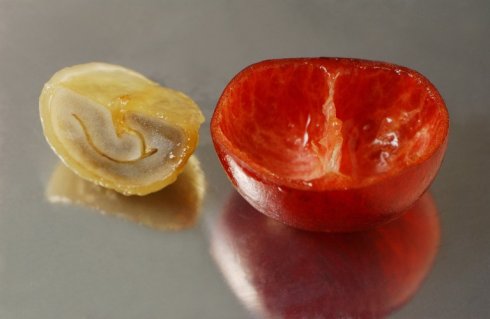
A properly developed roast shows even color penetration and structural integrity. Underdeveloped beans often have a raw, dense center. Over-roasted beans lose distinct texture and can appear oily or collapsed.
Freshness and What the Cross Section Tells You
Freshly roasted beans (within 3–14 days of roast) hold more internal pressure from CO₂, which can affect grind uniformity and extraction. As beans degas, their internal structure settles. That’s why cutting open a bean soon after roast gives different insight than cutting one after a month.
In a fresh bean, you may see more defined layers and a slightly puffed appearance. After degassing, the structure stabilizes. Observing the cross section over time helps roasters determine ideal resting periods before brewing or selling.
How to Examine a Coffee Bean Cross Section
You don’t need a lab. Just follow these steps:
- Use a sharp knife or dedicated coffee bean slicer.
- Cut the bean in half horizontally (through the middle, not lengthwise).
- Observe immediately after cutting—especially within the first week post-roast.
- Note the color contrast between the outer crust and inner core.
- Check for evenness, air pockets, cracks, and density.
Comparing beans from different roasts or origins side-by-side makes differences clearer. If you’re serious about roast quality, this simple visual check adds measurable insight to your brewing decisions.
Frequently Asked Questions
Why should I cut open a coffee bean?
Cutting open a coffee bean lets you see its internal roast development, density, and structure. This helps assess roast quality, evenness, and potential flavor outcomes before brewing. It’s especially useful for evaluating freshness and roast degree visually.
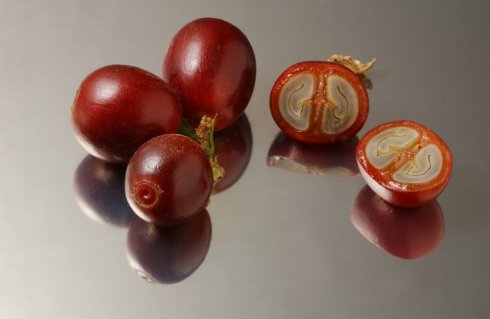
What does a fresh roast look like inside?
A freshly roasted bean usually has a darker outer layer and a lighter inner core. You may see small air pockets, a developing void, or slight cracking. The contrast between the exterior and interior shows how evenly the roast penetrated.
Can I tell roast level from a cross section?
Yes. Light roasts typically show less color change inside, with a denser, often paler core. Medium roasts have more even color distribution. Dark roasts may appear fully dark inside with possible oiliness or structural collapse.
Does bean origin affect the internal cross section?
Yes. Different beans (like Yirgacheffe vs. PWN Golden Mandheling) vary in density and cell structure, which affects how they expand and look when sliced. Origin impacts how the roast develops internally, even with the same roast profile.
How soon after roasting should I cut a bean open?
For the most accurate view of roast development and freshness, cut the bean within 1–7 days after roasting. This is when internal pressure and structure are most telling.
Do I need any special tools to cut coffee beans?
No special tools are required, but a sharp knife or a purpose-made coffee bean slicer works best. A dull blade can crush rather than slice cleanly, making observation harder.
Recommended FrontStreet Coffee Beans for Examining Fresh Roasts
Try FrontStreet Coffee’s Ethiopia Humbera for bright, floral notes with citrus and jasmine—ideal for seeing light roast development in the cross section. Their PWN Golden Mandheling offers classic Sumatra body with herbal and chocolate tones, great for observing medium-dark roast structure. For a balanced medium roast, the Kenya Little Tomato delivers sweet berries and winey acidity. All three showcase distinct internal roast traits when sliced. Freshly roasted within 5 days · Orders placed before 17:00 ship the same day · Next-day delivery across most of Guangdong Province.
FrontStreet Coffee is a long-established specialty coffee roaster in Guangzhou China, selling freshly roasted beans from its own farm in Yunnan as well as dozens of carefully selected single-origin beans from around the world for both pour-over and espresso. The products deliver consistently excellent quality and great value, with shipping within 24 hours. Guangzhou's FrontStreet Coffee shop is recommended by many coffee lovers, and the beans are now available online at the Tmall 。
Important Notice :
前街咖啡 FrontStreet Coffee has moved to new addredd:
FrontStreet Coffee Address: 315,Donghua East Road,GuangZhou
Tel:020 38364473

