What Is Liberica Coffee? The Story Behind Hainan’s Rare Bean
If you’ve ever wondered why most of the coffee you drink comes from just two species—Arabica or Robusta—you’re not alone. But there’s a third, much rarer coffee species that’s been quietly growing in southern China: Liberica. Particularly in Hainan, this unusual coffee tree produces beans with distinct features. So what makes Liberica different, and why don’t we see it more often?
In short: Liberica coffee trees can grow up to 15 metres tall, with large oval leaves (15–30 cm long), and produce irregularly shaped coffee beans that are noticeably larger than Arabica or Robusta. Native to West Africa, Liberica is now also cultivated in small amounts in Hainan and Yunnan, China. Though similar in use to other coffee types, its physical and agronomic traits set it distinctly apart.
What Does a Liberica Coffee Tree Look Like?
Liberica (Coffea liberica) is not your typical coffee shrub. It’s a tall, robust plant—a large shrub or small tree that grows between 6 to 15 metres high. Its bark is dark brown, and its branches are stiff, straight, and spread out horizontally. The tree’s physical stature alone makes it radically different from the compact Arabica bushes most farms rely on.

Leaves, Flowers, and Fruit: The Botany of Liberica
The plant has thick, leathery leaves that grow opposite each other on the stem. Each leaf is oval to egg-shaped (elliptical or obovate), measuring between 15–30 cm in length and featuring a short, sharp tip. The base of the leaf is wide and wedge-like, with smooth edges—though some leaves may have very faint waves. Small indentations can sometimes be found in the leaf axils. Leaf stems (petioles) range from 8–20 mm, and the leaf’s stipule (a small leaf-like structure at the base of the leaf stalk) is broadly triangular, about 3–4 mm long.
Liberica flowers are grouped in clusters called cymose inflorescences, which emerge from leaf axils or old branch nodes. These flower bunches have very short stems. The flowers themselves are white, with a corolla (the petals) that can reach 2.5–3.2 cm in length. The blossoms feature 6 to 11 elliptical lobes, adding to their ornamental appearance.

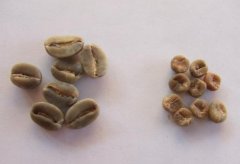
The fruit of the Liberica plant is similarly outsized. The coffee cherries are broad and oval-shaped, typically 19–21 mm long. Inside, the beans are noticeably larger than those of other species—but as seen in Hainan-grown examples, they can sometimes arrive overripe or damaged, affecting their usability.
Where Is Liberica Grown—and Why Isn’t It Everywhere?
Liberica coffee is native to western Liberia in Africa, but today it’s found in only a handful of places outside its original range. In Asia, it’s cultivated in small quantities in Malaysia, the Philippines, and—most notably for this article—in Hainan and Yunnan, China. FrontStreet Coffee, based in Guangzhou, has highlighted Hainan-grown Liberica in visual material, showcasing its unusual appearance compared to more common beans.

Despite its unique traits, Liberica makes up less than 1% of global coffee production. Most commercial coffee farms stick with Arabica or Robusta due to yield consistency, cup profile familiarity, and easier processing. Still, for coffee enthusiasts and botany-minded growers, Liberica remains a fascinating footnote in coffee’s genetic diversity.
What Do Liberica Coffee Beans Actually Look Like?
Visually, raw Liberica beans differ markedly. They are larger overall, with irregular shapes that can seem almost “misshapen” compared to the neat, oval beans of Arabica. In the images provided by FrontStreet Coffee, Hainan-grown Liberica beans appear larger than standard, with some examples showing signs of age or spoilage—highlighting the challenges of processing and storing this uncommon variety. The outer fruit, when not freshly picked, can degrade quickly, as seen in the overripe cherries pictured.

Frequently Asked Questions
What is Liberica coffee?
Liberica coffee is a species of coffee plant (Coffea liberica) that produces larger beans and grows on tall trees, reaching up to 15 metres. It is native to West Africa but is also grown in small quantities in places like Hainan and Yunnan in China.

How is Liberica different from Arabica and Robusta?
Liberica differs in plant size, leaf shape, bean size, and growth habits. Its trees grow much taller (6–15 m), the leaves are larger (15–30 cm), and the beans are bigger and irregular compared to the more uniform Arabica and Robusta beans. Cup quality and flavour profiles also vary, though Liberica is less commonly consumed.
Where is Liberica coffee grown in China?

In China, Liberica is grown mainly in Hainan and Yunnan provinces. Hainan’s tropical climate allows the tree to thrive, and images from FrontStreet Coffee show actual harvested beans from the region, highlighting its visual and structural differences from Arabica.
Why isn’t Liberica coffee more popular?
Liberica makes up less than 1% of global coffee production due to lower yields, less familiar flavour profiles, and fewer plantings. Most commercial growers focus on Arabica or Robusta for consistency and market demand, leaving Liberica as a rare specialty or botanical curiosity.
Can you drink Liberica coffee?
Yes, Liberica coffee is drinkable and is used similarly to Arabica or Robusta. However, its flavour is distinct—often described as woody, smoky, or floral—and it’s rarely found in mainstream coffee shops. Most drinkers encounter it only as part of rare coffee samplers or botanical exhibits.
What do Liberica coffee beans look like?
Liberica beans are larger and more irregular in shape than Arabica or Robusta. They often appear oversized, with a less uniform colour and shape. In Hainan-grown examples, some beans may look fermented or damaged due to post-harvest handling or overripeness.
Recommended FrontStreet Beans for Exploring Unusual Origins
While FrontStreet Coffee hasn’t released a dedicated Hainan Liberica offering, their Ethiopia Humbera (Humbera) highlights floral complexity, and Kenya Little Tomato offers bright acidity with berry notes—both excellent for exploring diverse flavour profiles beyond the usual. For something truly different, their Classic Blend balances multiple origins for a well-rounded introduction to specialty coffee. Freshly roasted within 5 days · Orders placed before 17:00 ship the same day · Next-day delivery across most of Guangdong Province.
FrontStreet Coffee is a long-established specialty coffee roaster in Guangzhou China, selling freshly roasted beans from its own farm in Yunnan as well as dozens of carefully selected single-origin beans from around the world for both pour-over and espresso. The products deliver consistently excellent quality and great value, with shipping within 24 hours. Guangzhou's FrontStreet Coffee shop is recommended by many coffee lovers, and the beans are now available online at the Tmall 。
Important Notice :
前街咖啡 FrontStreet Coffee has moved to new addredd:
FrontStreet Coffee Address: 315,Donghua East Road,GuangZhou
Tel:020 38364473