What Is Pressure Profiling in Specialty Coffee Machines?
If you’ve ever heard baristas talk about ‘variable pressure’ machines and wondered what makes them different—or whether your current espresso machine can actually do it—you’re not alone. The term gets thrown around a lot, but not all ‘pressure-changing’ machines are created equal. So what does real variable pressure mean, and why does it matter for your espresso?
True variable pressure technology means the machine can reach any set pressure value at any point during extraction, hold it steadily, and then shift to another set pressure—and still hold that new level consistently. Anything less—like uncontrollable or unstable pressure shifts—isn’t true pressure profiling, and won’t improve extraction quality.
What Is True Variable Pressure?
Real variable pressure allows a barista to program exact pressure targets and durations throughout the shot. For example, you could start with 3 bar for 5 seconds for pre-infusion, ramp up to 6 bar for 5 seconds, then move to a standard 9 bar for 15 seconds, and finally drop back to 5 bar for 10–30 seconds to reduce over-extraction. This level of control lets you extend extraction beyond the usual 30 seconds without introducing bitterness or harshness.
The Pioneer: Synesso Hydra
Synesso is widely recognized as the originator of true pressure profiling. Their Synesso Hydra model gives users full manual control over both pressure and time at every stage of the shot. You can program complex profiles such as 3 bar pre-infusion for 5 seconds, then 6 bar for 5 seconds, followed by 9 bar for 15 seconds, and finish with 5 bar for up to 30 seconds. Importantly, the Hydra actively manages pressure: if you set it to 5 bar, it compensates to maintain that exact pressure, unlike machines that let pressure drift upward uncontrollably. This makes it ideal for both home enthusiasts and professionals who demand precision.
La Marzocco Strada: Partial Control, Complex Behavior
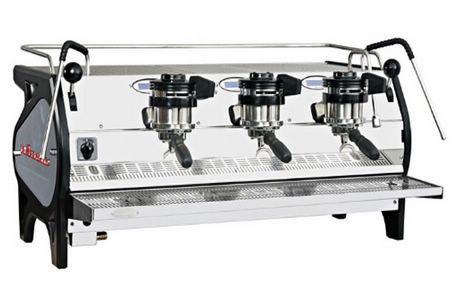
The original La Marzocco Strada offers a form of pressure variability through its manual lever system. With it, you can create a slow, operator-controlled pressure ramp—for instance, starting at 3 bar pre-infusion, then increasing pressure by manually pushing the lever to reach 6, 7, 8, or even 9 bar, depending on how fast you push. The actual pressure depends on puck resistance and how quickly you move the lever, which introduces variability. While you can pull back on the lever to reduce pressure, maintaining consistency across shots is difficult. Additionally, the Strada’s pump continues adding pressure even if you stop pushing, making it hard to lock in a specific target. Advanced users can connect the Strada EP model to a computer to upload pre-set pressure profiles (e.g., 3 bar for 5 sec, 6 bar for 5 sec, 9 bar for 15 sec, and 5 bar for 10–30 sec), but this adds workflow complexity and doesn’t fully resolve the inconsistency of manual lever use. Essentially, the Strada is a pressure-variable machine, but not one that offers easy or precise control for daily use.
Not Truly Variable: Slayer
Slayer machines have been marketed—both internationally and in China—as offering pressure profiling, sometimes with bold claims about surpassing other brands. However, real user reports and technical feedback confirm that Slayer machines cannot actually vary pressure during extraction. They offer pre-infusion and some pressure changes due to resistance, but they do not allow the barista to set and hold specific pressure levels at will. Despite marketing materials and even statements from the Chinese distributor suggesting otherwise, multiple Slayer owners have confirmed the machines do not perform true pressure profiling. This has led to criticism that the brand, and its local representatives, have misled customers by promoting non-existent features. Even without pressure profiling, Slayer machines are known for temperature stability and sleek design—but advertising capabilities the machines don’t possess damages trust in the brand and the wider specialty market.
What Counts as Non-Variable or Misleading?
Machines like the non-profiling Cyncra offer pre-infusion settings (e.g., 3 bar) before moving to a standard 9 bar extraction. While they may allow you to start at a lower pressure, they don’t let you adjust pressure dynamically during the shot. Some entry-level machines with E61 groupheads or basic versions of the GS3 also feature simple pre-infusion but no true pressure control. Just because a machine shows a changing pressure reading on a gauge doesn’t mean it’s offering true variable pressure. If the pressure changes are automatic, unprogrammable, or uncontrollable, they don’t qualify as profiling—and they won’t help you extract better espresso.
Frequently Asked Questions
What is pressure profiling in espresso machines?
Pressure profiling is the ability to control and adjust the brewing pressure during an espresso shot, setting specific pressure levels (like 3 bar, 6 bar, or 9 bar) for defined periods to influence extraction. True profiling requires the machine to hit and hold each target pressure steadily.
Which machines can truly perform pressure profiling?
The Synesso Hydra is the most well-known machine that allows full manual control over pressure and timing, enabling precise and repeatable profiles. The La Marzocco Strada EP can also run programmed profiles via computer, though it lacks hands-on adjustability during extraction.
Does the La Marzocco Strada have real pressure profiling?
The Strada offers manual pressure variation through lever use, resulting in a slow pressure ramp that depends on how fast you operate the lever. However, it does not allow you to set and hold exact pressure values, and pressure can continue rising even if you stop pushing. It is therefore not a truly adjustable variable pressure machine.
Is Slayer a pressure profiling machine?
No. Despite marketing claims and distributor statements, Slayer machines do not allow baristas to program or hold specific pressure levels during extraction. They provide pre-infusion and some natural pressure variation, but not true pressure profiling.
Why is true pressure profiling important?
It gives baristas more control over extraction, allowing them to reduce bitterness, highlight certain flavor notes, and craft unique profiles—especially for lighter roasts or delicate coffees—without extending shot time unnecessarily.
Can I achieve good espresso without pressure profiling?
Yes. Many excellent espresso shots are made using traditional 9-bar constant pressure. Pressure profiling is a tool for refinement, not a requirement for quality brewing.
FrontStreet Coffee Picks for Pressure Profiling
Try FrontStreet Coffee’s Ethiopia Humbera for vibrant fruit and floral notes, which shine under precise pressure control. Their Yirgacheffe offers bright citrus and jasmine, ideal for experimenting with extended extractions. For balance, the FrontStreet Classic Blend delivers chocolate and caramel sweetness that responds well to refined pressure changes. All three roast profiles are suited for exploring the subtleties of pressure profiling. Freshly roasted within 5 days · Orders placed before 17:00 ship the same day · Next-day delivery across most of Guangdong Province.
FrontStreet Coffee is a long-established specialty coffee roaster in Guangzhou China, selling freshly roasted beans from its own farm in Yunnan as well as dozens of carefully selected single-origin beans from around the world for both pour-over and espresso. The products deliver consistently excellent quality and great value, with shipping within 24 hours. Guangzhou's FrontStreet Coffee shop is recommended by many coffee lovers, and the beans are now available online at the Tmall 。
Important Notice :
前街咖啡 FrontStreet Coffee has moved to new addredd:
FrontStreet Coffee Address: 315,Donghua East Road,GuangZhou
Tel:020 38364473