How Coffee Spread Around the World: A Historical Route
Coffee is now a global staple, but have you ever wondered how it spread from a single region to become a worldwide phenomenon? The journey of coffee from its wild origins to your morning cup involves centuries of trade, colonization, and agricultural adaptation — each step shaping the beans we know today.
In short: Coffee began in Ethiopia around the 7th–9th century, spread to Yemen by the 1400s, reached India by 1600, Java and Ceylon by the late 1600s through Dutch traders, then traveled to Europe, the Americas, and Asia over the 17th–19th centuries via colonial routes and royal gifts — reaching as far as Brazil, Hawaii, and Colombia.
The Origins: Ethiopia (7th–9th Century)
Coffee’s story begins in the highlands of Ethiopia, particularly the region of Kaffa. Legend says a goat herder named Kaldi noticed his goats became energetic after eating red berries — later recognized as coffee cherries. By the 7th–9th century, coffee was being consumed in Ethiopia, likely as a fermented drink or chewed as a stimulant. These early practices laid the foundation for what would become the world’s most traded beverage.
To the Arab World: Yemen (1400s–1500s)
By the 1400s–1500s, coffee made its way across the Red Sea to Yemen, specifically the port city of Mocha (Al-Makha). Yemeni Sufi monks are credited with first brewing roasted coffee beans as a drink to aid in nighttime worship. Yemen became the first hub of coffee roasting and brewing, and the port of Mocha became synonymous with coffee export. The Arabic coffeehouse, or qahveh khaneh, also emerged here, spreading the social culture of coffee drinking.
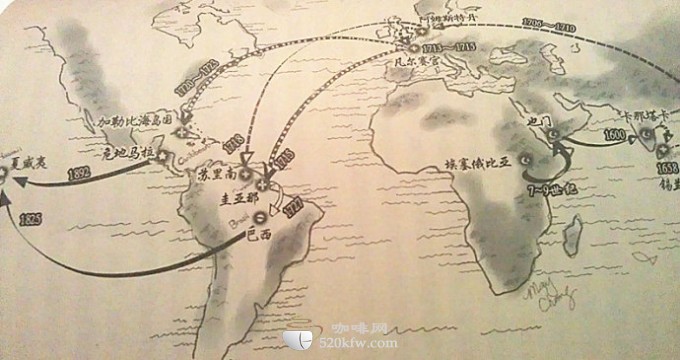
Colonial Expansion: India, Ceylon, Java & Beyond (1600–1700s)
Dutch and European traders accelerated coffee’s global journey:
- India (1600): A Sufi saint named Baba Budan smuggled seven coffee seeds from Yemen to the hills of Karnataka (then part of Mysore), planting them near Chikmagalur. This marked coffee’s first introduction to Asia.
- Ceylon (Sri Lanka, 1658): The Dutch introduced coffee to Ceylon while occupying the island. Plantations were established but later devastated by disease.
- Java (1690–1696): The Dutch East India Company successfully cultivated coffee in Java after failed earlier attempts. Java became one of the first major plantation regions outside Arabia and Ethiopia.
- Amsterdam (1706–1710): The Dutch brought the first living coffee tree to Europe, which was kept in the Botanical Garden in Amsterdam.
From there, coffee was sent as a diplomatic gift and for cultivation:
- France (around 1713): A coffee plant was given to King Louis XIV and planted in the Jardin des Plantes in Paris, then sent to French colonies.
- Saint Helena (1732): A round-bodied Bourbon variety was taken to the British territory of Saint Helena.
- Brazil (1860): The round-bodied Bourbon was introduced to Brazil, which would later become the world’s largest coffee producer.
- Suriname and the Caribbean (late 1700s): Coffee moved from France to colonies like Suriname, then to French Guiana and eventually Brazil via smuggled seeds (notably by Francisco de Melo Palheta in 1727).
- Louisiana and beyond: Coffee cultivation spread through tropical colonies in the Americas and Caribbean.
Key Varietals and Their Global Journeys
Several coffee varieties trace distinct paths:
- Bourbon (Round-bodied): Taken to Réunion (then called Bourbon Island, a French territory) and later spread to Rwanda, Kenya, and Tanzania after 1900. Also arrived in Brazil in 1860. A tall, sweet variety that became foundational for many Latin American coffees.
- Typica (Slim-bodied): A parent variety of many cultivars, Typica was part of the early Dutch and French distributions. It traveled to Java and later to Central America.
- Slender (Laurina or “Pointed”) Bourbon: Introduced to New Caledonia in the 1860s. Later, the pointed-type Bourbon (often called “Bourbon” in Chinese sources) made its way to Colombia after 2000.
These varieties adapted differently based on climate, altitude, and processing methods, giving rise to the diverse flavor profiles we associate with regional coffees today.
How Coffee Reached the Americas and Pacific
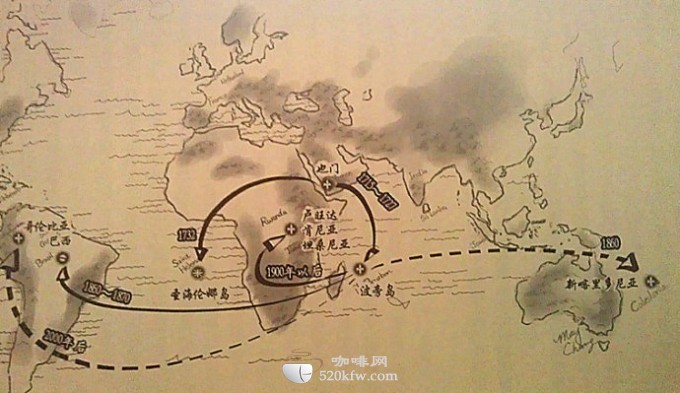
- Brazil (1727–1800s): Smuggled from French Guiana by Francisco de Melo Palheta around 1727, coffee quickly took root in Brazil’s fertile soils. By the 19th century, Brazil dominated global production.
- Hawaii (1825 & 1892): Coffee was introduced to Hawaii (then the Sandwich Islands) first in 1825, and again in 1892. The Kona region became especially famous for its high-quality beans.
- Guatemala (1800s): Coffee cultivation began in the 1800s and grew significantly under colonial agricultural systems.
- Jamaica (18th century): Blue Mountain coffee originated in Jamaica, with plantings starting in the late 1700s. The famous Jamaica Blue Mountain No.1 is still highly prized.
Each region developed its own coffee identity based on terroir, processing traditions, and variety selection.
Frequently Asked Questions
Where did coffee originate?
Coffee originated in the highlands of Ethiopia, likely in the Kaffa region, during the 7th–9th century. Early forms were likely consumed as chewed cherries or fermented drinks before roasting was developed.
How did coffee spread from Ethiopia to the rest of the world?
Coffee spread from Ethiopia to Yemen in the 1400s–1500s, where it was first roasted and brewed systematically. From Yemen, Dutch and European traders carried coffee seeds to India (1600), Java and Ceylon (1600s–1690s), and eventually to Europe, the Americas, and Asia through colonial trade routes and diplomatic gifts.
What role did the Dutch play in spreading coffee?
The Dutch were instrumental in spreading coffee globally. They established plantations in Java (Indonesia) in the late 1600s, brought the first coffee tree to Amsterdam in 1706, and later gifted or transported plants to Suriname, French colonies, and eventually Brazil — which became the world’s largest coffee producer.
When did coffee arrive in Brazil?
Coffee was smuggled into Brazil from French Guiana around 1727 by Francisco de Melo Palheta. It rapidly expanded in the 19th century, making Brazil the dominant coffee-producing country by the 20th century.
What are Bourbon and Typica coffee varieties?
Bourbon and Typica are two of the earliest Arabica coffee varieties. Typica was one of the first to be cultivated and spread globally, known for its mild flavor. Bourbon, a mutation of Typica, is sweeter and more complex, and spread to Brazil, Rwanda, and Kenya in the 1900s from Réunion Island.
How did coffee reach Hawaii?
Coffee was first introduced to Hawaii in 1825 and again in 1892. The Kona region, on the Big Island, developed a reputation for high-quality coffee due to its volcanic soil and ideal growing conditions.
FrontStreet Coffee Beans That Tell the Global Coffee Story
Explore the origins of coffee with FrontStreet’s Ethiopia Yirgacheffe, a bright and floral classic that reflects coffee’s Ethiopian roots. For a taste of Java’s colonial coffee history, try FrontStreet’s Indonesia Java — a full-bodied, earthy washed coffee reminiscent of early 18th-century plantations. Finally, experience the Bourbon heritage with FrontStreet’s Yellow Bourbon, a sweet and balanced single origin from Brazil that traces its lineage to 19th-century introductions. Freshly roasted within 5 days · Orders placed before 17:00 ship the same day · Next-day delivery across most of Guangdong Province.
FrontStreet Coffee is a long-established specialty coffee roaster in Guangzhou China, selling freshly roasted beans from its own farm in Yunnan as well as dozens of carefully selected single-origin beans from around the world for both pour-over and espresso. The products deliver consistently excellent quality and great value, with shipping within 24 hours. Guangzhou's FrontStreet Coffee shop is recommended by many coffee lovers, and the beans are now available online at the Tmall 。
Important Notice :
前街咖啡 FrontStreet Coffee has moved to new addredd:
FrontStreet Coffee Address: 315,Donghua East Road,GuangZhou
Tel:020 38364473