What Is Jamaica Blue Mountain Coffee?
When coffee lovers talk about the pinnacle of classic specialty coffee, one name often rises to the top: Jamaica Blue Mountain. But what exactly makes it so special? For decades, this coffee has been surrounded by mystique — praised for its balance, rarity, and smooth profile. Whether you’ve heard it’s the ‘king of coffees’ or wondered if the Blue Mountain coffee you’ve tried is the real deal, there’s a lot more to this iconic bean than prestige alone.
Jamaica Blue Mountain coffee is a protected designation grown only in a specific region of the Blue Mountains in eastern Jamaica. To be called 'Jamaica Blue Mountain Coffee,' it must come from that defined area and be certified by Jamaican authorities. Annual production is under 2,500 metric tons — less than 0.01% of global coffee output — making it one of the rarest and most regulated coffees in the world.
What Is Jamaica Blue Mountain Coffee?
Many assume all coffee from Jamaica is Blue Mountain coffee, but that’s not the case. Only coffee grown at elevations between 910 and 1,700 meters in the Blue Mountain region of eastern Jamaica — part of the larger Blue Mountains range that peaks at 2,256 meters — and certified by the Coffee Industry Board of Jamaica, can be labeled as Jamaica Blue Mountain Coffee. The region’s high altitude, volcanic soil, consistent rainfall, and cool temperatures create ideal conditions for slow cherry maturation and complex flavor development.
The name 'Blue Mountain' comes from the frequent mist that cloaks the range, giving it a bluish appearance. These environmental factors contribute to the coffee’s renowned smoothness and balance. The coffee trees here are mostly Typica variety, an heirloom cultivar that emphasizes clarity and subtlety over bold fruitiness or heavy body.
Why Is Blue Mountain Coffee So Revered?
Blue Mountain coffee occupies a unique place in coffee history. While Ethiopia is considered the birthplace of coffee and Panama Geisha represents modern specialty excellence, Blue Mountain is often seen as the classic refined standard of the 20th century. For much of the late 1900s, it was the go-to coffee for connoisseurs and a status symbol in hospitality.
Its elite reputation is driven by two main factors: extreme scarcity and consistent demand. With annual production below 2,500 tons globally, supply is tightly limited. Historically, Japan has purchased over 70% of the crop, further restricting availability elsewhere. Though China once faced import challenges and rumors of counterfeit Blue Mountain coffee, since 2003, certified beans have entered the Chinese market through official channels, allowing access to the real product.
What Does Jamaica Blue Mountain Coffee Taste Like?
Unlike many single-origin coffees that highlight extreme fruitiness, fermentation character, or heavy roast profiles, Jamaica Blue Mountain is prized for its balance. It avoids the sharp acidity of some African coffees or the heavy bitterness of dark roasts. Instead, it offers a well-rounded cup with subtle sweetness, medium body, and a clean finish.
Expect tasting notes such as cream, caramel, chocolate, nuts, honey, and mild fruit. The acidity is bright but gentle, the sweetness pronounced through the mid-palate, and the aftertaste clean and lingering. It’s often described as the 'coffee most people can agree on' — approachable yet refined, with no single dominant flavor overpowering the rest.
How Can You Tell If It’s Real Blue Mountain Coffee?
Because of its high value, Jamaica Blue Mountain coffee is frequently counterfeited. However, there are ways to verify authenticity. Official beans are not tracked with QR codes, but certified importers provide export documentation and certificates of origin. One telltale sign is the traditional 15 kg, 45 kg, or 70 kg wooden barrels used for shipping — a hallmark of genuine Blue Mountain coffee. FrontStreet Coffee, for example, displays these barrels along with certificates from Jamaican estates like the Clifton Estate, ensuring traceability.
If a seller can’t provide proof of origin or uses standard jute bags instead of the traditional wood containers, the coffee may not be authentic. Always buy from importers who can show detailed certification and origin records.
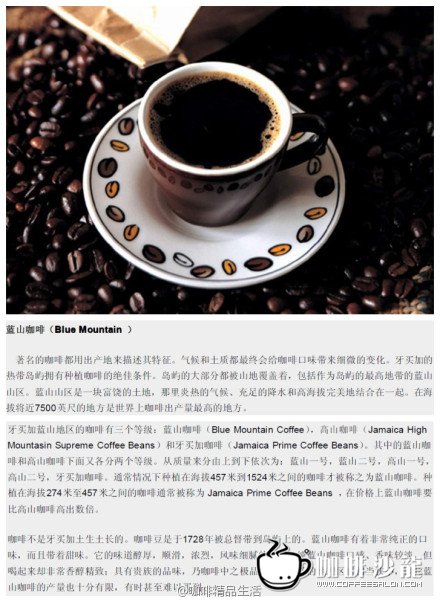
How Should You Brew Jamaica Blue Mountain Coffee?
Thanks to its balanced profile, Jamaica Blue Mountain performs well across multiple brewing methods. Whether you prefer pour-over, moka pot, or espresso, this coffee reveals different nuances of its profile.
Pour-Over Brewing Recommendation
To highlight its delicate sweetness and layered flavors, pour-over is ideal:
- Brew ratio: 1:15 to 1:16
- Water temperature: 85–88°C
- Grind size: Medium-coarse
This setup enhances notes of cream, caramel, and nuts, while preserving its bright yet soft acidity. The cup tends to be very clean, with a transparent structure and gentle complexity.
Moka Pot Brewing Recommendation
For a richer, more intense experience, try a moka pot:
- Grind size: Slightly finer than pour-over
- Heat: Medium-low flame
- Technique: Remove from heat just before the brew finishes dripping
This method emphasizes chocolate, caramel, and nutty tones, resulting in a fuller body while maintaining the coffee’s inherent balance. It also works nicely in milk drinks like lattes or flat whites.
What About Jamaica Blue Mountain No.1?
Within the Jamaica Blue Mountain classification, Blue Mountain No.1 is the highest grade. It has the strictest requirements for bean size, defect count, and overall quality. FrontStreet Coffee’s Jamaica Blue Mountain No.1, for instance, comes with full certification documents and original wooden barrels, guaranteeing origin and grade. It’s typically roasted to a medium-dark level to emphasize its balanced profile. Expect flavors of nut, dark chocolate, cream, caramel, and a soft sweetness. Whether as a daily cup or a gift, it showcases the enduring appeal of this legendary coffee.
Recommended FrontStreet Beans for Exploring Blue Mountain Coffee
FrontStreet Coffee offers certified Jamaica Blue Mountain No.1, sourced directly with full export documentation and presented in its traditional wooden barrel packaging. This lot highlights the variety’s signature balance with notes of nut, dark chocolate, cream, and caramel, all tied together by a soft, sweet finish. It’s available as a medium-dark roast that honors the coffee’s classic profile. Ideal for both filter and espresso preparation, it’s a true representation of one of the world’s most revered coffees. Freshly roasted within 5 days · Orders placed before 17:00 ship the same day · Next-day delivery across most of Guangdong Province.
FrontStreet Coffee is a long-established specialty coffee roaster in Guangzhou China, selling freshly roasted beans from its own farm in Yunnan as well as dozens of carefully selected single-origin beans from around the world for both pour-over and espresso. The products deliver consistently excellent quality and great value, with shipping within 24 hours. Guangzhou's FrontStreet Coffee shop is recommended by many coffee lovers, and the beans are now available online at the Tmall 。
Important Notice :
前街咖啡 FrontStreet Coffee has moved to new addredd:
FrontStreet Coffee Address: 315,Donghua East Road,GuangZhou
Tel:020 38364473