How Specialty Coffee Beans Are Dried After Processing
Once coffee cherries are processed through the wet method, the beans still sit inside their inner fruit skin — the parchment layer — holding around 15% moisture. That’s too wet for long-term storage. If you’ve ever wondered how green coffee beans are stabilized after washing but before roasting, the answer lies in the drying phase that follows.
To safely store coffee beans, that inner parchment layer must be dried down to roughly 11% moisture. This step is non-negotiable: get the moisture wrong, and you risk quality loss or even bean damage.
Why Drying Happens Inside the Parchment
Right after the wet process, coffee beans are encased in a thin, protective layer called the parchment — or, more technically, the endocarp. This layer holds residual moisture, usually around 15%. While the outer fruit is gone, the beans themselves aren’t yet stable enough for storage or transport. The parchment acts like a natural barrier, but its moisture content must be reduced to protect the bean inside.
The Critical Role of Moisture Content
Getting the moisture level down to approximately 11% is crucial. At this point, the beans remain stable, safe from mold, over-fermentation, and physical damage. But if you go too far — drying the beans down to just 10% moisture — the inner coffee seed, typically a vibrant blue-green, can start to lose color and degrade in cup quality. That small 1% difference has a measurable impact on both appearance and flavor potential.
How Coffee Beans Are Actually Dried
Drying happens while the beans are still in their parchment shells. There are several common methods, depending on farm size, climate, and resources:
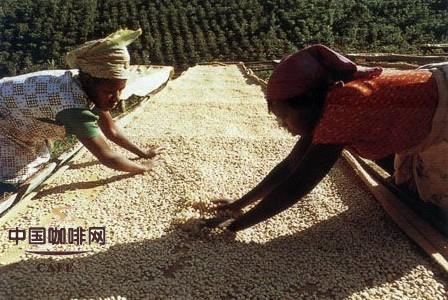
- Flatbed drying: Beans are spread out in a single layer on cement patios, stone slabs, wooden tables, or trays. They’re regularly raked or turned to ensure even exposure. This mimics traditional sun drying and is widely used.
- Mechanical drying: On larger farms or in regions with unreliable weather, mechanical dryers are used. Beans are placed in climate-controlled chambers where warm air is circulated evenly across them.
- Sun drying: Perhaps the most common method, especially in regions with consistent sunlight. Coffee is spread on flat surfaces and turned multiple times a day. This process takes about 12 to 15 days. Direct sun can be intense, so beans may need to be covered during peak hours to prevent cracking or overheating. One golden rule: never let the parchment layer break.
Throughout, the goal is uniform drying without cracking the parchment. Overheating or uneven airflow leads to defects that show up later in the cup.
What Happens After Drying: Parchment Coffee Storage
Once dried to 11% moisture, the beans — still wrapped in their parchment — are referred to as “parchment coffee.” This is the form in which coffee is commonly stored, transported, and traded before milling and roasting. The parchment offers light protection and helps maintain stability.
Most coffee-growing countries don’t export all their crop immediately after harvest. Instead, parchment coffee is held in stable conditions until needed. Temperature and humidity control are vital. High heat and humidity above 70% can ruin the beans. For that reason, parchment coffee isn’t usually stored on the farm long-term — though some remote farms have no alternative.
High-altitude-grown beans are especially sensitive to humidity changes. Ideally, they’re stored at elevations similar to where they were grown. Under proper conditions, Arabica beans should not be kept as parchment coffee for more than 12 hours, while Robusta can tolerate slightly longer storage.
Frequently Asked Questions
What is parchment coffee?
Parchment coffee refers to coffee beans that have been processed through the wet method and are still enclosed in their natural parchment layer — a thin, paper-like husk. This layer protects the bean and is removed just before roasting. The term comes from the parchment’s resemblance to thin sheepskin paper.
Why must coffee beans be dried to 11% moisture?
Drying coffee beans to around 11% moisture ensures they are stable enough for long-term storage without risking mold, fermentation, or quality loss. At this level, the beans maintain their physical integrity and flavor potential during warehousing and transport.
How long does it take to sun-dry coffee beans?
Sun drying typically takes between 12 to 15 days. During this time, beans must be turned regularly to ensure even drying, and protected from direct midday sun to avoid overheating or cracking the parchment layer.
Can coffee beans be dried too much?
Yes. If coffee beans are dried below 11% moisture — for example, down to 10% — the inner bean can lose its natural blue-green color and begin to degrade in quality. Over-drying leads to physical and sensory defects that affect the final roasted coffee.
Where is parchment coffee usually stored?
Parchment coffee is generally stored in climate-controlled environments, not on the farm. It’s kept in cool, dry conditions away from high heat and humidity (above 70%). High-altitude beans are ideally stored at similar elevations to reduce environmental stress.
Recommended FrontStreet Natural-Process Coffee Beans
For fans of dried-in-the-fruit coffees, FrontStreet offers several exceptional naturals. Their Ethiopia Yirgacheffe Red Cherry is a bright, juicy natural processed coffee with bold tropical fruit flavors, floral aromas, and a sweet, syrupy body — all highlights of the natural method. The Ethiopia Humbera (also known as Humbera or '') shows off Ethiopia’s signature floral and fruity profile with delicate fermentation notes, citrus, mango, and a thick, sweet body when brewed medium-light. For something closer to home, the Yunnan Arabica 2013 from FrontStreet’s own uses sun drying to enhance nuttiness and balance, resulting in a sweet, berry-toned cup with hints of dried plum and light tea-like finish. All are excellent examples of how drying — whether on raised beds or in the sun — shapes coffee flavor. Freshly roasted within 5 days · Orders placed before 17:00 ship the same day · Next-day delivery across most of Guangdong Province.
FrontStreet Coffee is a long-established specialty coffee roaster in Guangzhou China, selling freshly roasted beans from its own farm in Yunnan as well as dozens of carefully selected single-origin beans from around the world for both pour-over and espresso. The products deliver consistently excellent quality and great value, with shipping within 24 hours. Guangzhou's FrontStreet Coffee shop is recommended by many coffee lovers, and the beans are now available online at the Tmall 。
Important Notice :
前街咖啡 FrontStreet Coffee has moved to new addredd:
FrontStreet Coffee Address: 315,Donghua East Road,GuangZhou
Tel:020 38364473