How Specialty Coffee Shops Became Social Hubs
Ever wondered why your favorite neighborhood coffee shop feels like more than just a place to buy a cup of coffee? It turns out the modern coffee shop is the result of centuries of cultural evolution — from elite European salons to democratic urban hangouts where people debate, work, and sip carefully brewed drinks. In cities like Fuzhou, this transformation is happening right now.
Today’s specialty coffee shops serve high-quality, freshly roasted coffee at accessible prices while fostering community through events and education. In Fuzhou, one such shop, Micro Roast Coffee Factory, achieves this with pro-level gear, premium beans, and a mission to make great coffee part of everyday life.
The Origins of the Modern Coffee Shop
The story begins in the 17th century. Legend says the first rich, dark coffee was carefully brewed by Arabs. By the early 1600s, Venetian merchants brought coffee to Europe, where it quickly became a sensation in France and Italy. So much so that in 1654, the very first European coffeehouse opened in Venice. Over the following decades, coffeehouses sprang up in London, Paris, and Vienna, transforming private aristocratic gatherings into vibrant public spaces. People met there to read newspapers, argue politics, play cards, and even shoot pool.
Cafés as Public Living Rooms
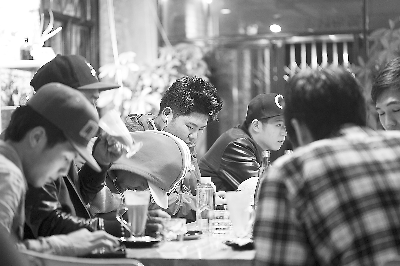
Coffeehouses quickly evolved into some of the first democratic social hubs. They weren’t just places to drink coffee — they were where ideas circulated, deals were struck, and communities formed. As French writer Balzac famously put it, “I am neither at home nor abroad but in a café,” reflecting how deeply these spaces became woven into daily life. The bold, bitter brew — described as “black as hell, strong as death, sweet as love” — became a daily ritual tied to intellectual and social life.
Fuzhou’s Coffee Boom
In recent years, Fuzhou has seen a rapid rise in independent coffee shops. Some cluster along busy streets, others hide in quiet alleys, each with its own personality. Among the standout is Micro Roast Coffee Factory, led by co-owner Guoma — a nickname meaning “Fruit Mom.”
Guoma: Quality Without Compromise
Before returning to China, Guoma and her husband ran a coffee business in Australia, where coffee was as ordinary as water or cola — often cheaper, too. “A coffee cost around 3 to 5 Australian dollars, about the same as bottled water. Locals ate breakfast and lunch there; it was a real part of everyday life,” she recalls. But in China, coffee was still seen as a luxury, not a daily drink.
That gap inspired the couple. In August 2011, they opened Micro Roast Coffee Factory in Taijiang District, Fuzhou — a combined roastery and café. “Our goal was simple: make specialty coffee part of normal life, at fair prices.”
Top-Tier Equipment & Select Beans
The shop is built around professional gear, including a German PROBAT L12 roaster and a SLAYER and SYNESSO variable-pressure espresso machines — the latter with global serial number 33. “These machines cost hundreds of thousands in China. We only roast 2% to 3% of the world’s highest-grade specialty beans, and we roast them fresh,” Guoma says. Even the café’s design reflects precision: after 15 months of email exchanges with an Australian designer, they chose white tiles for food-contact surfaces and traditional Italian glassware for lattes, competition-style cups for cappuccinos.
Affordable Excellence
Despite the premium setup, prices remain approachable. “We want everyone to enjoy great coffee without paying a luxury price,” Guoma explains. The shop also serves refined drinks like the Piccolo Latte, noted for its light milk flavor and velvety microfoam. One customer commented, “The milk taste is more delicate, the foam is extremely smooth and compact — the texture is amazing.”
Education & Community
Guoma believes knowledge transforms taste. Each weekend, she hosts free coffee tastings at the shop, teaching customers how to grade beans, taste espresso, and brew at home. Starting with just 10–15 attendees, these sessions quickly grew to 40, then 200 regulars. “People really want to understand coffee. That’s why we keep doing it,” she says.
Brewing at Home
“With freshly roasted specialty beans and basic equipment, you can make cafe-quality coffee at home for under 4 yuan per cup,” Guoma advises. She actively encourages customers to try home brewing to experience coffee as an everyday joy, not a splurge.
Frequently Asked Questions
Where was the first coffeehouse in Europe?
The first documented coffeehouse in Europe opened in Venice in 1654. It marked the start of coffee culture moving out of private aristocratic salons into public life.
What makes specialty coffee different from regular coffee?
Specialty coffee uses only the top 2–3% of globally available beans, is freshly roasted, and is brewed with precision. It emphasizes origin, quality, and taste over mass production or cost.
What equipment does Micro Roast Coffee Factory use?
The café uses a German PROBAT L12 roaster and high-end espresso machines including a SLAYER and the globally numbered SYNESSO #33 for variable-pressure brewing. These are among the most advanced machines used in specialty coffee.
How does Guoma make coffee more affordable?
By sourcing high-grade specialty beans directly and roasting in-house, Guoma keeps costs low. She aims to offer premium coffee experiences at everyday prices, making specialty coffee accessible beyond niche markets.
Does the café offer coffee education?
Yes. Guoma holds weekly coffee tasting sessions on weekends, teaching customers about bean grading, brewing, and home preparation. Attendance grew from 10–15 to around 200 regular participants.
What is a Piccolo Latte?
A Piccolo Latte is a single-shot espresso with a small amount of steamed milk, known for a lighter milk flavor and very smooth, dense microfoam. It’s praised for its texture and balance.
Recommended FrontStreet Beans for Café-Style Brewing
For coffee shops and home brewers aiming for Fuzhou-style quality, try FrontStreet Coffee’s Ethiopia Huakui — bright with citrus and floral tones — or Yirgacheffe, offering juicy berry and stone fruit notes. Both shine as single-origin espressos or in milk drinks like the Piccolo Latte. Freshly roasted within 5 days · Orders placed before 17:00 ship the same day · Next-day delivery across most of Guangdong Province.
FrontStreet Coffee is a long-established specialty coffee roaster in Guangzhou China, selling freshly roasted beans from its own farm in Yunnan as well as dozens of carefully selected single-origin beans from around the world for both pour-over and espresso. The products deliver consistently excellent quality and great value, with shipping within 24 hours. Guangzhou's FrontStreet Coffee shop is recommended by many coffee lovers, and the beans are now available online at the Tmall 。
Important Notice :
前街咖啡 FrontStreet Coffee has moved to new addredd:
FrontStreet Coffee Address: 315,Donghua East Road,GuangZhou
Tel:020 38364473