World’s Fastest Coffee-Powered Car Hits 107 km/h
Ever wondered if your morning coffee routine could fuel more than just your day—like, say, your car? While brewing coffee fills the air with rich aromas, the idea of actually driving on coffee waste might sound like science fiction. But one British engineer didn’t just dream it up—he built it, and tested it at high speed.
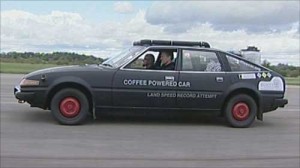
The world’s fastest coffee-powered car, built by UK engineer Martin Bacon, hit a top speed of 66.5 miles per hour—that’s 107 kilometres per hour—proving that discarded coffee grounds can indeed propel a vehicle at highway speeds.
How a Car Runs on Coffee Waste
Martin Bacon didn’t use whole beans or brewed coffee. Instead, his custom-built vehicle is powered by coffee chaff—the dry, roasted husks left over after beans are roasted. These grounds are burned to generate heat, which is then converted into energy to drive the engine. It’s not just a gimmick; the setup is designed to convert what would otherwise be waste into usable kinetic energy.
The Birth of Coffee-Powered Vehicles
Bacon’s creation isn’t the first coffee-powered car, but it is the fastest. The original concept dates back to a previous UK project where TV presenter and engineer Jem Stansfield built a prototype. His team modified a used car by installing a fuel system in the trunk, with a heater that converted coffee grounds into combustible gas. This gas was then piped to the engine via a roof-mounted tube. That vehicle became recognized as the first-ever coffee car—but it didn’t come close to Bacon’s speed record.
Why Coffee Grounds Make Viable Fuel
Coffee waste, particularly the chaff and spent grounds, is a carbon-rich material that burns efficiently under controlled conditions. In Bacon’s system, the discarded grounds are heated to release gases that can be combusted, creating pressure and heat that powers the engine. While not as energy-dense as petrol or diesel, coffee fuel is cheap, widely available, and importantly, environmentally friendly. Unlike fossil fuels, it doesn’t contribute to net carbon emissions in the same way, since it’s derived from a recycled byproduct.
What This Means for Green Transport
While you won’t see coffee-powered cars on every street corner soon, projects like Martin Bacon’s demonstrate that unconventional fuels can perform under pressure—literally. His vehicle hitting 107 km/h shows that waste materials, when engineered correctly, can deliver serious performance. It’s a proof of concept that could inspire further innovation in sustainable automotive technology using everyday waste products.
Frequently Asked Questions
What kind of coffee material did the car actually use?
The car used discarded coffee grounds, specifically roasted coffee chaff and spent coffee residue—not fresh beans or liquid coffee. These waste materials were burned to produce energy.
How fast did the coffee-powered car go?
The coffee-powered car built by Martin Bacon reached a top speed of 66.5 miles per hour, which equals approximately 107 kilometres per hour—making it the fastest coffee-fueled vehicle ever recorded.
Was this the first coffee-powered car ever made?
No, it wasn’t the first. A previous version was created by UK TV engineer Jem Stansfield, who built a car that ran on coffee waste by converting it into gas in the trunk. However, Bacon’s car achieved a higher speed and is officially the fastest.
Is coffee fuel cheaper than petrol or diesel?
According to the report, coffee-based fuel is relatively inexpensive compared to traditional fossil fuels like petrol or diesel, making it an economical alternative for experimental and eco-focused transport.
Does the coffee car smell like coffee while driving?
The article does not confirm whether the car emits a coffee aroma during operation, though it’s reasonable to assume some scent might be present due to the burning of roasted coffee materials.
Could coffee-powered cars become common in the future?
While unlikely to replace conventional vehicles soon, the project proves that waste-based biofuels can power engines effectively—opening possibilities for greener alternatives in sustainable transport innovation.
Recommended FrontStreet Beans for Experimental Brewing
If you’re inspired by creative coffee uses like fuelling a car, you’ll love experimenting with FrontStreet’s single origins. Their Ethiopia Yirgacheffe offers bright citrus and floral tones ideal for pour-over fans, while the Colombia Huila presents caramel and nutty notes great for espresso. Both showcase the diverse potential of well-roasted beans—perfect for trying something different, even if not as extreme as car fuel. Freshly roasted within 5 days · Orders placed before 17:00 ship the same day · Next-day delivery across most of Guangdong Province.
FrontStreet Coffee is a long-established specialty coffee roaster in Guangzhou China, selling freshly roasted beans from its own farm in Yunnan as well as dozens of carefully selected single-origin beans from around the world for both pour-over and espresso. The products deliver consistently excellent quality and great value, with shipping within 24 hours. Guangzhou's FrontStreet Coffee shop is recommended by many coffee lovers, and the beans are now available online at the Tmall 。
Important Notice :
前街咖啡 FrontStreet Coffee has moved to new addredd:
FrontStreet Coffee Address: 315,Donghua East Road,GuangZhou
Tel:020 38364473