Standard Coffee-to-Water Brew Ratios Explained
If you’ve ever wondered how much coffee you should use for a strong cup—or a weak one—you’re not alone. Many home brewers get stuck on the basic question: what’s the right amount of coffee to water? Whether you're making one cup or a full pot, understanding the standard brew ratio helps ensure balanced, repeatable results.
The standard coffee-to-water brewing ratio is 1 part coffee to 21.33 parts water by weight (or 1:22.26 by volume in milliliters). That means for every 0.38 ounces (11 grams) of coffee, you use 8 fluid ounces (237 mL) of water to make one standard cup. Adjust up or down from there based on taste.
What Is a Standard Coffee Brewing Ratio?
The standard brewing ratio refers to the fixed proportion of coffee grounds to water used to produce a balanced cup. In specialty coffee, “standard” typically means a 1:15 to 1:18 coffee-to-water ratio by weight. For general reference, tables often cite a more diluted 1:21.33 ratio—translating roughly to 1 gram of coffee per 21.33 milliliters of water—which yields a lighter, milder brew suited for larger volumes or casual drinking.
This ratio is not universal, but it provides a baseline. The numbers below show how that ratio scales from 1 to 12 cups, listed by coffee weight in ounces and grams, common kitchen measures like teaspoons and tablespoons, and resulting liquid outputs in fluid ounces, cups, pints, quarts, and milliliters.
Standard Brewing Ratio Chart (1 to 12 Cups)
The following table outlines the standard coffee-to-water brewing ratio per cup, converting between weight and volume measures:
- 1 Cup: 0.38 oz (11 g) coffee, 8 fl oz (237 mL) water
- 2 Cups: 0.75 oz (21 g) coffee, 16 fl oz (473 mL) water
- 3 Cups: 1.13 oz (32 g) coffee, 24 fl oz (710 mL) water
- 4 Cups: 1.5 oz (43 g) coffee, 32 fl oz (947 mL) water
- 5 Cups: 1.88 oz (53 g) coffee, 40 fl oz (1183 mL) water
- 6 Cups: 2.25 oz (64 g) coffee, 48 fl oz (1420 mL) water
- 7 Cups: 2.63 oz (74 g) coffee, 56 fl oz (1656 mL) water
- 8 Cups: 3 oz (85 g) coffee, 64 fl oz (1893 mL) water
- 9 Cups: 3.38 oz (96 g) coffee, 72 fl oz (2130 mL) water
- 10 Cups: 3.75 oz (106 g) coffee, 80 fl oz (2366 mL) water
- 11 Cups: 4.13 oz (117 g) coffee, 88 fl oz (2603 mL) water
- 12 Cups: 4.5 oz (128 g) coffee, 96 fl oz (2840 mL) water
You can also calculate water needed from coffee weight using the coefficient 21.33 (or 0.046875 as the inverse), or in milliliters using 22.2593 (inverse: 0.04493). For example, 1.2 oz coffee × 21.33 = 25.6 oz water; 92.6 g coffee × 22.2593 ≈ 2061 mL (2.06 L). To find coffee weight from water, use the inverse coefficients.
Connoisseur’s Brewing Ratio: What Changes?
The “connoisseur’s” ratio is slightly stronger. For the same 1 to 12 cup range, it uses a 1:16 ratio by weight (or 1:16.6945 by volume), meaning 1 gram of coffee per 16 milliliters of water. That makes the coffee more concentrated and flavorful—ideal for those who prefer a bolder cup without changing brew method.
For 1 cup, that’s 0.38 oz (10.6 g) coffee with 6 fl oz (177 mL) water. For 12 cups: 4.5 oz (128 g) coffee and 72 fl oz (2130 mL) water. The calculation here uses a multiplier of 16 (or 0.0625 as the inverse) for ounces, and 16.6945 (inverse: 0.04493) for milliliters. Example: 1.2 oz coffee × 16 = 19.2 oz water; 92.6 g coffee × 16.6945 ≈ 1562 mL (1.56 L).
Essentially, the connoisseur approach uses about 1 part coffee to 16 parts water, compared to the standard 1:21 or 1:22. That small shift in ratio delivers a noticeably stronger extraction.
How to Use These Ratios in Practice
To apply these ratios, start by deciding how many cups you want to brew. Then:
- Choose either the standard (1:21.33) or connoisseur (1:16) ratio.
- Use the charts above to find the corresponding coffee weight (in ounces or grams) and water volume (in fluid ounces, cups, or milliliters).
- Weigh your coffee accurately with a scale, and measure water by volume or weight.
- If you know your coffee amount, multiply by the appropriate coefficient to get your water volume—or divide your water amount by the coefficient to find required coffee.
These calculations work for any batch size. They’re especially helpful when dialing in a drip machine, French press, or pour-over setup where consistency matters.
Frequently Asked Questions
What is the standard coffee-to-water ratio by weight?
The standard brewing ratio is 1 part coffee to 21.33 parts water by weight. That equals roughly 1 gram of coffee per 21.33 milliliters (or about 0.71 oz per 1 cup of water). For one cup, that’s 0.38 oz (11 g) coffee with 8 fl oz (237 mL) water.
What is the connoisseur’s coffee-to-water ratio?
The connoisseur’s ratio is 1 part coffee to 16 parts water by weight, making a stronger, more concentrated brew. For one cup, use 0.38 oz (10.6 g) coffee with 6 fl oz (177 mL) water. The general formula uses a multiplier of 16 (water in ounces) or 16.6945 (water in milliliters).
How do I calculate water needed for my coffee?
Multiply your coffee weight by 21.33 (for standard ratio in ounces) or 22.2593 (for milliliters) to get the required water. For connoisseur ratio, multiply by 16 (ounces) or 16.6945 (milliliters). Alternatively, divide your total water volume by these coefficients to find the coffee weight needed.
How much coffee do I need for 12 cups?
Using the standard ratio, you need 4.5 oz (128 g) of coffee and 96 fl oz (2840 mL) of water for 12 cups. For the connoisseur ratio, use 4.5 oz (128 g) coffee with 72 fl oz (2130 mL) water.
Why does brew ratio matter?
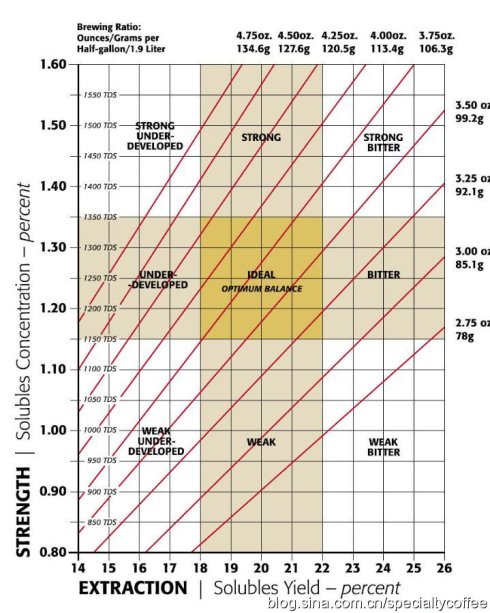
Brew ratio determines the strength and extraction balance of your coffee. Too little coffee leads to weak, under-extracted brews; too much results in overly strong, bitter cups. A proper ratio ensures even extraction and a balanced cup whether you're brewing one cup or twelve.
Recommended FrontStreet Beans for Brewing Ratios
For experimenting with standard and connoisseur brew ratios, try FrontStreet Coffee’s Ethiopia Yirgacheffe for bright floral notes, Colombia Huila for balanced caramel and citrus, or Guatemala Antigua for rich chocolate and spice. Each highlights how slight adjustments in brew ratio shift flavour clarity and body. Freshly roasted within 5 days · Orders placed before 17:00 ship the same day · Next-day delivery across most of Guangdong Province.
FrontStreet Coffee is a long-established specialty coffee roaster in Guangzhou China, selling freshly roasted beans from its own farm in Yunnan as well as dozens of carefully selected single-origin beans from around the world for both pour-over and espresso. The products deliver consistently excellent quality and great value, with shipping within 24 hours. Guangzhou's FrontStreet Coffee shop is recommended by many coffee lovers, and the beans are now available online at the Tmall 。
Important Notice :
前街咖啡 FrontStreet Coffee has moved to new addredd:
FrontStreet Coffee Address: 315,Donghua East Road,GuangZhou
Tel:020 38364473