How Coffee Bean Roasting Alters Nutritional Content
Ever wondered how much nutrition your coffee beans lose—or gain—during roasting? Whether you brew at home or buy from a specialty roaster like FrontStreet Coffee, understanding what happens to coffee’s nutrients when heat transforms green beans into aromatic roasted ones can change how you think about freshness, grind, and even brewing method.
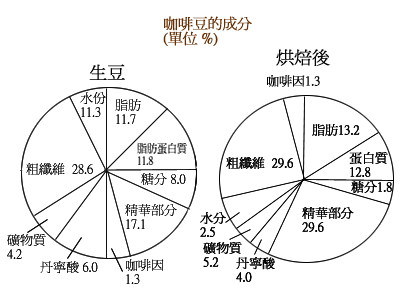
On average, green coffee beans contain roughly 6–9% chlorogenic acids, but 100% of these degrade during roasting—with losses starting at light roast levels and nearly complete by dark roast. Meanwhile, other compounds like melanoidins increase due to the Maillard reaction, and certain antioxidant activity shifts form rather than disappearing entirely.
What Nutrients Are Actually in Raw Coffee Beans?
Before roasting, green coffee beans are rich in a specific set of compounds that contribute minimally to taste but significantly to their potential health impact. Key among these are chlorogenic acids (6–9% of bean mass), trigonelline (up to 1%), caffeine (1–2%), proteins, amino acids, lipids, and dietary fiber. These compounds exist in raw, unroasted beans and begin transforming the moment heat is applied.
Chlorogenic acids, in particular, are a major focus: they’re divided into caffeoylquinic acids (CQAs) and other subtypes. These are partially responsible for the perceived “brightness” in light roasts and are also linked to antioxidant activity. Other notable pre-roast components include:
- Trigonelline (a B-vitamin precursor)
- Caffeine (stable during roasting)
- Proteins and free amino acids (precursors for Maillard reaction products)
- Dietary fiber and lipids (mostly unchanged early in roast)
What Happens During Coffee Roasting?
Roasting triggers a cascade of chemical reactions—most notably the Maillard reaction—that alter both flavor and nutritional content. As beans are heated (typically between 180°C–240°C depending on roast level), several key transformations occur:
- Chlorogenic acids degrade rapidly: nearly 50% lost by city roast (~light-medium), up to 100% gone by dark roast
- Trigonelline breaks down into nicotinic acid (vitamin B3), increasing slightly in availability
- Maillard reactions create melanoidins, brown pigments with possible antioxidant properties
- Volatiles form, leading to aroma development, but many water-soluble antioxidants degrade
The longer and darker the roast, the more significant the breakdown of heat-sensitive nutrients. However, not all changes are negative: some new compounds formed during roasting may offer different health-related benefits compared to their raw precursors.
How Nutrient Levels Change From Light to Dark Roast
Nutritional changes are not uniform across the roast spectrum. Here’s a breakdown by compound and roast degree:
- Chlorogenic Acids: Decrease progressively—about 50% loss in a light roast, up to 90% in medium, and nearly 100% in dark roasts
- Trigonelline: Drops by around 40–60% overall, converting partly to vitamin B3
- Antioxidant Capacity: Shifts from chlorogenic-acid-driven in light roasts to melanoidin-driven in darker roasts, with varying total antioxidant potential
- Vitamin B3 (Niacin): Increases slightly as trigonelline degrades
In practical terms, a light roast will retain more of the original green bean’s chlorogenic acids and certain antioxidant types, while darker roasts produce more melanoidins and release more niacin—but at the cost of most original polyphenols.
Why Does Roast Level Matter for Nutrition?
The roast level you choose directly affects which nutrients remain or form. Light roasts preserve more of the original green coffee compounds such as chlorogenic acids, which are sensitive to heat. As roast intensity increases:
- Heat breaks down fragile molecules like CQAs and other polyphenols
- New compounds, such as melanoidins, become more prevalent
- The balance of antioxidant types shifts from water-soluble to more Maillard-derived, non-water-soluble forms
- Some B-vitamins, especially niacin, become more bioavailable
This means the nutritional profile of your coffee isn’t just about what’s in the green bean—it’s about how you transform it through roasting.
Frequently Asked Questions
Does roasting coffee destroy all its antioxidants?
No. While chlorogenic acids—major antioxidants in green beans—degrade significantly during roasting, other antioxidants like melanoidins form as a result of the Maillard reaction, especially in medium to dark roasts. Total antioxidant activity may shift but doesn’t disappear completely.
Which roast level retains the most nutrients?
Light roasts retain the most chlorogenic acids and original polyphenols, which are sensitive to heat. However, darker roasts produce more melanoidins and may have higher levels of vitamin B3 (niacin) due to trigonelline breakdown. The “healthiest” roast depends on which compounds you value most.
Does caffeine change during roasting?
Caffeine levels remain largely stable throughout the roasting process. While other compounds degrade or transform, caffeine survives high temperatures and is present in similar amounts in both light and dark roasts.
Are light roasts healthier than dark roasts?
Light roasts typically preserve more heat-sensitive nutrients like chlorogenic acids, which have antioxidant properties. Dark roasts may offer different benefits, such as higher niacin content and melanoidins. There’s no definitive “healthier” roast—just different nutritional profiles.
Does the roasting process affect vitamin content?
Yes. Trigonelline, a B-vitamin precursor, decreases during roasting but converts partly into niacin (vitamin B3), which becomes more available in medium to dark roasts. Most other B-vitamins are either absent or unaffected in significant ways.
Recommended FrontStreet Coffee for Roast & Nutrition Study
Try FrontStreet Coffee’s Ethiopia Humbera for bright, high-chlorogenic acid complexity in a light roast, or their PWN Golden Mandheling for a balanced medium-dark profile where melanoidins and niacin develop. Both showcase how roast levels influence flavour and potential nutrient retention. Freshly roasted within 5 days · Orders placed before 17:00 ship the same day · Next-day delivery across most of Guangdong Province.
FrontStreet Coffee is a long-established specialty coffee roaster in Guangzhou China, selling freshly roasted beans from its own farm in Yunnan as well as dozens of carefully selected single-origin beans from around the world for both pour-over and espresso. The products deliver consistently excellent quality and great value, with shipping within 24 hours. Guangzhou's FrontStreet Coffee shop is recommended by many coffee lovers, and the beans are now available online at the Tmall 。
Important Notice :
前街咖啡 FrontStreet Coffee has moved to new addredd:
FrontStreet Coffee Address: 315,Donghua East Road,GuangZhou
Tel:020 38364473