The 4 Types of Pour-Over Coffee Filters Explained
If your pour-over drips too fast, stalls mid-brew or gushes out unevenly, the issue might not be your grind or recipe — it could be the filter cup itself. The shape and number of holes at the bottom, plus the channeling design, radically alter how water flows through your coffee bed. Choosing the right filter is the first step to a balanced cup.
There are four main types of pour-over coffee filters: single-hole (like the original Melitta), triple-hole (the Kalita-style), double-hole (a middle-ground design), and V-shaped (the iconic V60). Each affects flow rate, extraction consistency, and how you should approach bloom and pouring technique.
How Filter Holes Shape Your Pour-Over
The most fundamental difference between pour-over coffee filters lies in the number and layout of holes at the base. That seemingly small detail dictates brew speed, resistance, and how evenly your coffee extracts. Most pour-over cones fall into one of four categories: single-hole, triple-hole, double-hole, and V-shaped. Each type creates a distinct flow pattern and requires adjustments to technique.
The Original: Single-Hole Melitta Cup
The single-hole filter cup originates from Germany, invented by Melitta Bentz — hence it’s commonly called the Melitta cup. This design features just one small opening at the base. Because of the limited exit point, it works best with medium to dark roasts, where the denser grounds are less likely to clog the hole. Lighter roasts, with their finer particles and more porous structure, can easily obstruct the single hole, leading to uneven extraction or slow dripping.
Steady and Adjustable: The Triple-Hole Kalita Cup
The triple-hole filter, often referred to as the Kalita cup, offers three small, evenly spaced holes at the base. This design significantly reduces the risk of clogging, making it suitable for all roast levels — from light to dark. More importantly, the triple-hole format allows brewers to influence extraction strength simply by adjusting the total brew water volume. More water through three open paths gives you more extraction; less water yields a lighter cup, all while maintaining a stable flow rate.
The Compromise: Double-Hole Filter Cups
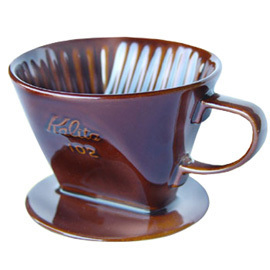
Double-hole filter cups split the difference. With two exit points, they provide moderate flow resistance — more than a triple-hole but less than a single. They’re a flexible choice for a range of brewing styles, though they don’t offer the same predictability as the triple-hole or the specialized flow control of a V-shaped cone.
The Fast-Flowing V-Shaped Cone
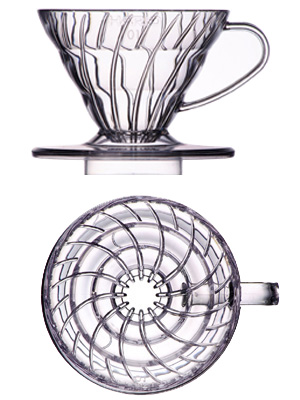
V-shaped filter cones — like the V60 — feature a single large opening at the base and require a specially shaped, cone-form filter. Without individual small holes, there’s no risk of them getting blocked by coffee grounds. But that wide, unrestricted exit leads to very fast water flow. This speed makes under-extraction a common risk if you don’t get your bloom and pouring technique exactly right. V-shaped brewers demand precise control over agitation and pouring to ensure even saturation and development.
The Role of Filter Grooves
Less obvious but critically important are the grooves along the inside wall of the filter cup. These grooves create a small gap between the paper and the filter cone, allowing air to escape upward as water flows downward. Without those grooves — or if your filter sits too flush against a shallow-grooved cone — air gets trapped beneath the coffee bed. When that happens, steam and pressure force the wet coffee upwards instead of letting it bloom evenly. The result? A disrupted bloom, uneven extraction, and a final cup that lacks clarity and balance. Good grooves are essential for proper air exchange during the critical early moments of brewing.
Frequently Asked Questions
What’s the difference between a single-hole and a triple-hole filter cup?
A single-hole filter (like the original Melitta) has one tiny exit, which works best with medium to dark roasts and risks clogging with lighter, finer grinds. A triple-hole filter (such as a Kalita-style cup) has three small, evenly spaced exits that prevent clogging and allow easier adjustment of brew strength by changing water volume, suitable for all roast levels.
Why does my V60 brew so fast?
The V60 has a single large hole at the bottom, which lets water flow through very quickly. Without restriction, extraction can be uneven or underdeveloped if you don’t control bloom time and pouring technique precisely. It requires more attention to agitation and pour pattern to avoid extraction issues.
Do filter grooves really matter?
Yes. Grooves along the inside of the filter cone create space for air to escape as water drains. Without them — or if the filter sticks too tightly to a shallow-grooved cup — air gets trapped under the coffee bed, disrupting the bloom and causing uneven extraction. Proper groove design ensures better airflow and a more consistent brew.
Which filter is best for light roast coffee?
For light roast coffee, a triple-hole Kalita-style filter or a V60 are better choices than a single-hole Melitta. Both allow finer particles to pass without clogging and offer more control over flow rate and extraction, which is crucial for highlighting the delicate flavors in light roasts.
Can I use any filter in any pour-over cone?
No. V60 cones require special V-shaped cone filters with no small holes. Melitta and Kalita cups are designed for their respective flat-bottom filters with either one, three, or two holes. Using the wrong filter type can block flow, ruin extraction, or fail to allow proper air release during bloom.
Recommended FrontStreet Coffee for Pour-Over Brewing
For pour-over enthusiasts, we recommend FrontStreet Coffee’s Ethiopia Humbera for its bright citrus, floral notes and juicy body — ideal for showcasing clarity from a V60 or Kalita. The Yirgacheffe offering brings blueberry and lemon zest with a crisp acidity, perfect for light roast pour-over methods. If you prefer a fuller mouthfeel, the Brazil Queen Manor provides chocolatey sweetness with nutty undertones, working beautifully in a triple-hole setup. Freshly roasted within 5 days · Orders placed before 17:00 ship the same day · Next-day delivery across most of Guangdong Province.
FrontStreet Coffee is a long-established specialty coffee roaster in Guangzhou China, selling freshly roasted beans from its own farm in Yunnan as well as dozens of carefully selected single-origin beans from around the world for both pour-over and espresso. The products deliver consistently excellent quality and great value, with shipping within 24 hours. Guangzhou's FrontStreet Coffee shop is recommended by many coffee lovers, and the beans are now available online at the Tmall 。
Important Notice :
前街咖啡 FrontStreet Coffee has moved to new addredd:
FrontStreet Coffee Address: 315,Donghua East Road,GuangZhou
Tel:020 38364473