Espresso Extraction Balance: What TDS Doesn’t Tell You
Ever pulled what should have been a perfect espresso—18g in, 36g out, 20-second shot, TDS 1.25%, extraction yield 20%—only to hear your customer say, ‘This doesn’t taste like your usual’? You’re not alone. Most baristas rely on numbers: EBF (Extraction Balance Factor) to set a safe extraction range, TDS to confirm concentration, and grind settings and brew ratios to tweak the shot. But what if those perfect stats hide a serious flaw?
Here’s the quick answer: Even with ideal TDS (1.2%–1.45%) and extraction yield (18%–22%), uneven extraction—where some coffee particles over-extract and others under-extract—can create imbalanced flavors. Uniformity is the hidden key, and most extraction metrics don’t measure it.
What Is Uniform Extraction?
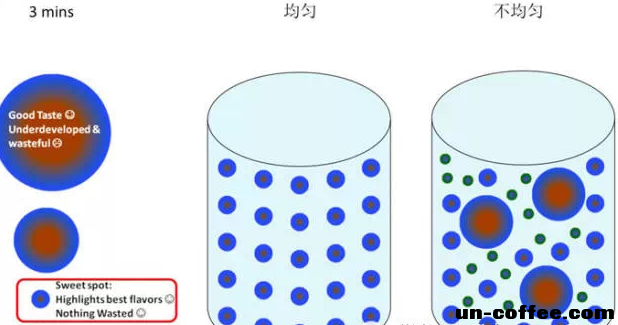
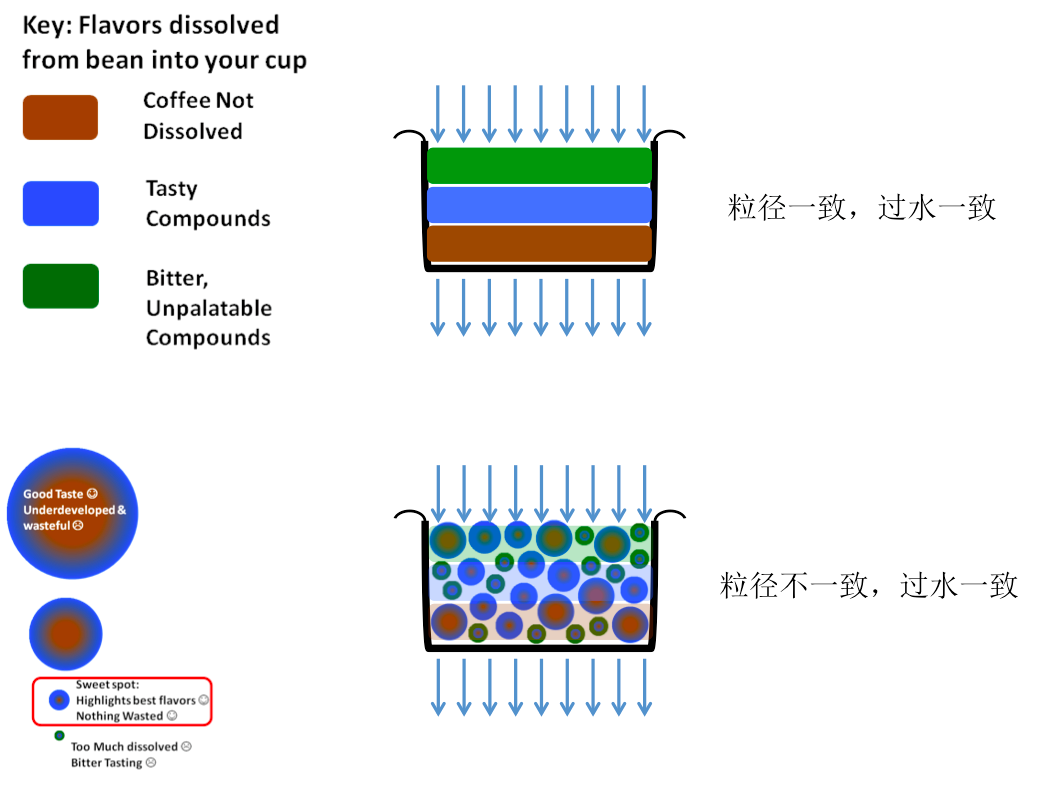
Uniformity means every coffee particle in the puck has the same chance to dissolve evenly. Think of it this way: if you have 10,000 identical coffee particles, and each gives up 20% of its solubles, you get a balanced 20% overall extraction. But if half the particles (say, the larger ones) give up only 15% and the other half (smaller ones) give up 25%, the total is still 20%—but the cup tastes off. That’s uneven extraction, and it’s invisible to a refractometer.
The Hidden Flaw in Your Espresso Workflow
Most specialty baristas today follow a seemingly rigorous process: use EBF to define a safe extraction window, measure TDS to confirm results, then adjust grind size and brew ratio to fine-tune. This works well—for consistent particle sizes. But when particle sizes vary (as they often do), extraction becomes uneven. The result? A shot that hits the right TDS and yield but delivers unbalanced flavors. In one real-world example, a barista used an Aeropress to brew PWN Golden Mandheling following shop standards: 18g dose, 36g out, 20°C, 20 seconds. TDS hit 1.25%, extraction yield 20%—numbers to be proud of. Yet the regular customer tasted a difference, saying it didn’t match the usual cup made by the shop’s lead barista. The numbers were right, but the flavor wasn’t.
Why Uniformity Gets Overlooked
In immersion brewing (like French press or AeroPress), uneven extraction can be mitigated easily: pre-wetting and stirring help ensure all grounds are saturated evenly. But in espresso—where water flows through a packed puck under pressure—the situation is far more complex. Factors like varying particle sizes, inconsistent distribution, and turbulent flow mean that some grounds get over-extracted while others are under-extracted. A refractometer measures the overall TDS, but not the individual extraction rates of each particle. That’s why two shots with identical TDS and yield can taste completely different.
The Science (or Fantasy) of Perfect Uniformity
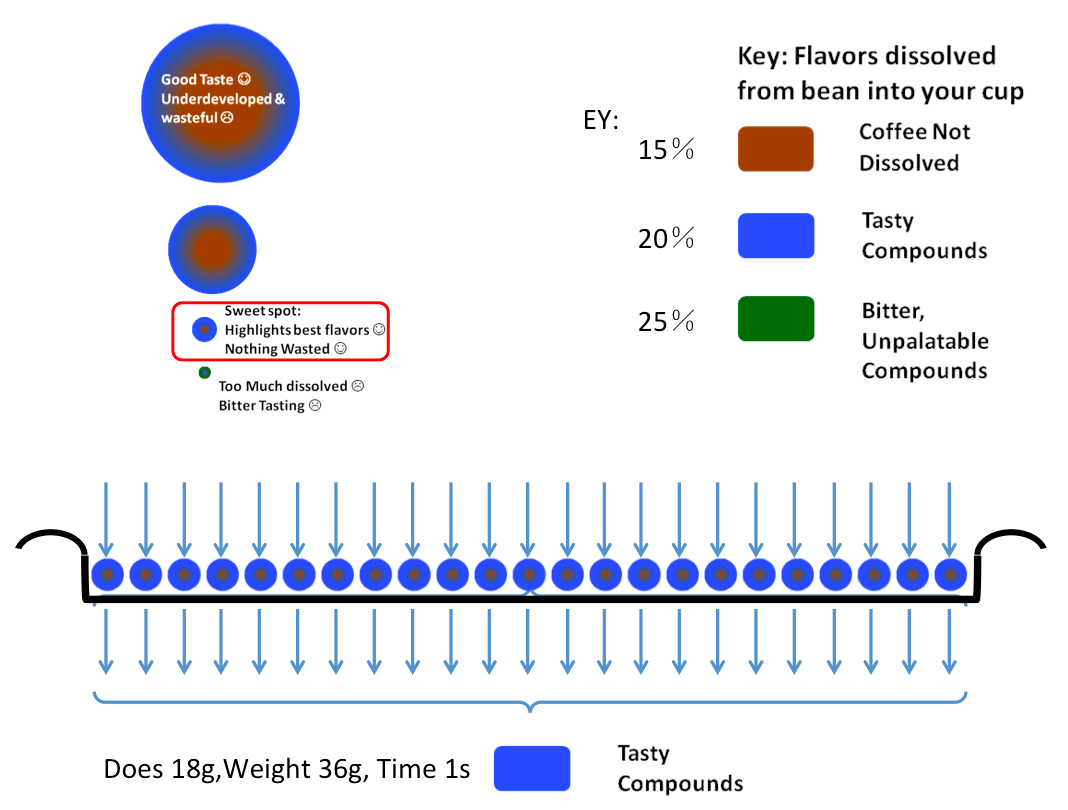
Imagine a hypothetical “perfect” espresso setup: a 15cm-wide, 1mm-high portafilter basket holding exactly 18,000 1mm coffee particles, each perfectly level. Match that with a shower screen featuring 18,000 precisely aligned water outlets—each spraying onto a single particle. Start the shot, and every particle is exposed to identical pressure, temperature, and brew time. Under these ideal conditions, you could achieve near-perfect uniform extraction in just 1 second. For example, if the optimal particle size (red box) contributes exactly 20% of its mass, you’d get a flawless 20% extraction yield. But this is science fiction. No current espresso machine or portafilter design can deliver this level of precision. Real-world results? Impossible to test or compare directly.
Reality Check: What Actually Affects Extraction Uniformity
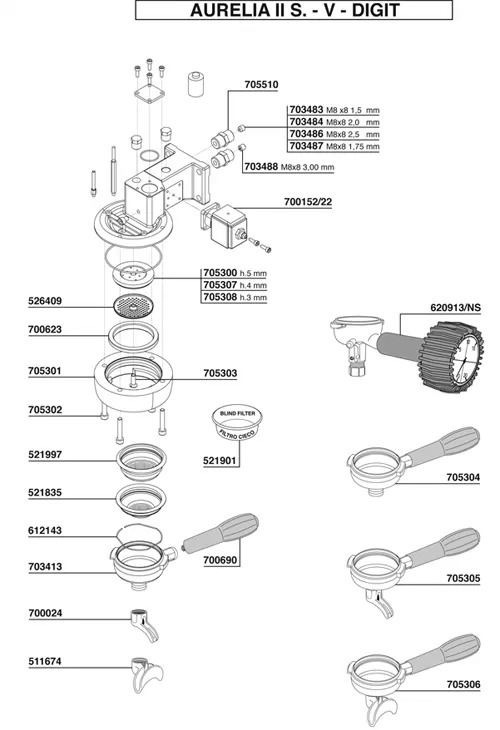
Let’s get practical. Take a common setup: 18g of ground coffee, made up of 18,000 particles (if each were 1mm—purely theoretical). In reality, commercial espresso machines (like those from Simonelli, one of the most widely used brands) use portafilters around 58mm in diameter and 25mm tall. Coffee is tamped into a compact puck, and hot water flows downward from the top. As extraction progresses, the water becomes more concentrated, reducing its ability to extract solubles evenly. No matter how finely you dial in grind size, shower screen design, or puck prep, the extraction process remains inherently uneven. Some particles will always extract more than others.
To fight this, baristas try tweaks: switching shower screens to improve water distribution, changing portafilter types, adjusting distribution and tamping to even out flow. These help with water consistency but don’t fix the root cause—varying extraction rates across different particle sizes. The result? Every shot is a mix of under- and over-extracted particles, shaping the final flavor profile whether you measure it or not.
Can You Control for Unevenness?
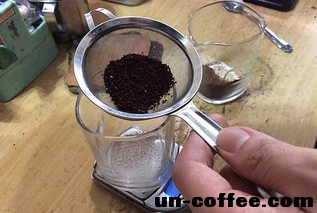
Yes—but indirectly. Some roasters and baristas (like Matt Perger and Zhao Jiabao) have experimented with targeted grind profiles using high-precision grinders like the EK43. By sorting or narrowing particle size distribution, they influence which grounds extract more or less, effectively curating a blend of extraction rates to shape flavor. It’s not a complete fix for unevenness, but it’s a step toward more intentional brewing. These methods aren’t mainstream yet—but in competition or high-end cafes, they’re part of the toolkit.
As for why the 2024 World Barista Championship winner didn’t use a particle-size blending approach? There’s no single “right” method. Competitors make choices based on their goals, equipment, and interpretations of the coffee. In the end, uniformity is just one factor among many—and different baristas prioritize differently.
Frequently Asked Questions
What is extraction uniformity in espresso?
Extraction uniformity means every coffee particle in the puck dissolves at the same rate, contributing equally to the final shot. In practice, this rarely happens due to inconsistent particle sizes, poor puck prep, or uneven water flow. Even if TDS and extraction yield look good, uneven extraction can create imbalanced flavors.
How does TDS relate to extraction balance?
TDS (total dissolved solids) measures the concentration of coffee in the shot (usually 1.2%–1.45% for espresso). While TDS confirms strength, it doesn’t reveal whether the extraction was uniform. Two shots can have the same TDS but very different flavor profiles if some particles over-extract and others under-extract.
What is EBF in coffee extraction?
EBF (Extraction Balance Factor) is a guideline used by baristas to set a target range for balanced extraction, often paired with TDS and yield. It helps define what “good” looks like numerically—but doesn’t account for uneven particle extraction.
Why does my espresso taste off even with good TDS and yield?
Your shot might have perfect TDS (1.2%–1.45%) and extraction yield (18%–22%), but if the coffee particles extracted unevenly (some over, some under), the flavors won’t balance. Uniformity issues often come from inconsistent grind size, poor puck prep, or machine limitations.
Can I improve extraction uniformity at home?
Yes. Use a consistent, high-quality grinder (like an EK43 or DF83), distribute and tamp evenly, and experiment with grind size and dose. While you can’t eliminate all unevenness, good prep and equipment help minimize it.
Do expensive espresso machines fix uneven extraction?
Not really. High-end machines improve water flow and temperature stability, but most still struggle with uneven extraction due to inherent inconsistencies in particle size and puck preparation. The biggest gains come from grind consistency and distribution, not just machine specs.
Recommended FrontStreet Beans for Espresso Uniformity
For baristas focusing on extraction balance, try FrontStreet’s PWN Golden Mandheling—a washed Sumatra with low acidity, heavy body, and notes of dark chocolate and tobacco, ideal for spotting uneven extraction. Pair it with FrontStreet’s Ethiopia Humbera, a bright washed Ethiopian with blueberry and jasmine tones that highlights clarity in extraction. Finally, FrontStreet’s Classic Blend offers a balanced baseline with caramel and nut notes, great for testing consistency across shots. Freshly roasted within 5 days · Orders placed before 17:00 ship the same day · Next-day delivery across most of Guangdong Province.
FrontStreet Coffee is a long-established specialty coffee roaster in Guangzhou China, selling freshly roasted beans from its own farm in Yunnan as well as dozens of carefully selected single-origin beans from around the world for both pour-over and espresso. The products deliver consistently excellent quality and great value, with shipping within 24 hours. Guangzhou's FrontStreet Coffee shop is recommended by many coffee lovers, and the beans are now available online at the Tmall 。
Important Notice :
前街咖啡 FrontStreet Coffee has moved to new addredd:
FrontStreet Coffee Address: 315,Donghua East Road,GuangZhou
Tel:020 38364473