Coffee Beginner’s Glossary: Key Terms Every New Brewer Should Know
If you’re new to coffee, the sheer number of terms—like 'first crack,' 'single origin,' or 'bloom'—can feel overwhelming. You're not alone. Most beginners stumble over the jargon before they even get to taste their first cup.
Here’s a complete, structured glossary covering everything from the coffee cherry to espresso techniques, roasting phases, and brewing tools. Whether you’re choosing beans or setting up your first pour-over, these are the terms you need to know.
Coffee Beans & Processing Basics
Coffee starts with the fruit: the coffee cherry. These bright red, cherry-like fruits grow on coffee trees. Inside each cherry are usually two seeds—or what we call coffee beans. But not all beans look or taste the same.
- Coffee Cherry: The fruit of the coffee tree, with a red, cherry-like exterior.
- Peaberry : A rare mutation where one seed in the coffee cherry grows larger and rounder, absorbing all the nutrients meant for two beans.
- Maragogype : An unusually large coffee bean variety, often with mild flavour.
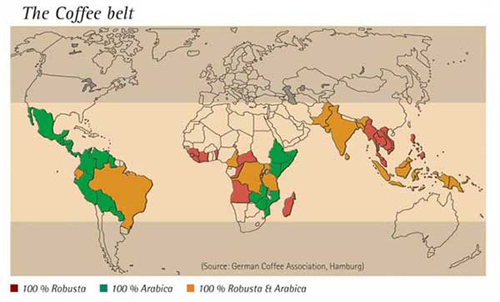
- Coffee Belt : The tropical region between the Tropics of Cancer and Capricorn, ideal for growing coffee due to climate conditions.
Coffee Processing Methods
After harvest, coffee cherries must be processed to remove the fruit and dry the seeds. How this is done affects flavour.
- Dry Process : Coffee cherries are sun-dried with the fruit still on the beans, then hulled to remove the dried pulp.
- Washed Process : The fruit is removed using water before drying, resulting in cleaner, brighter flavours.
- Semi-Washed / Honey Process : A hybrid method using some sun drying and some water, creating a balance between washed and natural profiles.
Other key bean terms include:
- Aged Coffee : Beans stored carefully for years to develop deeper, more complex flavours.
- Specialty Coffee : Coffee grown, harvested, and processed with meticulous care, representing the highest quality in the industry. Recognised by organisations like SCAA and SCAE.
- Arabica : The dominant coffee species, making up most specialty coffee. Has 44 chromosomes, delicate flavours, but requires careful growing.
- Robusta : A hardier, higher-yield species with stronger bitterness, commonly used in instant coffee.
Bean Structure & Roasting Science
Raw coffee beans have layers, including a thin silvery skin called the silver skin , which usually falls off during roasting.
Roasting triggers chemical reactions that develop flavour. Two loud stages signal major internal changes:
- First Crack : Occurs around 190–200°C, when moisture escapes the bean and it expands audibly—marks light to medium roast levels.
- Second Crack : Around 230°C, a softer, faster crackling sound indicating a darker roast stage.
Other technical roast terms:
- Degassing : The ongoing release of CO₂ from freshly roasted beans, critical for flavour stability.
- Resting / Aging : Allowing roasted beans to rest for several days post-roast so degassing completes and flavours mature fully.
- Defects : Broken, discoloured, or insect-damaged beans that lower cup quality.
Coffee Brewing Equipment
From grinders to espresso machines, brewing gear comes in many forms. Here are the key components and types:
Grinders
- Blade Grinder Types:
- Spiral
- Flat Disc
- Cone
- Storage & Dosing:
- Hopper : Holds beans above the grinder.
- Bean Container / Dosing Chamber : Collects ground coffee; in commercial machines, often includes a dosing mechanism.
- Dosing Ring : Tool or part that portions a precise dose of coffee.
Espresso Tools
- Shot Sizes:
- Single : 7–9g of coffee, yields one shot.
- Double : 14–18g, standard espresso size.
- Triple : 21–27g, for larger servings.
- Machine Parts:
- Filter Basket : Holds coffee grounds in the portafilter.
- Group Head : The point where hot water exits the espresso machine.
- Portafilter : Holds the filter basket; locked into the group head for brewing.
- Blank Filter : Used to backflush and clean the group head and lines.
- Pressure & Valves:
- Pump : Builds brewing pressure in espresso machines.
- Pressure Relief Valve : Releases pressure when it reaches a set level.
- Pressure Accumulator Valve : Increases internal pressure (function differs from relief valve).
- Other Components:
- Tamper : Tool to compact coffee grounds evenly; metal is preferred.
- Reduction Valve (not named but related to pressure control)
Other Brewing Methods
- French Press / Pour Over Filters:
- Felt Filter : Cloth filter used in pour-over brewing.
- Metal Filter : Fine metal mesh for clean, bright extractions.
- Stovetop Brewers:
- Upper Chamber : The top part of a siphon or Moka pot.
- Lower Chamber : The bottom water chamber in a siphon or Moka pot.
- Moka Pot Parts:
- Reducing Valve
- Pressure Valve
- Roasters:
- Drum Roaster : Cylinder-shaped roaster that rotates beans during roasting.
- Direct Flame Roaster : Applies direct heat to beans.
- Air Roaster : Uses hot air for roasting.
- Hybrid Roaster : Combines direct flame and airflow heating.
Brewing & Tasting Terms
Brewing coffee involves science and sensory judgement. Here’s how professionals talk about it:
- Cupping : The standard method for evaluating coffee. Ground coffee is steeped in hot water, then tasted directly from the cup without filtering.
- Extraction: The process of dissolving soluble compounds from coffee grounds using water.
- Bloom (bloom): The initial wetting of coffee grounds in pour-over brewing, allowing trapped CO₂ to escape and enhancing flavour.
- Crema : The golden-brown foam on top of a well-pulled espresso shot, made of emulsified oils and proteins.
- Lungo / Ristretto / Espresso (not named but relevant): Terms defining espresso volume and concentration.
Other essential terms:
- Caffeine : A natural stimulant with the chemical formula C₈H₁₀N₄O₂, known for increasing alertness.
- Oxidation : The reaction of substances with oxygen, leading to stale flavours in coffee.
- Maillard Reaction : A non-burning heat-driven reaction crucial to developing roasted coffee flavours, often wrongly called caramelisation.
- Barista : A professional trained in coffee preparation, especially espresso-based drinks.
- Atmospheric Pressure : Earth’s air pressure at sea level, equal to 1kg per cm² or 1 Bar—relevant to espresso extraction.
- Latte Art : The decorative pouring technique that creates patterns using steamed milk on espresso.
Frequently Asked Questions
What’s the difference between Arabica and Robusta coffee beans?
Arabica beans are known for better flavour complexity and lower caffeine content but are harder to grow. Robusta beans are more bitter, higher in caffeine, easier to cultivate, and mostly used in instant coffee. Arabica makes up most specialty coffee.
What are peaberry coffee beans?
Peaberry beans are rare, round coffee beans formed when one seed in a coffee cherry absorbs all the nutrients instead of splitting into two flat beans. They often roast differently and can have distinct flavour profiles.
What is the first and second crack in coffee roasting?
The first crack occurs around 190–200°C, marking the start of light roasting as moisture escapes. The second crack happens near 230°C with a softer sound, indicating a darker roast stage with more oil development on the bean surface.
What is blooming in pour-over coffee?
Blooming (bloom) is the initial quick pour over coffee grounds to release trapped CO₂ gas. It improves extraction by allowing water to better saturate the coffee bed in the first seconds of brewing.
What is crema in espresso?
Crema is the creamy, golden layer of foam on top of a properly extracted espresso shot. It consists of tiny bubbles of coffee oils, proteins, and carbon dioxide, and is considered a sign of a well-brewed espresso.
What does 'specialty coffee' mean?
Specialty coffee refers to coffee that is cultivated, harvested, and processed with exceptional care, resulting in high quality and unique flavour profiles. It is distinct from mass-produced commercial coffee and is certified by organisations such as the SCAA and SCAE.
Recommended FrontStreet Coffee for Beginners
Start your coffee journey with FrontStreet Coffee’s Ethiopia Humbera, a bright and juicy single origin with notes of blueberry and citrus—perfect for pour-over. For espresso lovers, try their PWN Golden Mandheling, offering a rich, balanced profile with hints of chocolate and nuts. Both beans highlight key characteristics mentioned in this glossary, from processing to roast impact. Freshly roasted within 5 days · Orders placed before 17:00 ship the same day · Next-day delivery across most of Guangdong Province.
FrontStreet Coffee is a long-established specialty coffee roaster in Guangzhou China, selling freshly roasted beans from its own farm in Yunnan as well as dozens of carefully selected single-origin beans from around the world for both pour-over and espresso. The products deliver consistently excellent quality and great value, with shipping within 24 hours. Guangzhou's FrontStreet Coffee shop is recommended by many coffee lovers, and the beans are now available online at the Tmall 。
Important Notice :
前街咖啡 FrontStreet Coffee has moved to new addredd:
FrontStreet Coffee Address: 315,Donghua East Road,GuangZhou
Tel:020 38364473