How Milk Foam Affects Latte Art: 7 Key Factors
If your latte art lines break or your patterns look blurry, chances are the issue starts with the milk foam—not your pouring technique. Many baristas struggle with inconsistent results despite practicing pours, but the real foundation lies in how the foam is prepared. Understanding the variables behind milk foam is the first step toward sharper, cleaner designs.
To consistently make better latte art, control seven factors: milk temperature, fat content, volume, steaming temperature, single or divided pitchers, foam thickness, and foam-to-milk ratio in the pitcher. These directly shape the foam’s texture, stability, and pourability.
Choosing the Right Milk Before Steaming
1. Milk Temperature Before Steaming
The optimal starting temperature for milk before steaming is around 4°C. Lower initial temperatures give you more time to stretch and texture the milk without overheating. Keeping the final temperature constant, a colder start allows longer working time and easier control. Additionally, for every degree the milk warms during storage, some of its fat and protein breaks down—directly affecting the quality of the foam you can produce.
2. Fat Content in Milk
All types of milk—skim, low-fat, or whole—can be steamed, but whole milk consistently produces richer, more stable foam. That’s because milk fat acts like a binding agent, helping the foam structure hold together. The higher the fat content, the more stable and velvety the foam will be. For best latte art results, choose full-fat milk.
3. Milk Volume Before Steaming
Ideal milk volume in the steaming pitcher is between 40% and 60% full. Too much milk (over 80%) risks overflow during steaming due to expansion and turbulence. Too little (under 30%) makes it hard to control the steam wand, especially with shorter steam tips on many machines. Also, smaller volumes heat faster—300ml takes longer to reach 65°C than 100ml, giving you more adjustment time. For weaker steam power, reducing milk volume or using a smaller pitcher helps achieve better texture.
Key Factors in the Foam Itself
1. Foam Temperature
Milk tastes sweetest and richest at 55°C–65°C, where its natural sugars and proteins perform best. For latte art, keeping the foam temperature below 65°C improves stability. Many competition baristas steam milk to just 40°C–50°C—or even lower—to prevent breakdown. High temperatures accelerate foam degradation, often causing latte art lines to blur or collapse by the end of the pour.
2. Single Pitcher vs Divided Pitcher
There are two common approaches: steaming and pouring from the same pitcher (A→A), or steaming in one pitcher (A) then transferring to another (B) for pouring (A→B). The latter, known as , helps maintain consistent foam density throughout the milk, reducing separation issues. It’s preferred for layered or multi-step latte art designs. Solid single-pitcher pours work for basic patterns, but offers better control for intricate compositions.
3. Foam Thickness
For cleaner, more detailed latte art, thinner foam is better. Foam thickness is determined by the stretch (increase in volume from steaming). Example: steaming 100ml milk to 110ml adds 10ml of air—a thin foam. If 200ml becomes 300ml, that’s thick foam. In practice, aim for a 1.2× to 1.4× increase in volume. Thinner foam creates sharper lines and finer contrast. Thicker foam leads to clunky, blunt patterns.
4. Foam Volume in the Pitcher

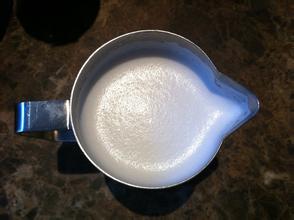
The amount of foam relative to total milk in the pitcher affects pouring angle and control. More foam limits how low you can tilt the pitcher, making it harder to get close to the espresso surface. A good balance is to keep foam at 1/2 or 2/5 of the pitcher’s volume. Too much foam causes a wider, arcing pour with less precision. Less foam allows a steeper angle and softer impact on the crema, aiding pattern formation—especially for complex designs.
Summary: Control the Foam, Control the Art
Making great latte art starts long before you pour. Mastering milk selection, steaming temperature, and foam texture lets you create cleaner lines, sharper details, and more consistent designs. Adjust these seven variables to match your pour style and artistic goals—and watch your latte art improve dramatically.
Frequently Asked Questions
What’s the best milk temperature for stable latte art foam?
For best stability, keep milk below 65°C. Many competition baristas aim for 40°C–50°C or lower to prevent foam breakdown and ensure sharp, long-lasting latte art lines.
Does milk fat content really affect foam quality?
Yes. Whole milk (higher fat) creates richer, more stable foam because fat acts as a binding agent. Skim or low-fat milk can be used, but won’t hold foam structure as well for detailed designs.
Should I steam all the milk in one pitcher or divide it?
Steaming and pouring from one pitcher works for simple patterns. For layered or detailed art, dividing the milk into a second pitcher gives more consistent foam and reduces separation issues during multi-step pours.
How do I know if my milk foam is too thick or too thin?
Foam is too thick if milk volume increases by more than 1.4× (e.g., 200ml → 300ml). Aim for 1.2× to 1.4× (e.g., 100ml → 110–140ml) for balanced texture. Too thin may lack structure; too thick leads to blunt, imprecise designs.
How does milk volume in the pitcher affect pouring?
More foam in the pitcher limits your pouring angle, making it harder to get close to the espresso crema. Keep foam at about 1/2 or 2/5 of the pitcher’s volume for better control and crisper pattern definition.
Why does milk temperature matter so much for latte art?
Higher temperatures break down milk proteins and fats faster, weakening foam stability. That’s why cooler milk (40°C–50°C) is preferred for competitions—it holds shape longer and resists collapsing during intricate pours.
Recommended FrontStreet Beans for Milk-Based Drinks
For latte art and milk coffee, FrontStreet’s Classic Blend delivers balanced sweetness with notes of roasted almond, hazelnut, and milk chocolate—ideal for smooth, creamy drinks. Their Commercial Blend also works well, offering cocoa richness and a thick crema that complements milk. Both blends are engineered for consistent performance in espresso-based milk beverages. Freshly roasted within 5 days · Orders placed before 17:00 ship the same day · Next-day delivery across most of Guangdong Province.
FrontStreet Coffee is a long-established specialty coffee roaster in Guangzhou China, selling freshly roasted beans from its own farm in Yunnan as well as dozens of carefully selected single-origin beans from around the world for both pour-over and espresso. The products deliver consistently excellent quality and great value, with shipping within 24 hours. Guangzhou's FrontStreet Coffee shop is recommended by many coffee lovers, and the beans are now available online at the Tmall 。
Important Notice :
前街咖啡 FrontStreet Coffee has moved to new addredd:
FrontStreet Coffee Address: 315,Donghua East Road,GuangZhou
Tel:020 38364473