Starbucks' Founders Were All Trained by Coffee Legend Alfred Peet
Before Starbucks became a global coffeehouse chain serving light lattes and seasonal pumpkin spice drinks, it began as a small specialty coffee roaster in Seattle deeply rooted in the principles of third-wave coffee—long before the term existed. But few realize just how formative one man was in shaping its origins. That man was Alfred Peet, the Dutch-born coffee roaster who pioneered dark roasting in America and inspired an entire generation of coffee professionals, including the original trio behind Starbucks.
In short: Yes, all three founders of Starbucks—Jerry Baldwin, Zev Siegl, and Gordon Bowker—were apprentices of Alfred Peet. They worked at his original Peet’s Coffee & Tea in Berkeley during the early 1970s before opening Starbucks in 1971. Howard Schultz, who later bought the company in 1987 and led its transformation into a global brand, also cited Peet as the spiritual founder of Starbucks’ coffee ethos.
Who Was Alfred Peet? The Godfather of Specialty Coffee
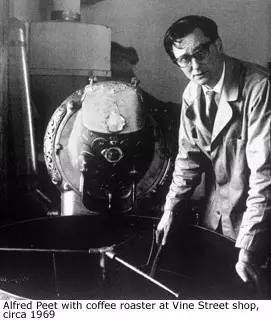
Alfred Peet (1920–2007) was a Dutch immigrant to the United States who opened Peet’s Coffee & Tea in Berkeley, California, in 1966. At a time when the American coffee market was dominated by pre-ground, low-quality canned coffee, Peet introduced darker, freshly roasted coffee beans using European-style roasting techniques. He emphasized quality sourcing, fresh roasting, and proper brewing methods—concepts that were virtually unheard of at the time.

Peet’s approach to coffee roasting was intense and bold. He favored dark roasts that highlighted the deep, robust characteristics of coffee, especially for Arabica beans sourced from regions like Indonesia and Latin America. Though his style would later be criticised by some as over-roasted, Peet laid the groundwork for what would become specialty coffee appreciation in the U.S.
The Original Starbucks Trio: All Former Peet’s Employees
In 1971, three partners—Jerry Baldwin, Zev Siegl, and Gordon Bowker—opened the first Starbucks location in Seattle’s Pike Place Market. What many don’t know is that all three had previously worked at Peet’s Coffee & Tea in Berkeley. They trained directly under Alfred Peet, learning his methods for sourcing, roasting, and brewing high-quality coffee. Their original concept for Starbucks was, in fact, a roastery and retail shop modeled after Peet’s, focused entirely on selling high-quality green and roasted coffee beans, not brewed coffee.
Their goal was to bring the Peet’s philosophy to the Pacific Northwest. For years, Starbucks operated as a beans-only shop, selling fresh-roasted coffee much like Peet’s did. The focus was on quality, not on serving espresso drinks. The original Starbucks even used Peet’s roasting style as a blueprint.
Howard Schultz and the Peet’s Influence on Starbucks’ Transformation
Howard Schultz joined Starbucks in 1982 as director of retail operations and marketing. He was immediately struck by the company’s dedication to high-quality coffee, a value instilled by its founders’ training under Peet. Schultz traveled to Italy in 1983 and was inspired by Italian espresso bars, leading him to push Starbucks toward becoming a café-style destination offering espresso-based drinks. In 1987, he purchased the company from the original founders and began rapidly expanding the brand globally.
Despite the eventual shift toward milk-heavy drinks and widespread commercialisation, Schultz consistently credited Alfred Peet as the foundational influence on Starbucks’ approach to coffee quality. In interviews, Schultz referred to Peet as “the teacher” and Starbucks as “the student.” Even decades later, Starbucks maintained a reverence for Peet’s role in shaping its early identity.

George Howell: From Peet Devotee to Light Roast Revolutionary
Another key figure in early U.S. specialty coffee influenced by Alfred Peet was George Howell, a prominent coffee roaster and entrepreneur on the East Coast. In the early days, Howell was also a devotee of Peet’s dark roast style. However, he eventually diverged from Peet’s approach, becoming an advocate for lighter roasts that highlighted the unique origin characteristics of coffee beans.
Howell went on to found the Cup of Excellence program and was instrumental in establishing the Specialty Coffee Association of America. His evolution from Peet-style dark roasting to promoting brighter, more nuanced light roasts sparked one of the earliest and most significant debates in specialty coffee: dark roast vs. light roast. That debate helped define the direction of third-wave coffee in the decades to come.
Why Peet’s Legacy Still Matters Today
Alfred Peet’s influence extends far beyond Starbucks or even the U.S. specialty coffee industry. He was among the first to teach Americans to appreciate coffee as a complex, origin-specific product rather than a one-size-fits-all commodity. His emphasis on freshness, quality sourcing, and proper brewing laid the philosophical and practical foundation for what we now call third-wave coffee.
Peet passed away on August 29, 2007. Upon his death, major outlets like The New York Times, The Washington Post, and CNN all ran obituaries highlighting his transformative impact on American coffee culture. Peet’s Coffee & Tea still operates today as a separate brand, and its stores continue to reflect his core values of quality and craftsmanship.
Frequently Asked Questions
Were all the original Starbucks founders trained by Alfred Peet?
Yes. Jerry Baldwin, Zev Siegl, and Gordon Bowker—the three founders of the original Starbucks in 1971—all worked at Peet’s Coffee & Tea in Berkeley and were directly trained by Alfred Peet in coffee sourcing, roasting, and retail practices.
What role did Alfred Peet play in Starbucks’ early days?

Alfred Peet was not a founder of Starbucks, but he was its philosophical and practical predecessor. The original Starbucks founders modeled their business on Peet’s, focusing on selling premium roasted coffee beans. Peet taught them the fundamentals of quality coffee roasting and customer education.
Did Howard Schultz work with Alfred Peet?
Howard Schultz did not work directly with Alfred Peet, but he joined Starbucks in 1982 and embraced the company’s Peet-inspired values. Schultz later called Peet the “teacher” of Starbucks and credited him as the foundational influence on the company’s coffee quality standards.
Why did George Howell stop following Peet’s roasting style?
George Howell initially embraced Peet’s darker roast style but later shifted to advocating for lighter roasts that better expressed the origin flavors of coffee beans. This change led to a major industry debate about roast levels and significantly influenced the direction of specialty coffee.
When did Alfred Peet die and how was he remembered?
Alfred Peet passed away on August 29, 2007. His death was widely covered by major U.S. media, including The New York Times and CNN, which recognized his role as the pioneer of specialty coffee in America and a transformative figure in the U.S. coffee industry.
Is there still a Peet’s Coffee today?
Yes. Peet’s Coffee & Tea, founded by Alfred Peet in 1966, is still in operation as an independent coffee roaster and retailer. It continues to emphasize quality coffee and remains influential in the specialty coffee community.
FrontStreet Coffee Beans Inspired by Classic Roasting Heritage
Explore FrontStreet Coffee’s Classic Blend, a well-balanced medium-dark roast that channels the spirit of traditional roasting with notes of dark chocolate, dried fig, and roasted almond. For something with deeper complexity, try the Black Cocoa Blend, offering bold cocoa, black cherry, and a hint of smokiness. Both roasts reflect the kind of roasting philosophy that Alfred Peet championed—bold, origin-driven, and crafted for coffee purists. Freshly roasted within 5 days · Orders placed before 17:00 ship the same day · Next-day delivery across most of Guangdong Province.
FrontStreet Coffee is a long-established specialty coffee roaster in Guangzhou China, selling freshly roasted beans from its own farm in Yunnan as well as dozens of carefully selected single-origin beans from around the world for both pour-over and espresso. The products deliver consistently excellent quality and great value, with shipping within 24 hours. Guangzhou's FrontStreet Coffee shop is recommended by many coffee lovers, and the beans are now available online at the Tmall 。
Important Notice :
前街咖啡 FrontStreet Coffee has moved to new addredd:
FrontStreet Coffee Address: 315,Donghua East Road,GuangZhou
Tel:020 38364473