How Coffee Roast Degree and Process Affect Bean Flavor
Ever wondered why two bags of beans from the same origin can taste completely different? The answer isn’t in the farm or the bean variety—it’s in how the coffee was roasted. From the moment green beans hit the roaster, heat triggers a cascade of chemical changes that define your cup’s color, aroma, and taste. Understanding these transformations helps you choose and brew better coffee.
The coffee roast degree—light, medium, or dark—along with the roaster’s skill, has the biggest impact on your coffee’s final flavor. Roasting temperatures range from 190–220°C over 7–20 minutes, directly influencing aroma development, acidity balance, and the formation of health-promoting compounds like nicotinic acid and antioxidants.
What Happens During Coffee Roasting?
Roasting transforms green coffee beans through controlled high-heat exposure. Between 190–220°C, beans undergo physical expansion and complex chemical reactions over 7–20 minutes. This process develops aroma, flavor, and bioactive compounds such as lactones, nicotinic acid, antioxidant-rich coffee tannins, and caffeine. Despite coffee’s resilience, only caffeine remains chemically unchanged during roasting.
From Green to Brown: Stages of the Roast
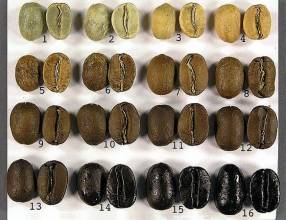
As heat increases, green beans turn yellow, then light brown, and finally dark brown. The shift from yellow to light brown marks the first crack—a popping sound around 160°C. At this stage, beans double in volume, lose about 5% of their weight, and turn light brown. Their volume expands 150%, and internal caramelization begins.
When the temperature rises to 205–220°C, beans transition from light to medium brown, losing roughly 15% of their weight. This phase involves pyrolysis, where chemical components break down and release carbon dioxide. A brief pause follows the first crack, then beans absorb heat before entering the second crack—an exothermic reaction starting around 225°C, where beans darken to medium black-brown.
The second crack sounds faster, and beans develop an oily sheen and become brittle. At this point, cellulose and the bean structure begin breaking down, leading to carbonization and burnt flavors. Before the first crack, early coffee aromas emerge. The first crack reflects physical expansion and related reactions like water vapor and carbon dioxide release. The second crack, at peak temperature, causes cellulose, matrix, and bean integrity to fracture.
How Roast Level Affects Different Beans
Roast level dramatically influences flavor expression. Darker roasts enhance the inherent qualities of Robusta beans, while overly dark roasts diminish the desirable traits of Arabica beans. A medium roast often balances and highlights the best characteristics of both species. This makes roast degree a critical factor in how the inherent flavors of the bean are perceived.
Quality Control in Roasting
Modern roasting facilities use automated sorting systems to ensure bean quality. These systems remove underdeveloped or overly dark beans using precision techniques. Tools like ultraviolet fluorescence analyzers detect moldy beans, while trichromatic imaging maps each bean’s color fingerprint across yellow-green, red, and infrared spectra. Such controls help maintain consistency and reduce defects in the final roasted product.
Storing and Packaging Roasted Coffee
Soluble coffee requires vacuum packaging due to its high moisture absorption. Unlike freshly roasted beans, soluble coffee retains fewer volatile compounds, and most commercial soluble products are made from Robusta beans. Robusta is generally less expensive than Arabica and contains higher caffeine levels, making it more economical for mass production.
Frequently Asked Questions
What temperature range is used for coffee roasting?
Coffee is roasted at temperatures between 190–220°C. This range is critical for developing aroma, flavor, and health-related compounds during the 7–20 minute roast cycle.
What is the first crack in coffee roasting?
The first crack occurs around 160°C, when beans expand in volume by over 100%, turn light brown, and lose about 5% of their weight. It sounds like popcorn popping and marks the start of significant chemical and physical changes.
What happens during the second crack?
The second crack starts around 225°C, producing a faster series of sounds. At this stage, beans turn medium black-brown, develop an oily surface, become brittle, and begin carbonizing, which can introduce burnt flavors.
Does roast level affect Arabica and Robusta differently?
Yes. Darker roasts enhance Robusta’s inherent flavors, but too dark a roast dulls Arabica’s desirable traits. A medium roast typically balances and highlights the best qualities of both bean types.
How is coffee bean quality controlled after roasting?
Automated sorters remove defective beans using tools like UV fluorescence analyzers for mold detection and trichromatic imaging for color analysis. These systems help ensure only high-quality beans reach consumers.
Why does soluble coffee need vacuum packaging?
Soluble coffee is highly hygroscopic and loses most volatile compounds during processing. Vacuum packaging preserves freshness, and most soluble coffee is made from Robusta due to its lower cost and higher caffeine content.
Recommended FrontStreet Beans for Roast Exploration
Explore how roast degree shapes flavor with FrontStreet Coffee’s Yirgacheffe (light-medium roast, bright citrus and floral notes), PWN Golden Mandheling (medium-dark, chocolate and spice balance), and Brazil Queen Manor (dark roast, nutty and low-acid profile). Each highlights how roast level interacts with origin character. Freshly roasted within 5 days · Orders placed before 17:00 ship the same day · Next-day delivery across most of Guangdong Province.
FrontStreet Coffee is a long-established specialty coffee roaster in Guangzhou China, selling freshly roasted beans from its own farm in Yunnan as well as dozens of carefully selected single-origin beans from around the world for both pour-over and espresso. The products deliver consistently excellent quality and great value, with shipping within 24 hours. Guangzhou's FrontStreet Coffee shop is recommended by many coffee lovers, and the beans are now available online at the Tmall 。
Important Notice :
前街咖啡 FrontStreet Coffee has moved to new addredd:
FrontStreet Coffee Address: 315,Donghua East Road,GuangZhou
Tel:020 38364473