What Makes Costa Rican Coffee Beans So Special?
If you’ve ever wondered why some specialty coffee bags proudly declare ‘Single Origin: Costa Rica,’ the answer lies in the country’s unique growing conditions, strict quality control, and distinctive processing methods. Readers often ask: what makes Costa Rican coffee so consistently bright, sweet, and complex? The answer isn’t just altitude—it’s a combination of policy, processing innovation, and terroir.
Costa Rican coffee is renowned for its high quality, especially beans grown above 1,500 meters, which develop more acidity, denser bodies, and complex flavors. About 10% of production is kept for domestic consumption—nearly double per capita compared to the US or Italy. Most exported beans are strictly screened; those failing quality checks are dyed blue and returned to local markets.
Why Costa Rican Coffee Tastes Different
Costa Rican coffee stands apart due to its growing altitude, processing methods, and national regulations. The country’s terrain supports elevations ideal for coffee—especially above 1,500 meters—where cooler temperatures slow ripening, allowing sugars to develop fully and creating a brighter, more complex cup. These high-altitude beans are classified as ‘Strictly Hard Bean’ (SHB), a mark of quality in the global market.
From Strict Quality Control to Blue-Dyed Rejects
The Costa Rican coffee industry was once managed by the Instituto del Café de Costa Rica (ICAFE), but is now overseen by the Oficina del Café. A unique quality measure involves coloring substandard export beans blue using plant-based dye, then redirecting them for domestic sale. Just 10% of production remains in the country, yet local coffee consumption per person is about twice that of the US or Italy. These beans may be dyed or undyed—but all meet lower standards for export.
The Role of Altitude in Flavor Development
Altitude is one of the clearest predictors of coffee quality in Costa Rica. Higher elevation means cooler nights, which slow the growth of coffee cherries and allow more time for natural sugars to accumulate. This results in higher acidity, greater density, and more nuanced flavor profiles. The challenges include increased transport costs to and from remote highland farms—but the flavor payoff is significant. Modern sorting technology, such as electronic eye sorting, helps maintain consistency by identifying and removing misshapen or defective beans early in the process.
How Processing Shapes Costa Rican Flavor Profiles
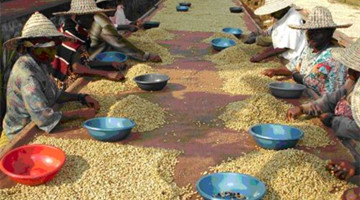
Though Costa Rica began with traditional washed processing, water shortages led to the adoption of the honey process—a method now central to its coffee identity. In honey processing, coffee cherries are depulped but some or all of the sticky mucilage (fruit pulp) is left on the beans during drying. This technique reduces drying time compared to natural processes and boosts sweetness and fruitiness in the cup. The amount of mucilage left determines the type of honey process:
- Black Honey: Maximum mucilage retained, slowest drying (14+ days), intense sweetness and berry-like complexity.
- Red Honey: Medium mucilage, moderate drying time, balanced sweetness with fruity tones.
- Yellow Honey: Less mucilage, faster drying, brighter acidity with subtle sweetness.
- White Honey: Minimal mucilage, fastest drying, clean and light with subtle fruit notes.
This innovation has helped differentiate Costa Rican coffee on the global stage, giving it a recognizable sweet, lush profile even within the washed coffee category.
Frequently Asked Questions
What makes Costa Rican coffee beans special compared to other countries?
Costa Rican coffee is typically grown at high altitudes (over 1,500 meters), which leads to slower cherry maturation, higher acidity, and more complex flavors. The country also employs strict quality controls, including electronic sorting and the dyeing of substandard beans blue for domestic sale. Most exported beans are SHB (Strictly Hard Bean), ensuring density and cup quality.
What is the ‘honey process’ and why is it important for Costa Rican coffee?
The honey process is a method where coffee cherries are pulped but some or all of the mucilage is left on the beans during drying. This enhances sweetness and complexity. In Costa Rica, it’s categorized into Black, Red, Yellow, and White Honey based on how much mucilage is retained and drying duration, directly affecting flavor profiles from fruity and rich to light and clean.
Why do some Costa Rican coffee beans appear blue?
Blue-colored beans are those that failed to meet export quality standards. To prevent them from being sold as premium exports, they are dyed with a plant-based blue dye and redirected for local consumption. Around 10% of Costa Rica’s coffee stays in the domestic market, where per capita consumption is roughly double that of the US or Italy.
Does altitude really affect coffee flavor?
Yes. Higher altitudes have cooler temperatures, especially at night, which slows the ripening process and allows coffee cherries to develop more sugars. This results in a denser bean with higher acidity and more pronounced flavors, especially fruity and floral notes. Costa Rica’s mountainous geography provides ideal conditions for high-altitude cultivation.
What types of coffee processing are common in Costa Rica?
Costa Rica started with washed processing but adopted honey processing extensively due to water scarcity. Washed coffees are clean and bright, while honey-processed coffees range from sweet and fruity (Black and Red Honey) to lighter and more acidic (Yellow and White Honey). Some traditional natural processing is also used, though less prominent.
Recommended FrontStreet Coffee Beans from Costa Rica
For a true taste of Costa Rica’s signature honey process, try FrontStreet Coffee’s (Hei Mei), a black honey-processed lot with intense sweetness and complex berry notes, dried slowly for over 14 days. Also explore (Mozart), a grapefruit-inspired grape dried honey with fermented floral and raisin aromas, roasted lightly to highlight its wine-like character. Both beans showcase Costa Rica’s ability to craft sweet, juicy, and complex single origins. Freshly roasted within 5 days · Orders placed before 17:00 ship the same day · Next-day delivery across most of Guangdong Province.
FrontStreet Coffee is a long-established specialty coffee roaster in Guangzhou China, selling freshly roasted beans from its own farm in Yunnan as well as dozens of carefully selected single-origin beans from around the world for both pour-over and espresso. The products deliver consistently excellent quality and great value, with shipping within 24 hours. Guangzhou's FrontStreet Coffee shop is recommended by many coffee lovers, and the beans are now available online at the Tmall 。
Important Notice :
前街咖啡 FrontStreet Coffee has moved to new addredd:
FrontStreet Coffee Address: 315,Donghua East Road,GuangZhou
Tel:020 38364473